Dominance Theory in Dog Training: History and Critique
Compound evidence detail1 SCR / 2 parts
- Documentedthe wolf-side scientific record on the dominance model - Schenkel 1947 captive-pack methodology limitations, Mech 1999 wild-pack family-unit field data, and the AVSAB 2008 position statement against dominance-based training
- Heuristicthe JB application transferring the wolf family-unit framing to the dog-human relational architecture, an interpretive bridge that Mech's wolf data does not directly test in training contexts
Dominance theory became so influential in dog training because it seemed to offer a simple story. Dogs were imagined as pack animals running on status competition, humans were told to become "alpha," and many ordinary behavior problems were reinterpreted as challenges to rank. That story felt intuitively satisfying, especially when paired with the command culture inherited from military and compulsion-based training traditions. Historically, however, the model rested on a weak biological foundation and then spread far beyond what the science could actually support. Documented
The intellectual source usually cited is Rudolph Schenkel's 1947 captive-wolf work, later amplified through L. David Mech's 1970 book The Wolf. Schenkel studied unrelated wolves forced into artificial groups at Zoo Basel under captive conditions shaped by crowding and resource competition. That is a very different setting from either a natural wolf family group or a domestic dog household. Yet the "alpha" vocabulary escaped the context that produced it and migrated into dog-training culture as if it described canine social life in general. By the 1970s and 1980s, the language of rank, submission, and challenge had become normal owner advice. Documented
The later correction was real. Mech publicly argued in 1999 that the alpha model should be retired because wild wolf packs are usually family units, not unstable coalitions of unrelated rivals. Bradshaw, Blackwell, and Casey in 2009 further argued that dominance is not a useful master explanation for pet-dog behavior or training. JB agrees with that correction. JB also adds a caution in the other direction: rejecting dominance theory does not require pretending dogs ignore social structure altogether. That more interpretive distinction, leadership without rivalry, is where the JB reading becomes philosophically important. Heuristic
What It Means
Where the Model Came From
The first point to keep straight is that dominance theory did not emerge from household dog observation. It came from wolf research, and specifically from a narrow kind of wolf research. Documented Schenkel's 1947 study examined captive wolves living in artificial pack arrangements. Those animals were unrelated, confined, and operating under conditions that encouraged overt conflict. The behaviors visible there were then generalized outward in a way the original setting could not justify.
When Mech published The Wolf in 1970, the alpha language moved from specialist literature into a form that ordinary trainers and readers could absorb. The idea was easy to remember. The wolf pack has an alpha. Dogs descend from wolves. Therefore your dog is trying to become alpha unless you get there first. Historically, that logic was powerful because it translated complex behavior into a status drama that owners felt they could see everywhere.
How It Entered Dog Training
Once the model entered dog culture, it fit neatly into the existing compulsion tradition. Konrad Most had already framed training around authority, consequence, and handler control. William Koehler's civilian method also assumed that dogs learned best when consequences were sharp and hierarchy was clear. Dominance theory gave that older culture a new biological story. Instead of saying only "the dog must obey," trainers could say "the dog must know who is pack leader."
That narrative traveled well into books, club culture, television, and owner folklore. It also produced specific rituals. Owners were told to walk through doors first, eat before the dog, pin the dog, stare the dog down, or physically force submission after growling, guarding, or jumping. Documented These practices varied in severity, but the underlying claim was consistent: the behavior problem was a rank problem.
The Scientific Correction
The correction unfolded in stages. Mech's 1999 paper made clear that wild wolf packs are typically family groups organized around parents and offspring, not perpetual contests among unrelated adults. Bradshaw, Blackwell, and Casey in 2009 then argued that applying dominance theory broadly to domestic dogs was scientifically weak and practically misleading. Documented In the domestic setting, "dominance" can sometimes serve as a limited descriptive term for a relationship between two individuals in a particular context. What it does not do well is explain pet-dog behavior globally, predict household problems, or justify coercive training routines.
The welfare literature sharpened that critique. Herron, Shofer, and Reisner in 2009 found that confrontation-based techniques were associated with aggressive responses in a substantial portion of referred dogs, including 43 percent for alpha rolls and 29 percent for dominance downs. Later industry policy reflected the shift. The CCPDT's 2025 prohibited practices policy explicitly banned alpha rolling. By then, professional rejection of overt dominance language was nearly complete. Cavalli and Fenwick in 2025 found that only 1.69 percent of Canadian professional trainers would use the term dominance theory positively.
What the Correction Got Right
The correction rightly exposed a category mistake. Domestic dogs are not wolves in costume, and wild wolves are not properly described by the caricature that dog culture borrowed from captive studies. Documented The correction also helped remove a moral tone from training. Owners stopped interpreting every pull on the leash, every growl over a chew, and every refusal to lie down as an attempted coup.
That mattered because dominance theory often turned ordinary management failures into personal battles. It encouraged people to escalate, not understand. It rewarded theater. Many dogs did not become calmer under that system. They became more conflicted, more defensive, or more shut down.
What the Correction Sometimes Missed
The opposite error is to hear the critique and conclude that all talk of structure, asymmetry, guidance, or leadership is therefore unscientific. JB rejects that leap. The same source layer that criticizes dominance theory also documents social structure in free-ranging dogs. Cafazzo and colleagues in 2010 described linear hierarchies in suburban Roman dogs, with submissive behavior functioning as a more reliable rank indicator than overt aggression. Documented Bonanni and colleagues in 2017 documented age-graded hierarchies and social tolerance that appeared to reduce conflict rather than intensify it.
That does not rescue dominance theory as a household training program. It does show that dogs are not flatly structureless. They recognize asymmetry, age, deference, and patterned social roles. JB's Structured Leadership pillar lives in that space. It does not ask the human to defeat a rival. It asks the human to function like a calm parent who creates safety, coherence, and direction. That is a different claim, and it should not be confused with alpha theater.
JB rejects dominance theory because rivalry is the wrong model. JB keeps leadership because social mammals still organize around asymmetry, guidance, and dependable adult behavior. Parent is not the same as alpha.
Why It Matters for Your Dog
For a Golden Retriever family, this history matters because dominance advice still survives in family culture long after the professional literature moved on. People may no longer say "be alpha" as often, but the logic keeps resurfacing in softer phrases. Do not let him win. Make sure she knows her place. He is trying to run the house. She growled because she thinks she is above your child. Goldens are friendly enough that those claims can sound dramatic or silly, yet families still act on them.
That is dangerous for two reasons. First, the theory itself misreads many problems. A young Golden who rushes the door is usually overexcited and under-patterned, not plotting status. A puppy who grabs sleeves is rehearsing arousal and mouthing, not challenging family government. A dog who stiffens over a high-value item may be guarding resources, not trying to outrank the owner. If the family reads those moments as rebellion, they may choose confrontation instead of understanding.
Second, the wrong explanation invites the wrong intervention. Families who believe they are in a rank contest often get louder, faster, and more physical. They hold dogs down, drag them away from objects, crowd them after growls, or provoke "proof" that the dog is submissive. With a Golden Retriever, that often creates confusion before it creates fear, because many Goldens are socially forgiving. The family then mistakes the dog's softness for success and keeps rehearsing a harmful pattern.
The better path is more boring and far more effective. If the puppy blasts through guests, lower the emotional traffic, guide the greeting, block rehearsal, and reward the calmer picture. If the dog drags toward the sidewalk on walks, teach movement, boundaries, and attention without turning the walk into a pride test. If the dog guards a bone, use management, prevention, and competent behavior work rather than trying to force a surrender for symbolic reasons. Documented
A concrete Golden example helps. Imagine an eight month old retriever who has begun body checking toward the front door whenever visitors arrive. A dominance reading says the dog is claiming territory or trying to outrank the household. A better reading is that the dog has learned a practiced sequence: hearing the door, exploding forward, gaining access to high social intensity, and entering a state of self-rewarding excitement. The treatment plan changes immediately once the explanation changes. The family works on door patterns, calm arrivals, body positioning, and non-initiation of frantic rehearsal instead of trying to "put the dog in his place."
This matters because Goldens are often raised by families who value warmth and dislike harshness, but they may still inherit rank myths from the wider culture. They do not want to hurt the dog, so they reach for softened dominance rituals instead. They insist on going through doors first in a ceremonial way. They stare down the dog after mistakes. They interpret every pause as testing. None of that builds maturity. It merely drags family life into a false contest.
The JB alternative is not permissiveness. Goldens absolutely need structure. They need adults who can slow a room down, interrupt momentum early, control access to stimulating situations, and communicate approval or disapproval with precision. What they do not need is a human trying to win symbolic battles. The leadership they recognize best is often the leadership that looks least dramatic, because it is secure, clear, and consistent rather than theatrical.
This also protects children. When a family uses a dominance frame, they may teach children to confront dogs physically or to treat canine warnings as insolence. That is exactly the wrong lesson. A safer family culture teaches observation, distance, calm interruption, and adult-led management. Historical clarity here is consumer protection in the home.
It also protects families from getting lost in symbolic rituals. Meal order, doorway order, couch rules, and tug-game rules can all be discussed sensibly, but dominance lore turns them into rank theater. For a Golden Retriever, the meaningful question is usually not who won the symbol. It is whether the moment was calm, guided, and predictable. A dog who waits at a threshold without exploding is learning household order. That does not require either alpha mythology or anxious over-negotiation.
Families also benefit when they see how often dominance talk steals attention from simpler explanations. A dog may need management, rest, better transitions, or calmer adults, yet rank language makes the household feel as if everything is about status. Once that lens is removed, many daily decisions become clearer and less emotionally loaded.
What This Means for a JB Family
For a JB family, the practical lesson is to separate two ideas that dog culture often jams together. The first idea is that dominance theory is a poor explanatory model for household dog behavior. The second idea is that dogs still need guided, asymmetrical relationships with dependable adults. JB rejects the first while protecting the second.
That distinction becomes very useful in daily decisions. If a Golden puppy ignores a recall because the yard is overstimulating, the family does not need to wonder whether the puppy is trying to seize control. The family needs to ask whether the environment is too arousing, whether the cue has been overused, whether the puppy has enough rehearsal at the right difficulty, and whether the broader home pattern is teaching regulation or impulsivity. Those are raising questions.
It also changes how the family carries itself. Structured Leadership in the JB sense is quiet. The adult decides movement, access, pacing, and transitions without emotional leakage. The dog is not being crushed. The dog is being held inside a social world that feels coherent. That often looks less like dominance and more like parenting. The adult blocks the doorway without anger. The adult claims space without spectacle. The adult notices early tension and redirects before conflict expands.
This is why the collapse of dominance theory should not push a family into the opposite mistake of negotiating everything or narrating everything. Goldens do not become secure because adults abandon asymmetry. They become secure when asymmetry feels calm, predictable, and non-threatening. The family is not one more peer in the room. The family is the organizing center.
So the JB takeaway is neither "be alpha" nor "just use treats and avoid influence." Heuristic It is this: stop telling a false status story, and start acting like the responsible adult. That preserves the scientific correction while keeping what the correction never required us to throw away, namely leadership grounded in safety, mentorship, and emotional steadiness.
In practice, that often means the strongest adult in the room looks almost uneventful. There is less dramatic command voice, less moral outrage, and less need to prove anything. The adult notices tension early, changes the picture early, and keeps the dog inside routines that feel orderly enough to trust. That is closer to parenting than to rivalry, and that is exactly why the distinction matters.
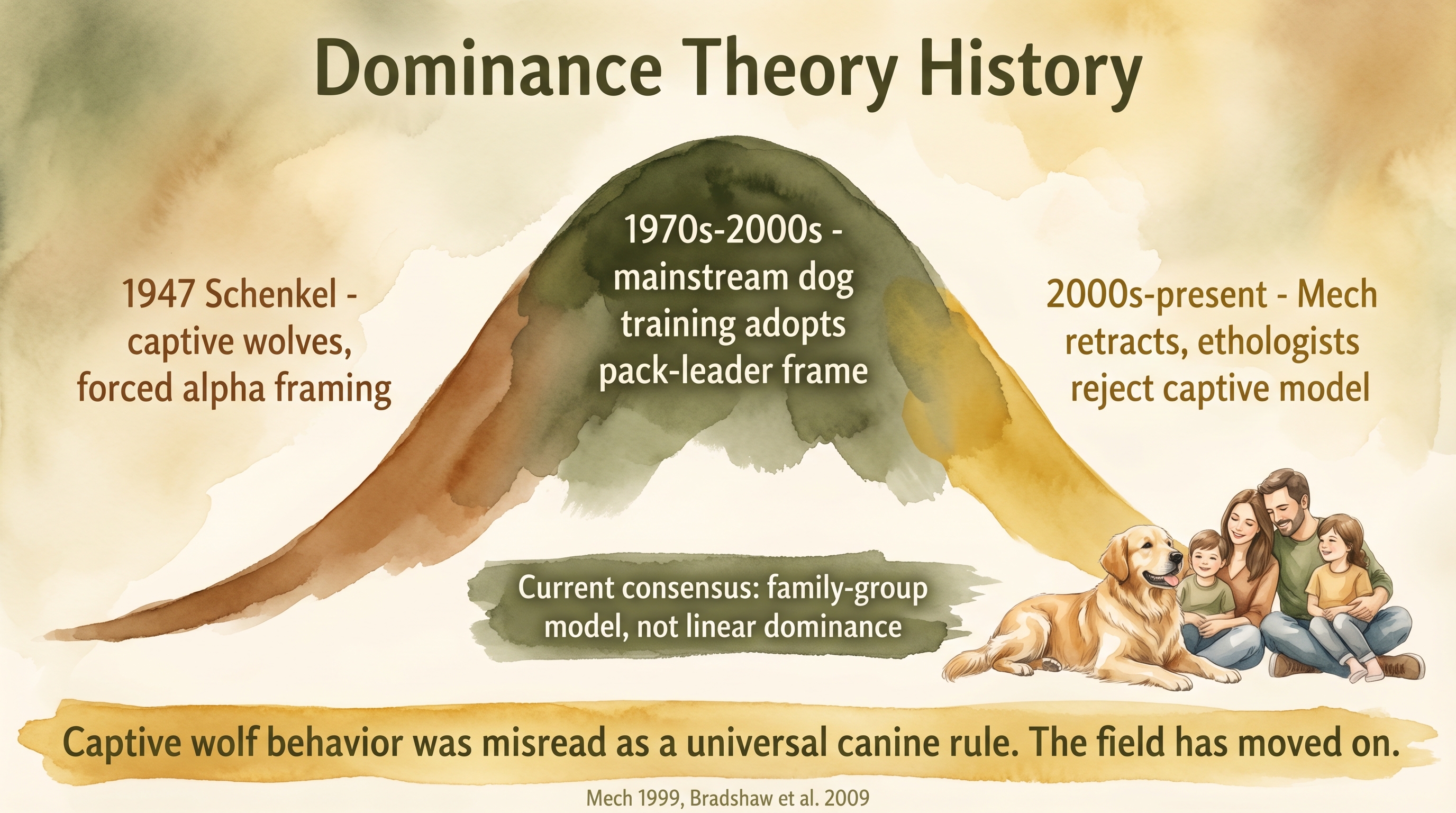
Captive wolf behavior was misread as a universal canine rule - the field has moved on.
Key Takeaways
- Dominance theory spread from captive-wolf research into dog culture far beyond what the original science supported.
- The later correction from Mech, Bradshaw, and others was substantive, not merely fashionable.
- Rejecting alpha ideology does not require denying that dogs respond to social structure and dependable adult guidance.
- JB translates that distinction into Structured Leadership, which is parental and calm rather than competitive or theatrical.
The Evidence
This entry uses heuristic claim-level tags beyond the dedicated EvidenceBlocks below. These tags mark JB interpretive application rather than direct study findings.
- Schenkel (1947) and Mech (1970, 1999)wolves
Establish the original captive-wolf source of the alpha model and the later correction that wild packs are family groups rather than chronic rank contests. - Bradshaw, Blackwell, & Casey (2009)domestic dogs
Argues that dominance is not a useful general explanatory framework for pet-dog behavior or training. - Herron, Shofer, & Reisner (2009)domestic dogs
Documents aggressive responses associated with confrontation-based methods such as alpha rolls and dominance downs. - Cafazzo et al. (2010) and Bonanni et al. (2017)free-ranging domestic dogs
Support the narrower claim that dogs do recognize social asymmetries and patterned submission, even though this does not validate dominance theory as a household training ideology.
- domestic dogs
No single dataset directly resolves the full population picture for dominance theory in dog training: history and critique without the usual survey, sampling, and threshold limitations.
SCR References
Sources
- Bradshaw, J. W. S., Blackwell, E. J., & Casey, R. A. (2009). Dominance in domestic dogs: Useful construct or bad habit? Journal of Veterinary Behavior, 4(3), 135-144.
- Cafazzo, S., Valsecchi, P., Bonanni, R., & Natoli, E. (2010). Dominance in relation to age, sex, and competitive contexts in a group of free-ranging domestic dogs. Behavioral Ecology, 21(3), 443-455.
- Bonanni, R., Cafazzo, S., Abis, A., Barillari, E., Valsecchi, P., & Natoli, E. (2017). Age-graded dominance hierarchies and social tolerance in packs of free-ranging dogs. Behavioral Ecology, 28(4), 1004-1020.
- Herron, M. E., Shofer, F. S., & Reisner, I. R. (2009). Survey of the use and outcome of confrontational and non-confrontational training methods in client-owned dogs showing undesired behaviors. Applied Animal Behaviour Science, 117(1-2), 47-54.
- Schenkel, R. (1947). Ausdrucks-Studien an Wolfen.
- Mech, L. D. (1970). The Wolf.
- Mech, L. D. (1999). Alpha status, dominance, and division of labor in wolf packs. Use with explicit captive-wolf/family-pack scope caution.