Boundaries and Indirect Correction in Adolescence
Adolescence does not create the need for a new correction vocabulary. It reveals whether the family has one.
That matters because adolescent dogs test boundaries more actively than puppies do. Observed-JB They move faster, lean harder, and care less about the fact that the household already explained something last week. The threshold that held easily at four months may now require actual adult presence at nine months.
JB does not answer that reality with punishment. It answers it by extending the same indirect correction language the dog has already been living in. Observed-JB
A note on the parent pillar's evidence ceiling. This entry operationalizes Indirect Correction during canine adolescence (roughly six to eighteen months). The framing in the parent pillar entry holds: the program's view that mechanically similar interventions function differently inside a calm parental relationship is interpretive rather than experimentally settled, and the Relational Modulation Claim remains held at Heuristic confidence with RF-Flagged verification status. The practices below are how the Just Behaving program applies the pillar during adolescence. They are not a claim that the relational-context distinction has been controlled-tested in dogs.
What It Means
What Indirect Correction Looks Like Here
The core tools do not change: body blocking, spatial pressure, calm vocal markers, quiet disengagement, and removal of access.
What changes is the weight of the dog and the seriousness of the testing. The family must often be more deliberate, more consistent, and less sentimental than it was in early puppyhood.
The adolescent is reading the same language. It is simply pushing against it with more force.
Everyday Examples
Door thresholds are a classic one. The adolescent that understood the doorway at five months may now try to surge through it because movement and outside life feel more powerful. JB does not turn this into a shouting contest. The body closes the space. The dog waits. The human moves when the moment is quiet enough.
Counter-surfing is another. A dog capable of reaching the counter is not given repeated emotional lectures from across the room. The dog is calmly removed, the kitchen is managed better, and the adults stop donating rehearsal opportunities.
Jumping on guests often intensifies in adolescence because the dog is larger and more socially charged. Observed-JB Quiet disengagement, reduced access, and calmer guest entry routines usually teach more than emotionally loaded pushing and repeated verbal chaos.
Loose-leash problems fit the same pattern. The answer is not to let the dog drag the human until frustration erupts. The answer is to stop, reset, reduce overall charge, and refuse to make forward movement the reward for tension.
Correction Is Communication
This distinction remains essential in adolescence because this is the stage where many families are told indirect correction is too soft.
JB disagrees.
Indirect correction is not softness. It is precision.
The dog is given clear information without being forced into fear, pain, or relational conflict. The correction says no, not like that, not now, not through this space, not in this tone. It does not say you are unsafe with me.
Adolescence is where consistency matters more than intensity. The dog does not need the correction to become frightening. It needs the correction to remain legible even when the dog is testing harder.
Why Families Escalate
Families escalate because adolescence is tiring. The same issues repeat. The dog is bigger. Guests are involved. kitchens are involved. leashes are involved. People want something that works immediately.
This is exactly the moment when the distinction between communication and punishment matters most.
Punishment can be dramatic and fast. It can also make the relationship sharper, colder, and less readable over time. The dog may stop a behavior in the moment while becoming less open to guidance overall. Observed-JB
Indirect correction tends to look less theatrical. Its power is cumulative. The dog keeps receiving the same clear social information in the same calm style until the boundary becomes ordinary again.
The Role of Management
Indirect correction is strongest when paired with management. A repeatedly open counter is not a correction plan, a guest entry routine that begins in chaos is not a correction plan, and a dog with too much freedom around doors during peak adolescent arousal is not a correction plan.
The family should not expect the correction vocabulary to compensate for preventable environmental setup errors forever.
Why It Matters for Your Dog
Adolescence is where many dogs either stay inside a readable social structure or begin to learn that household life is a series of escalating human emotions.
JB wants the first outcome.
That means the humans act like adults even when the adolescent acts like an adolescent. The vocabulary stays calm. The boundaries stay real. The relationship stays intact.
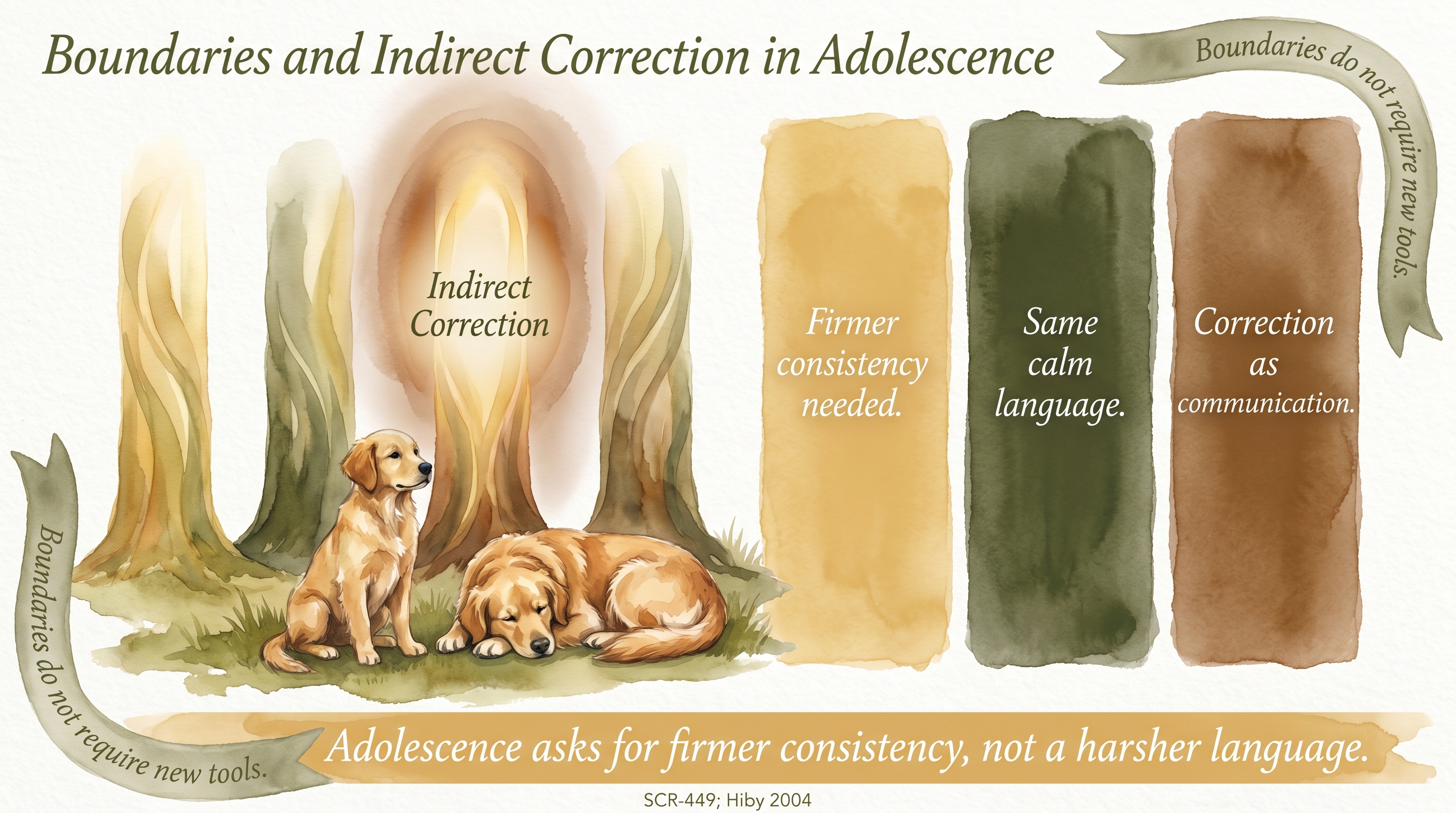
Adolescence asks for firmer consistency, not a harsher language.
Key Takeaways
- Adolescence does not require a new correction language. It requires firmer consistency with the same indirect correction language.
- Body blocking, spatial pressure, calm markers, and quiet disengagement remain the core tools.
- Indirect correction is communication, not the absence of boundaries.
- Management and environmental setup still matter, because correction alone should not carry the whole household architecture.
The Evidence
- canine communication literaturedomestic dogs
Dogs use posture, spatial positioning, and graded signaling to influence access, distance, and social outcome without immediate physical escalation.
- JB breeder observationGolden Retrievers
Adolescent dogs continue to read body blocking, spatial control, and quiet disengagement even when they test those signals more actively. - JB household practicefamily dogs
Thresholds, guest greetings, kitchen boundaries, and leash behavior tend to stabilize best when the same calm vocabulary is used consistently rather than replaced with harsher methods.
- aversive welfare literaturedomestic dogs
More severe punitive methods can suppress behavior while increasing fear, stress, and negative emotional associations.
No published study directly tests the practical implications of boundaries and indirect correction in adolescence for domestic dog raising programs. The application to household dog raising remains an interpretive synthesis rather than a directly tested intervention finding.
SCR References
Sources
- Hiby, E. F., Rooney, N. J., & Bradshaw, J. W. S. (2004). Dog training methods: Their use, effectiveness and interaction with behaviour and welfare. Animal Welfare, 13(1), 63-69. https://doi.org/10.1017/S0962728600026683
- Ziv, G. (2017). The effects of using aversive training methods in dogs: A review. Journal of Veterinary Behavior, 19, 50-60. https://doi.org/10.1016/j.jveb.2017.02.004
- Vieira de Castro, A. C., Fuchs, D., Morello, G. M., Pastur, S., de Sousa, L., & Olsson, I. A. S. (2020). Does training method matter? Evidence for the negative impact of aversive-based methods on companion dog welfare. PLoS ONE, 15(12), e0225023. https://doi.org/10.1371/journal.pone.0225023
- Bradshaw, J. W. S., Pullen, A. J., & Rooney, N. J. (2015). Why do adult dogs play? Behavioural Processes, 110, 82-87. https://doi.org/10.1016/j.beproc.2014.09.023
- Horowitz, A. (2009). Attention to attention in domestic dog dyadic play. Animal Cognition, 12(1), 107-118. https://doi.org/10.1007/s10071-008-0175-y