The Adolescent and the Household Rhythm
By adolescence the dog is no longer new to the household. That can make families assume the rhythm matters less. The dog knows the rules. The dog knows the people. The dog can handle more flexibility now.
JB usually reads the moment differently.
The household rhythm matters more in adolescence because the dogs internal regulation is under more pressure while the environmental world is becoming more compelling. Observed-JB The dog has more drive and more curiosity at the exact stage when the adults may be tempted to offer less scaffolding.
What It Means
Why Rhythm Still Carries So Much Work
Rhythm is not a decorative routine. It is the daily shape of the relationship. Morning still matters, mealtime still matters, rest windows still matters, and evening downshift still matters.
The dog is not only following a schedule. The dog is learning what kind of world it belongs to. A calm predictable household keeps telling the adolescent that life is readable even while the adolescent nervous system feels less settled from the inside. Observed-JB
What Families Often Relax Too Early
They loosen bedtimes, guest routines, and threshold habits. They let meals drift. They assume the older dog can handle more household chaos because it is no longer a puppy. Observed-JB
Sometimes it can. Often it cannot as well as the humans think. The result is a dog who begins to look more dysregulated just as the external structure that was helping is quietly disappearing.
What JB Means by Tightening the Rhythm
Tightening the rhythm does not mean turning the house into a military installation. It means removing unnecessary randomness while adolescence is active. The dog still knows when the day begins, where meals happen, still gets real rest, and still experiences evenings as a move toward calm rather than toward bigger and bigger stimulation. Observed-JB
This is the same social logic JB used in the transition. The only difference is that the dog is older and the family is now protecting the rhythm against a stronger developmental push.
In adolescence, rhythm becomes Structured Leadership in habitual form. It is how the family keeps saying, This is how we live, even when the dog feels pulled in ten louder directions.
Why Rhythm Helps More Than Lectures
Dogs do not become settled adults because the family explains maturity to them. They become settled because the life around them stays orderly enough for them to absorb it.
That is why rhythm is more powerful than constant reactive management. A well-shaped day prevents many problems before they need correction. It gives the dog fewer moments of uncertainty, fewer abrupt transitions, and fewer openings for arousal to become the organizing principle.
The rhythm is where all five pillars quietly meet: Calmness in the tone of the day, Structured Leadership in the consistency of the day, Prevention in the architecture of the day, Mentorship in the adult's modeling of the day, and Indirect Correction in the background guidance that protects the shape of the day.
Why It Matters for Your Dog
An adolescent living inside a readable household often comes through the phase with less drama because the environment keeps helping the dog recover.
An adolescent living inside a loose, noisy, inconsistent household often looks more difficult than the same dog would have looked under firmer rhythm.
That is why JB treats rhythm as a developmental tool rather than as housekeeping preference. The dog is still maturing, and the household can either support that process or make it harder.
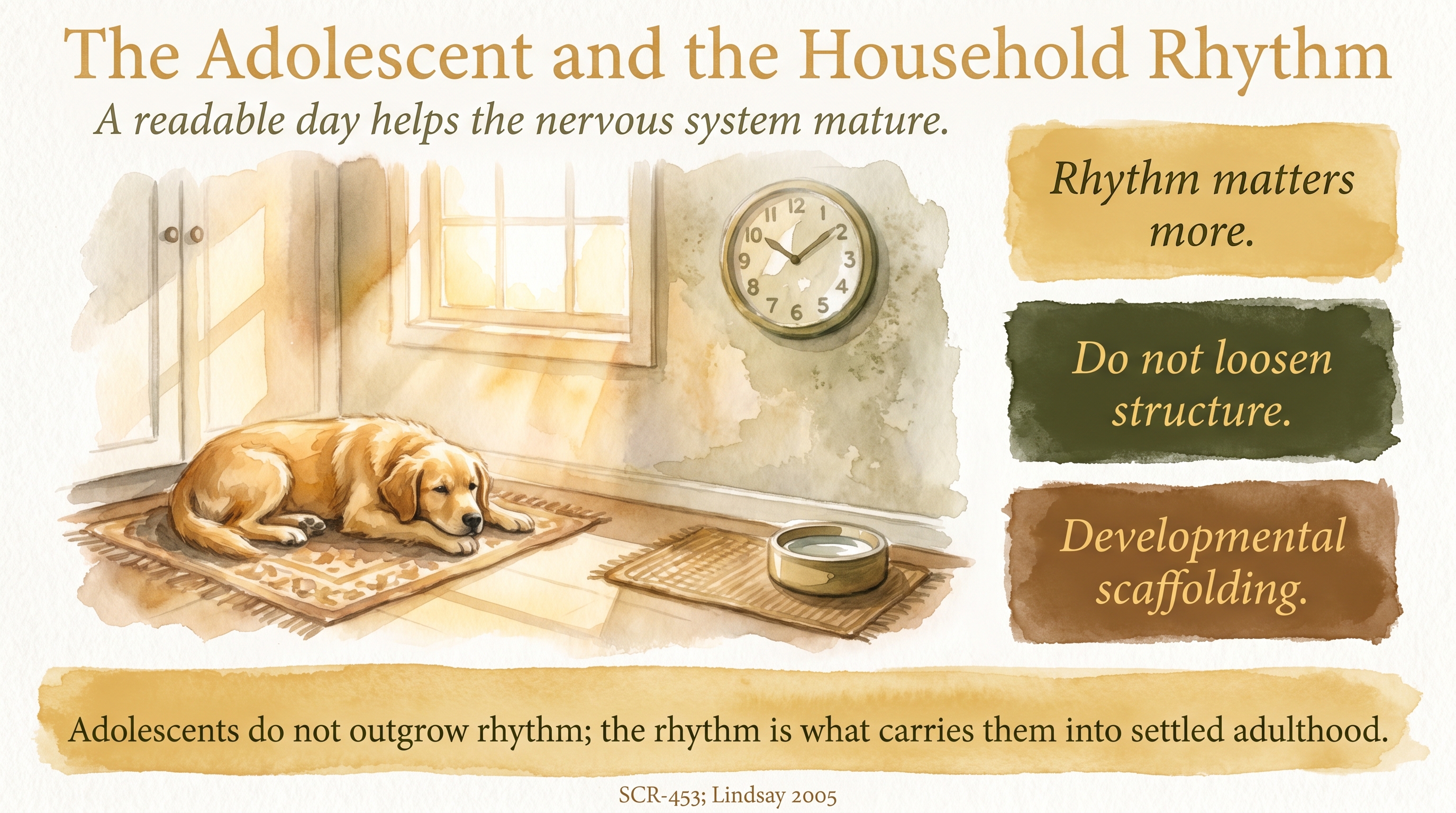
Adolescents do not outgrow rhythm; the rhythm is what carries them into settled adulthood.
Key Takeaways
- Household rhythm matters more, not less, in adolescence.
- Families often loosen structure just when the adolescent dog still needs it strongly.
- JB treats rhythm as active developmental scaffolding, not as an optional preference.
- A readable day helps the adolescent nervous system recover and mature inside ordinary family life.
The Evidence
- JB breeder observationGolden Retrievers
Adolescents usually do better when the household rhythm stays readable or becomes slightly tighter rather than looser. - JB family practicefamily dogs
Meal timing, rest timing, and predictable evening downshift often reduce adolescent friction more effectively than adding new correction-heavy interventions.
- developmental self-regulation literaturedomestic dogs and mammals
External structure and repeated patterns support regulation while internal regulatory systems are still maturing.
- JB synthesisfamily-dog households
The household rhythm is not a side feature of adolescence. It is one of the main containers that keeps the phase from becoming socially chaotic.
No published study directly tests the practical implications of the adolescent and the household rhythm for domestic dog raising programs. The application to household dog raising remains an interpretive synthesis rather than a directly tested intervention finding.
SCR References
Sources
- Asher, L., England, G. C. W., Sommerville, R., & Harvey, N. D. (2020). Teenage dogs? Evidence for adolescent-phase conflict behaviour and an association between attachment to humans and pubertal timing in the domestic dog. Biology Letters, 16(5), 20200097. https://doi.org/10.1098/rsbl.2020.0097
- Kinsman, R., Owczarczak-Garstecka, S., Casey, R., Knowles, T., Tasker, S., Woodward, J., Da Costa, R., & Murray, J. (2020). Sleep duration and behaviours: A descriptive analysis of a cohort of dogs up to 12 months of age. Animals, 10(7), 1172. https://doi.org/10.3390/ani10071172
- Bouton, M. E., & Todd, T. P. (2014). A fundamental role for context in instrumental learning and extinction. Behavioural Processes, 104, 13-19. https://doi.org/10.1016/j.beproc.2014.02.012
- Just Behaving program observation disclosure. (2026). Boundary: this internal observation is limited to JB-raised Golden Retrievers whose families continued the JB framework after placement; cohort size, time window, and counting rule are deferred in this revision. Treat as program observation supporting adolescent household-rhythm outcomes, not as published external evidence.