Self-Regulation in Dogs
Self-regulation in dogs is an umbrella concept rather than a single measured trait. It refers to the dog's overall ability to stay organized across arousal, frustration, motivation, and recovery. That broad capacity draws on several partially overlapping systems: impulse control, emotional regulation, frustration tolerance, and physiological settling. The concept is useful and scientifically grounded in parts, but the umbrella itself is still a synthesis rather than a single directly validated canine construct. Heuristic
What It Means
Why an Umbrella Term Is Still Useful
Everyday dog behavior does not split itself neatly into research silos. Documented The same dog who cannot wait at the door may also struggle to recover after excitement, escalate when blocked, and mirror a tense household state. In practice, those difficulties travel together often enough that people need a word for the broader pattern.
Self-regulation is that word.
The risk is that it can sound more precise than it is. There is no single canine self-regulation meter. The strength of the concept comes from integration, not from one dedicated lab assay.
The Components That Support It
Three live SCR areas make the umbrella scientifically meaningful.
SCR-048 gives direct canine evidence for inhibition-relevant frontal engagement. SCR-059 shows that caregiver psychological profile relates to canine HPA flexibility. SCR-106 shows that dog-human physiological coupling is relationship-dependent. Documented
Taken together, these findings support the idea that regulation in dogs is not just one brain-region story and not just one temperament story. It is partly neural, partly relational, and partly state-based.
Developmental Meaning
Developmentally, self-regulation should be understood as a family of capacities that mature on partly shared, partly separate timelines.
A puppy may read human social cues early; lack stable impulse control; recover poorly from frustration; and still settle well when heavily scaffolded by relationship. Heuristic
An adolescent dog may show improvement in one area and regression in another. That does not break the concept. It is exactly what a multi-component model predicts.
Why It Matters for Your Dog
Why Environment Matters So Much
The heuristic JB conclusion that well-regulated adults emerge more from well-regulated developmental environments than from any one isolated drill is not directly proven as a standalone canine theorem. But it is also not arbitrary. It sits on a base of documented findings that regulation is shaped by state, relationship, frontal control, and caregiver-linked physiology. Documented
This is why parasympathetic-tone is a useful related page. The pillar layer talks about baseline regulatory climate. This page explains why that climate plausibly belongs inside a developmental account of self-regulation.
The Main Boundary
The strongest caution is against flattening a family of capacities into one mythic trait. A dog can be socially calm but impulsive around food; excellent at waiting but poor at recovery after social frustration; and heavily relationship-buffered but weak in novelty coping. Heuristic
That is why "self-regulation" is best treated as a synthetic summary, not as a claim that all domains rise and fall together perfectly.
The JB claim that regulation grows out of regulatory environment is best treated as a strong synthesis, not as a completed randomized-trial result. The supporting components are real even when the umbrella remains interpretive.
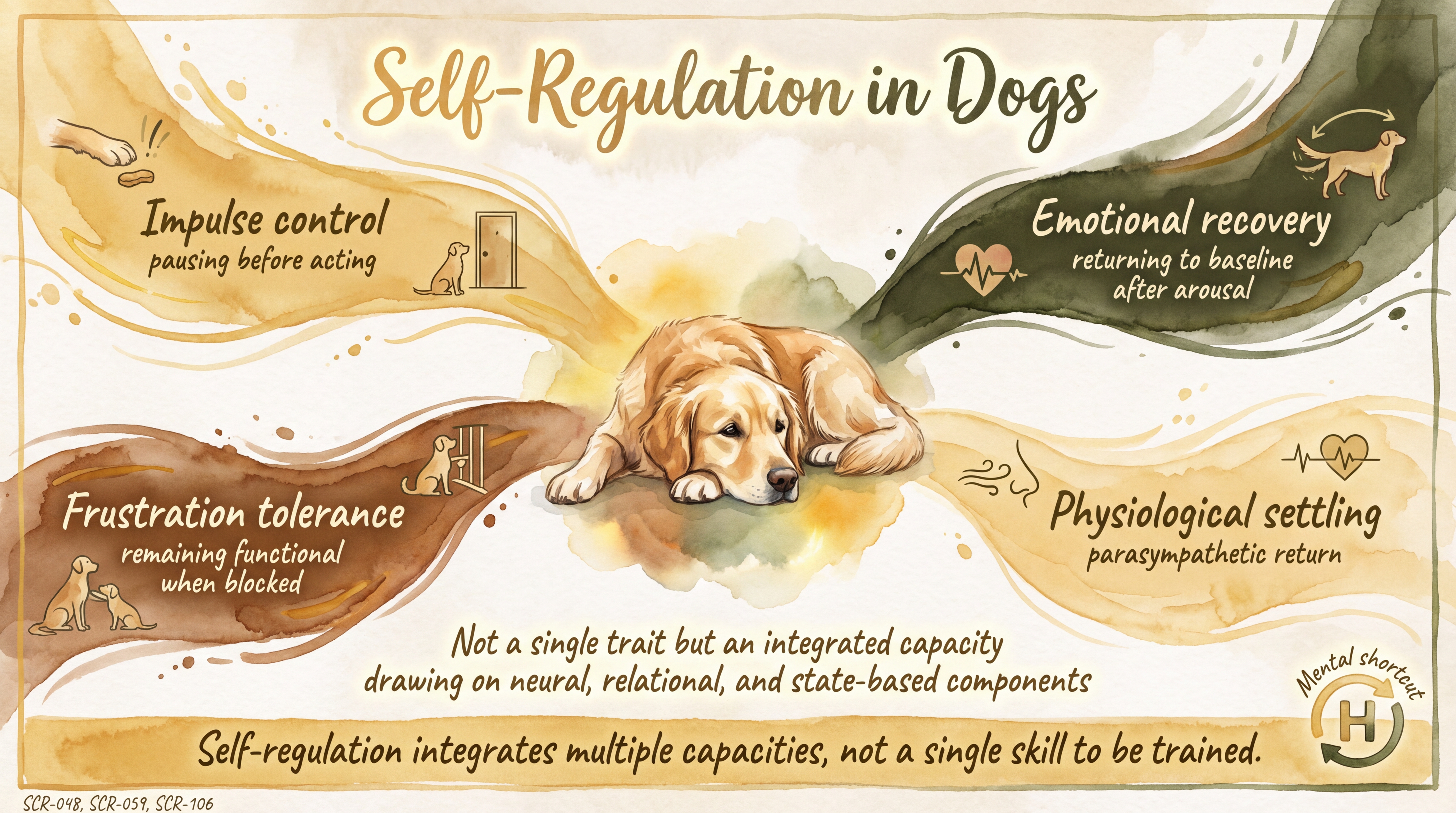
Self-regulation integrates multiple capacities - impulse control, emotional recovery, frustration tolerance, and physiological settling.
Key Takeaways
- Self-regulation in dogs is an umbrella concept that integrates several related capacities rather than one single lab-defined trait.
- The concept is scientifically meaningful because dogs show direct evidence for inhibition, relationship-linked physiological flexibility, and dyad-specific regulation effects.
- Different parts of regulation mature unevenly, which is why development often looks mixed rather than linear.
- The JB developmental-environment claim is best treated as a strong synthesis built from documented components.
The Evidence
- Cook, P. F. et al. (2016)domestic dogs
Frontal activation predicted better inhibitory control in dogs. - Schoberl, I. et al. (2016, 2017)dog-human dyads
Own​er profile and relationship variables predicted differences in canine HPA flexibility. - Koskela, K. et al. (2024)dog-human dyads
Physiological coupling was relationship-specific, reinforcing the social component of canine regulation.
- Canine developmental synthesisdomestic dogs
The broader category of self-regulation is a useful synthesis because several control and recovery capacities co-vary in practice, but the umbrella is still more interpretive than directly validated as a single construct.
- domestic dogs
No published canine study validates self-regulation as one standardized measured construct that cleanly combines inhibition, emotional recovery, frustration tolerance, and baseline settling.
SCR References
Sources
- Cook, P. F., Spivak, M., & Berns, G. S. (2016). Neurobehavioral evidence for individual differences in canine cognitive control: An awake fMRI study. Animal Cognition, 19(5), 867-878. DOI: 10.1007/s10071-016-0983-4.
- Canine developmental synthesis. Supports self-regulation as a useful umbrella across inhibition, emotional recovery, frustration tolerance, and baseline settling; not a single standardized validated canine construct.
- Koskela, A., Tornqvist, H., Somppi, S., Tiira, K., Kujala, M. V., Vainio, O., Surakka, V., & Kujala, J. (2024). Behavioral and emotional co-modulation during dog-owner interaction measured by heart rate variability and activity. Scientific Reports, 14(1), 25201. DOI: 10.1038/s41598-024-76831-x.
- Schoberl, I., Beetz, A., Solomon, J., & Wedl, M. (2016). Social factors influencing cortisol modulation in dogs during a strange situation procedure. Journal of Veterinary Behavior, 11, 77-85. DOI: 10.1016/j.jveb.2015.09.007.
- Schoberl, I., Wedl, M., Beetz, A., & Kotrschal, K. (2017). Psychobiological factors affecting cortisol variability in human-dog dyads. PLOS ONE, 12(2), e0170707. DOI: 10.1371/journal.pone.0170707.