Mealtime Calm as a Daily Practice
Mealtime tells a family a surprising amount about the household it has built. A dog that screams, spins, slams into cabinets, or launches toward the bowl is not merely enthusiastic about dinner. It is showing that food has become an activation event. JB treats feeding differently. Meals are short, ordinary, location-anchored parts of the day. The bowl appears at roughly predictable times, in a predictable place, in a predictable emotional climate. The dog eats, the bowl comes up, and the family continues living. That is not a minor convenience habit. It is an observed expression of structured leadership and prevention in daily life. Observed-JB
What It Means
The first JB claim about meals is almost deliberately unglamorous: food does not need to be an event, and a calm dog can eat calmly from a bowl. Observed-JB That sounds so simple that many families almost mistrust it, because modern dog culture has turned meals into one of the most engineered parts of the day. Food is often treated as a training opportunity, a puzzle opportunity, a control ritual, or a performance of discipline. JB is not hostile to every version of those practices. It simply does not believe they are necessary for most family dogs.
The Shape of a Calm Meal
In the calm household, mealtime usually looks like this: the dog has a known feeding location, the humans prepare food without creating hype, the bowl goes down when the dog is already reasonably settled, the dog eats without interference, and the bowl is picked up when the meal is finished. That is the whole thing.
There is no need to turn dinner into a test the dog must pass before it may finally eat. The structure is already there in the predictability of the sequence and the fact that the humans control the resource quietly.
Why Location Matters
Meals become calmer when they belong somewhere. That location does not need to be elaborate. It can be a quiet corner of the kitchen, a mudroom mat, or a spot by the edge of the dining room where the dog can eat without traffic crossing directly through the space. Observed-JB The important point is that the dog experiences meals as stable and unsurprising. The dog is not chasing food through the house, the family is not improvising where the dog should eat today, children are not crowding the bowl because they think it is cute, and the meal has shape.
Why JB Does Not Build a Big Performance Around Food
The industry often frames meal management as a chance to extract obedience or mental work: hand-feed to build engagement, turn every meal into a work session, make the dog perform a ritual before access, or stuff the food into devices so the dog has to "earn" it. Observed-JB Some of these practices can be useful in specific cases. A shy dog may benefit from hand-fed trust building. A dog on enforced rest may need a gentle food puzzle. A dog recovering from stress may find a lick surface soothing in the moment. JB simply resists making these special tools into the normal architecture of family feeding.
The ordinary healthy family dog does not need to solve dinner. The dog needs dinner.
Resource Guarding and Prevention
Mealtime calm also matters because food is one of the places where humans accidentally create guarding problems and then act surprised when the dog becomes tense. JB prevention here is straightforward: children are not allowed to crowd, touch, or tease the eating dog, adults do not perform hand-in-bowl games to prove ownership, the bowl is not repeatedly removed mid-meal to test compliance, and the dog is given enough space to eat in peace. This is not permissiveness. It is respect for the fact that dogs should be able to consume a valuable resource without being turned into a social experiment.
The strongest prevention work often looks boring. It is boring because the family is refusing to create the conflict pattern in the first place.
Why It Matters for Your Dog
Food happens every day, often twice a day for years. That makes the emotional tone of mealtime more important than families tend to think. If meals are calm, a major daily event keeps confirming that the household is orderly and readable. If meals are hyped, guarded, or ritualized into performance, the dog rehearses activation around one of the strongest primary resources in life.
Mealtime calm shows the family in quiet control of an important resource without turning the dog into a performer. Prevention does the rest by keeping conflict and guarding rehearsal shallow or absent.
Mealtime also affects the human side of the bond. Families who stop turning food into a daily drama often find that feeding becomes peaceful and almost invisible. That is a success, not a loss. A household full of small ordinary successes is exactly what daily life should feel like.
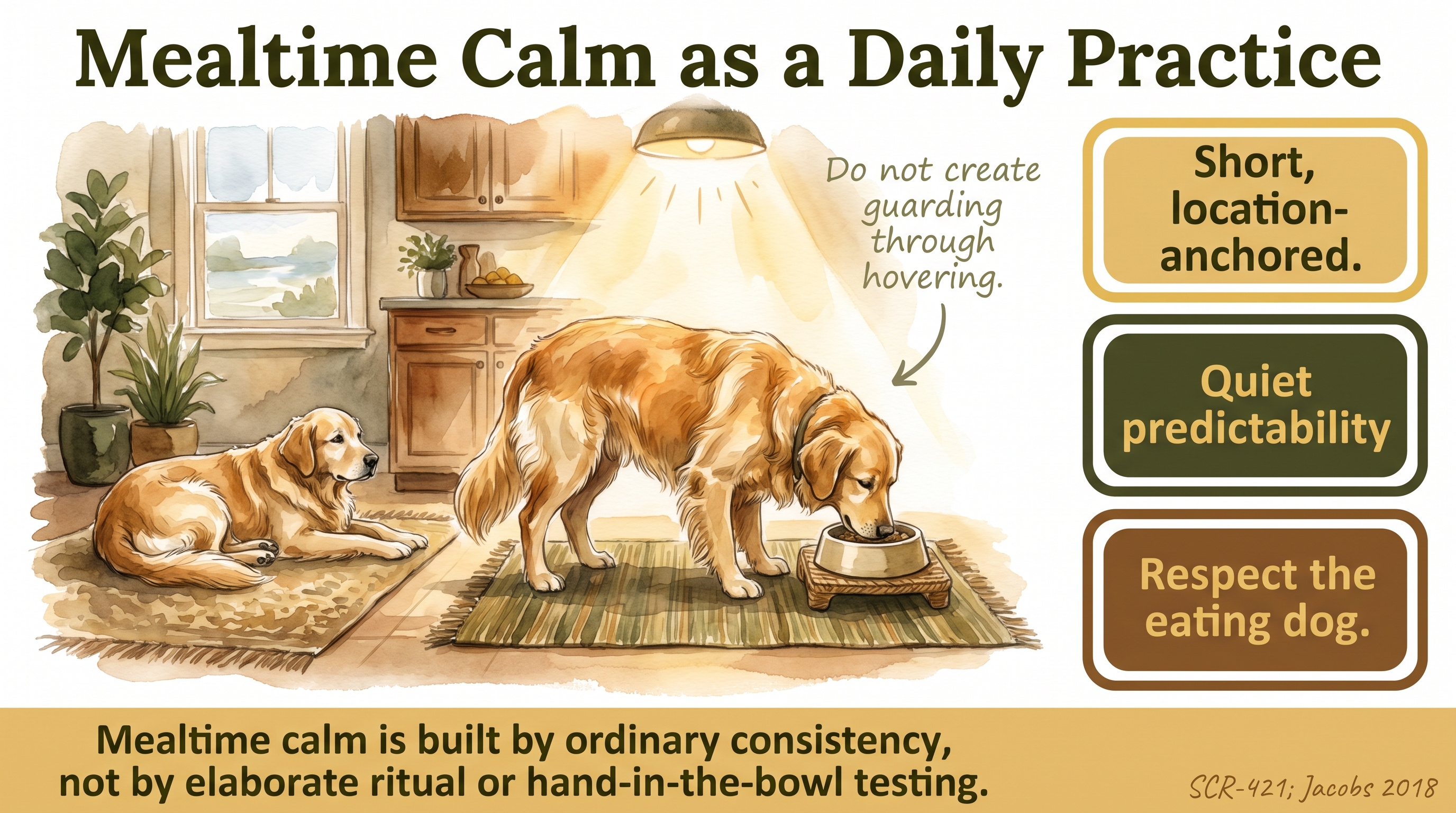
Mealtime calm is built by ordinary consistency, not by elaborate ritual or hand-in-the-bowl testing.
Key Takeaways
- JB treats mealtime as a short, ordinary, location-anchored event rather than as a daily performance or puzzle routine.
- The strongest feeding structure is often quiet predictability, not elaborate ritual.
- Preventing guarding starts with respecting the eating dog and refusing to create provocative bowl interactions in the first place.
- The JB mealtime claim is primarily observational, supported by routine and low-conflict management principles rather than by a single direct trial.
The Evidence
- JB breeder and family observationGolden Retrievers
Dogs fed in predictable locations and calm emotional climates tend to maintain lower mealtime arousal and fewer escalating bowl-time rituals than dogs whose meals are repeatedly turned into performance events. - JB prevention observationfamily dogs
Guarding is easier to prevent when children are kept away from eating dogs and adults avoid provocative bowl-handling routines presented as training.
- Resource-guarding and management literaturedogs
Predictable, low-conflict access to food reduces the chance that mealtimes become socially defensive or tense. - Routine and predictability literaturedogs
Dogs benefit behaviorally from stable daily routines, especially around highly salient resources such as food and rest.
- JB synthesisfamily feeding practice
The claim that the calm bowl best expresses relational feeding for most family dogs is a practical philosophy built from observation and prevention logic rather than a directly compared feeding-style trial.
No published study directly tests the practical implications of mealtime calm as a daily practice for domestic dog raising programs. The application to household dog raising remains an interpretive synthesis rather than a directly tested intervention finding.
SCR References
Sources
- Amat, M., Camps, T., Le Brech, S., & Manteca, X. (2014). Separation anxiety in dogs: The implications of predictability and contextual fear for behavioural treatment. Animal Welfare, 23(3), 263-266. https://doi.org/10.7120/09627286.23.3.263
- Bouton, M. E., & Todd, T. P. (2014). A fundamental role for context in instrumental learning and extinction. Behavioural Processes, 104, 13-19. https://doi.org/10.1016/j.beproc.2014.02.012
- Marder, A. R., Shabelansky, A., Patronek, G. J., Dowling-Guyer, S., & D'Arpino, S. S. (2013). Food-related aggression in shelter dogs: A comparison of behavior identified by a behavior evaluation in the shelter and owner reports after adoption. Applied Animal Behaviour Science, 148(1-2), 150-156. https://doi.org/10.1016/j.applanim.2013.07.007
- Just Behaving program observation disclosure. (2026). Boundary: this internal observation is limited to JB-raised Golden Retrievers whose families continued the JB framework after placement; cohort size, time window, and counting rule are deferred in this revision. Treat as program observation supporting mealtime-calm household outcomes, not as published external evidence.