Canine Adolescence (6 to 18 Months)
Canine adolescence is the developmental period when earlier foundations meet a temporarily uneven nervous system. Dogs are larger, stronger, and more socially forceful than they were as juveniles, but the systems that support restraint and stable regulation are still catching up. The result is the familiar adolescent pattern: inconsistency, conflict, reactivity, risk-taking, and selective unreliability that can look personal if it is read morally instead of developmentally. Documented
What It Means
Adolescence is one of the easiest phases to misunderstand because it can look so deliberate. The dog was responding well, and now seems to "know better" while acting worse. That invites the wrong story.
Historical framing
For a long time, canine adolescence was talked about mostly in practical behavior language: regression, testing, hormones, stubbornness. The most important modern shift is that dogs now have direct evidence for a distinct adolescent sensitive period rather than only trainer folklore.
SCR-038 anchors this. Asher and colleagues showed that dogs around eight months displayed reduced obedience and more conflict-like behavior directed specifically toward the primary caregiver, not strangers. Earlier puberty was associated with more of this caregiver-directed conflict, and attachment quality modulated severity. Documented
That is a major finding because it transforms adolescence from a vibes-based explanation into a documented developmental phenomenon.
What changes behaviorally
Adolescent dogs often show more inconsistency around known behaviors, stronger emotional reactions to frustration, greater interest in the environment than in the caregiver, more social boldness or pushiness, more selective listening, and temporary reductions in recall, inhibition, or tolerance. Observed-JB
These patterns do not mean every adolescent dog is in open revolt. They mean developmental forces are changing the balance between emotional drive and regulatory control.
The neurobiological picture
The canine evidence is strongest at the functional level rather than as a full late-adolescent cortical atlas. Several points can be held together without overstatement: dogs show direct frontal-cortical involvement in inhibitory control; adolescent conflict behavior is documented in dogs; canine brain maturation continues beyond the early puppy stage; and precise late developmental percentages and exact month-by-month cortical timelines remain less settled.
Taken together, that supports the familiar developmental logic: systems driving salience, motivation, and conflict can temporarily outpace systems supporting inhibition and restraint.
It is important not to overinflate the pruning language here. SCR-043 confirms pruning machinery in the developing dog brain, but it does not validate one detailed canine adolescent pruning schedule. Documented So the safest phrasing is that adolescence likely reflects continued neural reorganization and uneven maturation, not that we have already mapped every canine adolescent synaptic milestone.
Attachment quality changes the adolescent picture
One of the most useful parts of Asher's study is that the adolescent effect was not socially random. Documented It was shaped by the relationship with the caregiver.
That matters because it means adolescence is not only about gonads or generalized excitability. It is also about the developmental status of the bond. Dogs with less secure attachment organization showed a harsher version of the phase.
This is one reason adolescence often feels so personal in real homes. The dog is not simply more stimulated by the world. The dog is renegotiating behavior inside an already established relationship.
Adolescence tests earlier foundations
If the socialization period laid the first templates and the juvenile period consolidated them, adolescence pressure-tests them.
A dog with strong earlier foundations is not immune to adolescence. But the turbulence is easier to absorb.
A dog with weak recovery, poor frustration tolerance, inconsistent structure, or insecure attachment can compound faster during adolescence because the phase increases the demand on systems that were already underbuilt. Documented
Why larger body size makes the phase feel worse
There is also a practical reason adolescence is often experienced as a crisis. The same behavior is harder to shrug off in a larger body.
Pulling, jumping, grabbing, arousal spirals, threshold charging, rough social behavior, and delayed recovery all become more consequential when the dog is stronger and more physically confident. Documented
So adolescence often feels like the moment the family discovers whether earlier developmental work translated into real daily life.
Why adolescence drives so much frustration
Adolescence also concentrates frustration because it creates the appearance of reversal. A dog who used to seem responsive now hesitates. A dog who seemed socially easy now tests boundaries or startles harder. A dog who once settled quickly now feels noisier and more self-propelled.
That can make adults feel tricked, as if prior work was lost.
Usually, it was not lost. It is being tested under changed developmental conditions. The dog's body is stronger, the social world feels different, motivation is heavier, and inhibition is not keeping perfect pace. The reason adolescence produces so much human disappointment is not only that the dog changes. It is that the adult expected the earlier version to scale smoothly into adulthood without turbulence.
Once the phase is understood this way, the goal stops being to force the adolescent dog back into the earlier puppy. The goal becomes to carry the dog through developmental instability without letting instability become the family's permanent relationship style.
Why It Matters for Your Dog
The value of understanding adolescence is not just explanatory. It changes how adults respond.
If adolescence is read as betrayal, adults tend to escalate: more confrontation, more emotionality, more inconsistency, or sudden abandonment of routines because "nothing works now."
If adolescence is read as development, adults can do something much more useful: keep structure steady, reduce emotional noise, protect sleep and recovery, avoid turning conflict into a relationship pattern, and keep practicing the behaviors and routines that matter long-term.
They can also stop making a common mistake: treating temporary inconsistency as proof that structure failed. In many homes, adolescence is the first time adults are tempted either to give up on consistency or to replace steadiness with emotional escalation. Both responses can intensify the very instability they are reacting to.
The more productive developmental stance is quieter. Keep the rules intelligible. Keep transitions less dramatic. Keep rest protected. Keep repetition on the side of the adult dog you are trying to build.
The best canine adolescence evidence does not support panic or indulgence. It supports steadiness. Caregiver-directed conflict is a real developmental feature of the phase, and attachment quality changes how hard the phase hits.
The second fear period overlap
Adolescence is also where the often-discussed second fear period is usually placed. Not every dog shows that pattern, and the evidence is thinner than for adolescence itself, but the overlap matters. Emotional volatility, novelty reactivity, and conflict behavior can arrive together, making the dog look less predictable than it did only weeks earlier.
That is why adolescence should be understood as a developmental cluster rather than a single symptom.
Why "more freedom" often backfires here
Families frequently loosen expectations just as adolescence begins because the dog looks physically mature. That can create a mismatch: more autonomy is being granted at the exact stage where self-management is often least stable.
This does not mean adolescence requires harshness. It means it usually benefits from clearer scaffolding, not less of it.
Limits and open questions
The strongest direct adolescent study is still relatively specific in scope: guide-dog-type populations, female dogs, and a conflict measure focused on caregiver responsiveness. Documented That is enough to document the phase. It is not enough to say every breed, sex, or home expresses it identically.
The neuroscience side is also bounded. We have good direct canine evidence for frontal control and for adolescence as a behavioral phase, but not a complete high-resolution neural developmental map of every adolescent system in pet dogs.
How this connects to the rest of the wiki
This page connects directly to prefrontal-cortex-and-inhibitory-control, which explains why immature control and mature body size can coexist.
It also connects to second-fear-period, where the evidence gets thinner and the language needs more hedging. Documented
The next stage, social-maturity, is where many of these oscillations start settling into adult social style.
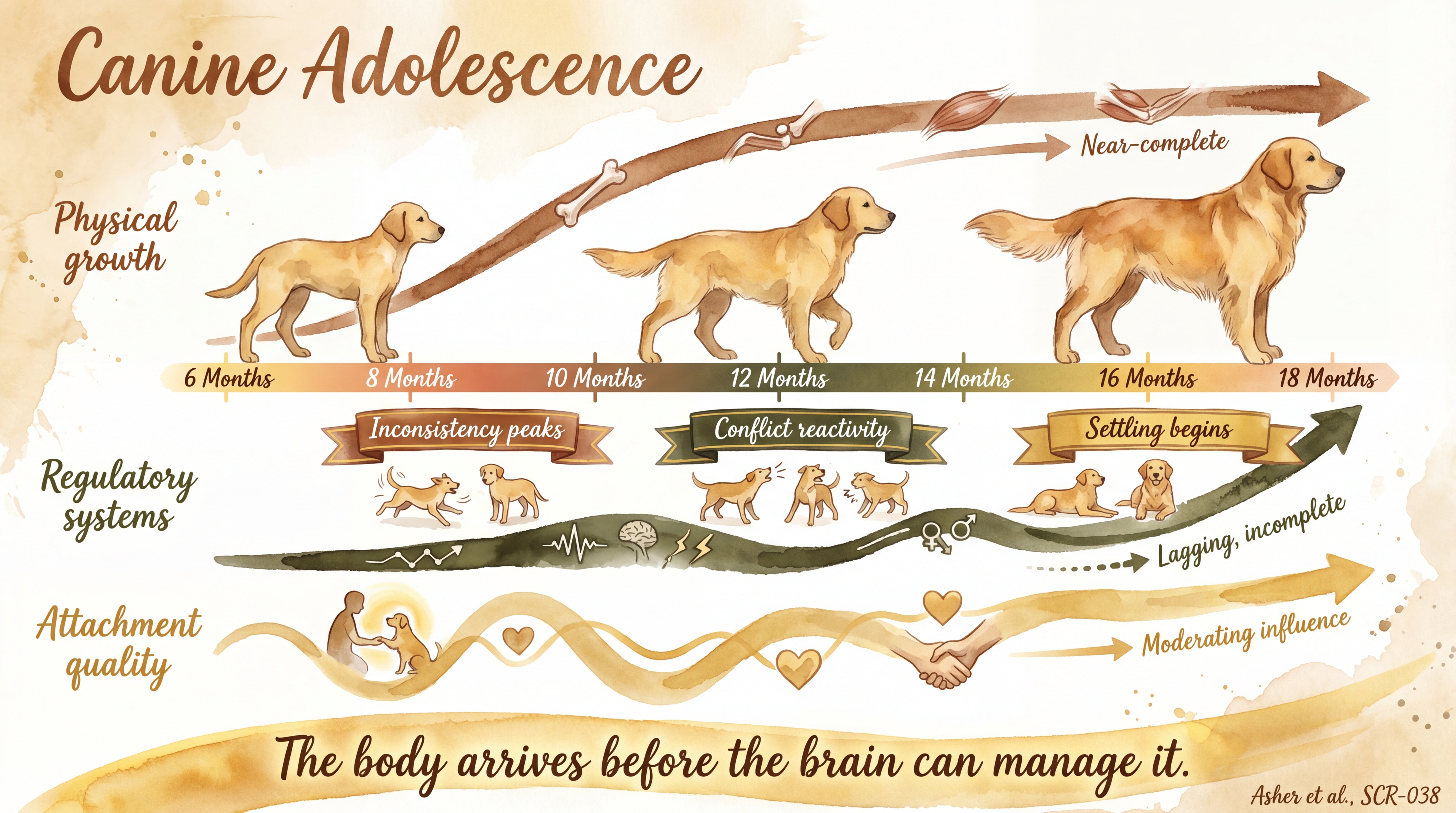
The body arrives before the brain can manage it - adolescence is developmental imbalance, not defiance.
Key Takeaways
- Canine adolescence is a real developmental phase, not just a popular training label.
- The strongest direct evidence shows caregiver-directed conflict and reduced responsiveness around adolescence, especially when attachment is weaker.
- Adolescent instability reflects developmental imbalance, not proof that the dog is choosing to become difficult.
- Steady structure matters more during adolescence, not less, because larger body size arrives before fully mature self-control.
The Evidence
This entry uses observed claim-level tags beyond the dedicated EvidenceBlocks below. These tags mark JB program observation or practice-derived claims that need dedicated EvidenceBlock coverage in a later content pass.
- Asher, L. et al. (2020)domestic dogs including Golden Retrievers
Documented a distinct adolescent sensitive period with reduced obedience and conflict-like behavior directed specifically at the primary caregiver, with attachment quality modulating severity. - Cook, P. F. et al. (2016)domestic dogs
Awake fMRI showed that stronger frontal cortical activation predicted better inhibitory control, supporting the relevance of still-maturing control systems to adolescent behavior. - Gross, B. et al. (2010) and Wu, Y. C. et al. (2011)domestic dogs
Showed that canine neural maturation continues well beyond the earliest puppy stage, supporting a developmental rather than purely moral reading of adolescent instability.
- Adolescent developmental neurosciencemultiple mammals
Across mammals, adolescence commonly involves temporary imbalance between motivational or emotional drive and slower-developing inhibitory control systems. - Canine developmental synthesisdomestic dogs
Source synthesis supports adolescence as a pressure-testing phase for attachment quality, regulation, and earlier socialization foundation.
- SCR-041 boundarydomestic dogs
Downstream writing should avoid false precision about late puppy or adolescent brain maturity percentages. - SCR-043 boundarydomestic dogs
Pruning machinery exists in dogs, but a detailed canine adolescent pruning timeline is not established.
No direct canine research located for this specific topic. Current understanding relies on related research, clinical observation, and cross-species inference.
SCR References
Sources
- Asher, L., England, G. C. W., & Sommerville, R. (2020). Teenage dogs? Evidence for adolescent-phase conflict behavior and attachment in domestic dogs. Biology Letters, 16(7).
- Cook, P. F., Spivak, M., & Berns, G. S. (2016). Neurobehavioral evidence for individual differences in canine cognitive control: An awake fMRI study. Animal Cognition, 19(5), 867-878.
- Gross, B., Garcia-Tapia, D., Riedesel, E., Ellinwood, N. M., & Jens, J. K. (2010). Normal canine brain maturation at magnetic resonance imaging. Veterinary Radiology & Ultrasound, 51(4), 361-373.
- Wu, Y.-C., Field, A. S., Duncan, I. D., & Samsonov, A. A. (2011). High b-value and diffusion tensor imaging in a canine model of dysmyelination and brain maturation. NeuroImage, 58(3), 829-837. DOI: 10.1016/j.neuroimage.2011.06.067.