Multi-Dog Household Dynamics
Multi-dog households can be beautiful. They can also be loud, unstable, and exhausting. JB does not romanticize the number of dogs in a home. Observed-JB The variable is not the number. The variable is the calm-floor capacity of the household holding them.
That is the first principle of this page: not every household should have multiple dogs.
What It Means
What Makes Multi-Dog Life Work
The most stable multi-dog homes usually share a few visible traits. The humans hold one clear emotional baseline, dogs have places to rest separately when needed, meals do not rely on trust alone if any resource sensitivity exists, each dog is treated as an individual rather than as part of a cheerful pack abstraction, and the adults still govern the rhythm rather than letting the dogs set it. When these things are in place, multiple dogs often deepen the social life of the home rather than fragment it.
Why Households Get This Wrong
Families sometimes imagine a second or third dog as a solution to the first dogs boredom, energy, or social needs. Observed-JB That can work in rare cases. More often it simply duplicates the households existing instability. If the first dog lives in too much excitement, the second dog often learns excitement faster than calm. If the first dog lacks structure, the new dog inherits the same vacuum.
JB sees this clearly: dogs co-regulate each other all the time. Observed-JB That is exactly why the household baseline matters so much. Dogs can pull each other upward. They can also lock each other into a higher arousal loop.
The Role of Mentorship
One of the real gifts of a strong multi-dog home is natural mentorship. A settled adult dog can do for a younger dog what the best adult dogs do at the breeder's home: model rhythm, correct lightly, embody boundaries, and help make calm look normal.
But this only works if the mentor is actually settled and the humans are still holding the house. A dysregulated older dog does not become a mentor simply because it is older.
The second dog should not be expected to create the calm floor. The home creates the floor first. Then a settled resident dog can help translate that floor to the younger one.
The Most Common Failure Modes
The first failure mode is adding dogs faster than the household can hold them. The second is treating dogs as a unit and missing who is actually struggling. The third is letting dogs rehearse high-charge greeting, feeding, and door rituals together until the whole house becomes easier to tip. The fourth is assuming affection equals capacity. A family can love dogs deeply and still not have the bandwidth for a healthy multi-dog home.
Practical Architecture
JB multi-dog homes usually benefit from simple visible structure: separate or clearly managed feeding, individual check-ins and one-on-one time, protected rest spaces, deliberate introductions to visitors, and enough human attention to prevent dogs from becoming their own emotional government. None of this is anti-dog. It is what makes the group livable.
Why It Matters for Your Dog
Multi-dog life can make a good home richer. It can also stretch a good home beyond what it can hold. JB would rather see one dog in a deeply calm house than three dogs in a house that is always trying to recover from itself. Observed-JB
That is not a criticism of multi-dog families. It is a reminder that the household, not the dog count, determines whether multiple dogs become a source of gravity or a source of drift.
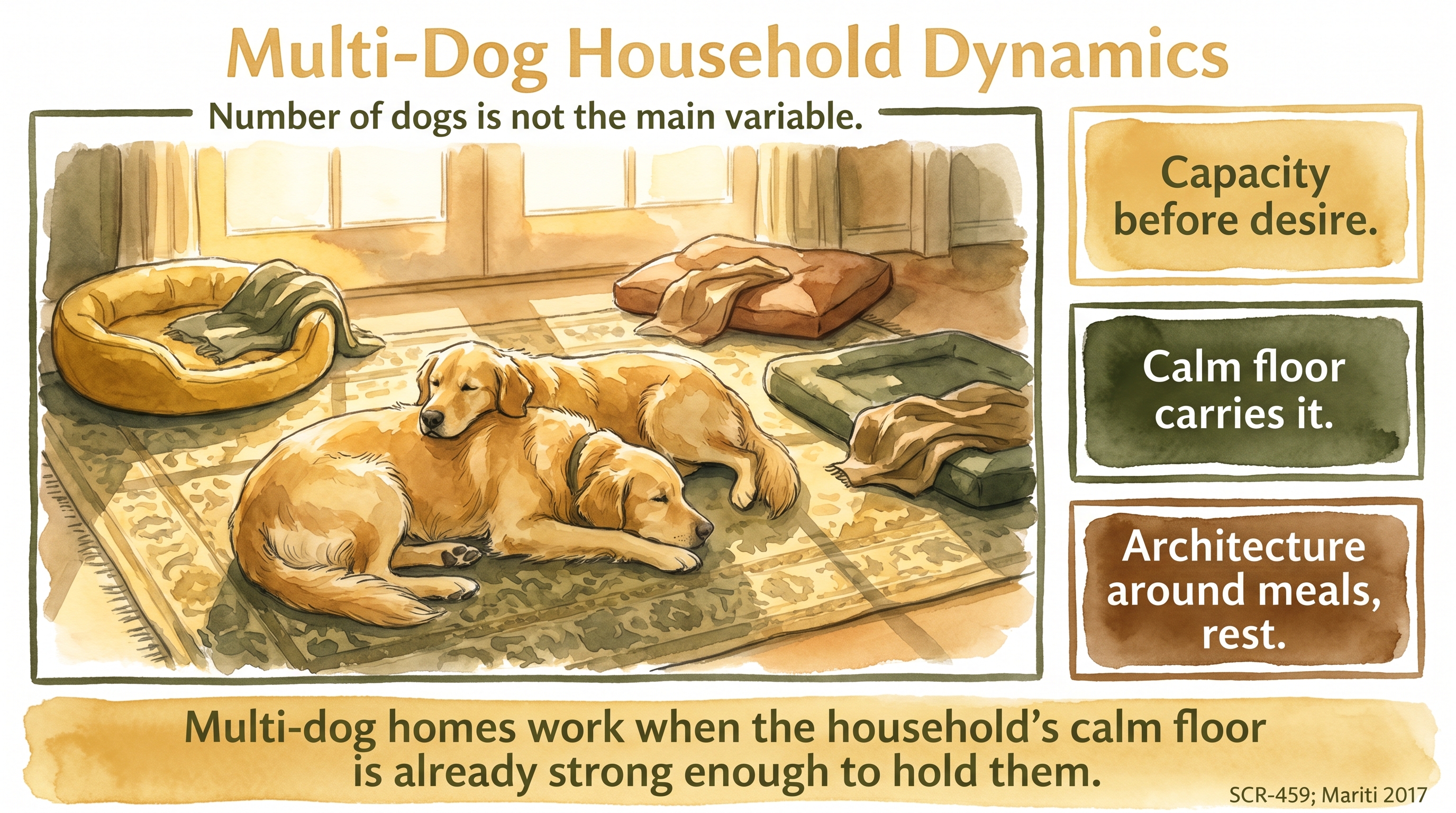
Multi-dog homes work when the household's calm floor is already strong enough to hold them.
Key Takeaways
- Not every household should have multiple dogs. Capacity matters more than desire.
- The number of dogs is not the main variable. The calm-floor capacity of the home is.
- A settled older dog can mentor a younger one, but only inside a house that already has structure.
- Multi-dog homes need visible architecture around meals, rest, and attention to stay stable.
The Evidence
- JB breeder observationGolden Retrievers and family dogs
Multi-dog households work best when the humans hold one calm baseline strongly enough that the dogs do not end up co-regulating each other into chronic excitement. - JB household practicefamily-raised dogs
Separate rest, meal clarity, and individual attention reduce many of the quiet stressors that make multi-dog homes unstable.
- canine communication and owner-effect literaturedomestic dogs
Dogs read each other and their humans continuously, which makes household tone and handler consistency especially important in group settings.
No published study directly tests the practical implications of multi-dog household dynamics for domestic dog raising programs. The application to household dog raising remains an interpretive synthesis rather than a directly tested intervention finding.
SCR References
Sources
- Sundman, A.-S., Van Poucke, E., Svensson Holm, A.-C., Faresjo, A., Theodorsson, E., Jensen, P., & Roth, L. S. V. (2019). Long-term stress levels are synchronized in dogs and their owners. Scientific Reports, 9, 7391. https://doi.org/10.1038/s41598-019-43851-x
- Payne, E., Bennett, P. C., & McGreevy, P. D. (2015). Current perspectives on attachment and bonding in the dog-human dyad. Psychology Research and Behavior Management, 8, 71-79. https://doi.org/10.2147/PRBM.S74972
- Schoeberl, I., Wedl, M., Bauer, B., Day, J., Mostl, E., & Kotrschal, K. (2012). Effects of owner-dog relationship and owner personality on cortisol modulation in human-dog dyads. Anthrozoos, 25(2), 199-214. https://doi.org/10.2752/175303712X13316289505422
- Kujala, M. V., Imponen, N., Pirkkala, A., Silfverberg, T., Parviainen, T., Tiira, K., & Kiuru, N. (2023). Modulation of dog-owner relationship and dog social and cognitive behavior by owner temperament and dog breed group. Scientific Reports, 13, 14739. https://doi.org/10.1038/s41598-023-41849-0
- Just Behaving program observation disclosure. (2026). Boundary: this internal observation is limited to JB-raised Golden Retrievers whose families continued the JB framework after placement; cohort size, time window, and counting rule are deferred in this revision. Treat as program observation supporting multi-dog household dynamics, not as published external evidence.