Adding a Second Dog
Families often imagine adding a second dog as an emotional decision. Observed-JB They love the first dog, so the idea of another feels natural. JB does not dismiss that impulse. It simply asks a harder question first: is the resident dog ready, and is the household actually ready?
The best time to add a second dog is usually not when the first dog is still chaotic, lonely, or difficult. It is when the first dog is settled enough to mentor rather than simply participate.
What It Means
Resident-Dog Timing
In many JB homes, the strongest resident-dog window is somewhere between about three and six years old. That is often late enough that the first dog is fully out of adolescence, secure in the household rhythm, and able to model adult life rather than just share space.
Harder timing windows include resident dogs still in adolescence, very old resident dogs with waning tolerance or energy, dogs with active reactivity or resource-guarding issues, and homes already going through stress or transition. Observed-JB
A second dog does not magically stabilize any of those situations. More often it inherits them.
Why Families Add Too Early
The most common mistaken reason for a second dog is that the first dog needs a companion to fix a problem. Needs a friend. Needs someone to play with. Needs someone to wear him out. Sometimes what the first dog actually needs is a stronger rhythm, better exercise quality, calmer household tone, or more honest management. A second dog cannot supply what the humans never organized clearly in the first place.
JB would rather delay the second dog than ask the second dog to perform emotional labor for the first one. Observed-JB
The Soft Landing Applies Again
When a second dog does arrive, JB treats the process as another transition rather than as instant social completion: quiet arrival, a small first week, protected rest, gradual integration with the resident dog, and no assumption that shared breed or shared house means instant shared rhythm. Observed-JB
The resident dog often becomes the primary canine mentor if temperament allows, but the humans still carry the floor. The new dog is not dropped into full-speed household life just because another dog lives there already.
The strongest second-dog households are not the ones that add fast. They are the ones that wait until the first dog is mature enough to model the life the second dog is arriving into.
What Fit Really Means
Fit is not just breed, sex, or age. It is energy, social style, recovery pattern, household capacity, and what the humans are actually hoping life will feel like with two dogs instead of one.
Two low-friction dogs in a calm house can feel easier than one difficult dog in a disorganized house.
Two poorly matched dogs in a stretched household can feel much harder than the family imagined.
That is why the breeder conversation matters. Someone outside the emotional center of the decision can often see timing and fit more clearly.
Why It Matters for Your Dog
Adding a second dog is not only about the incoming puppy. It is about protecting the first dog, the house, and the relationship culture that already exists. Families who get this right usually did not rush. They waited until the first dog could receive the change well and until the house had enough calm margin to hold it.
That patience usually pays for years.
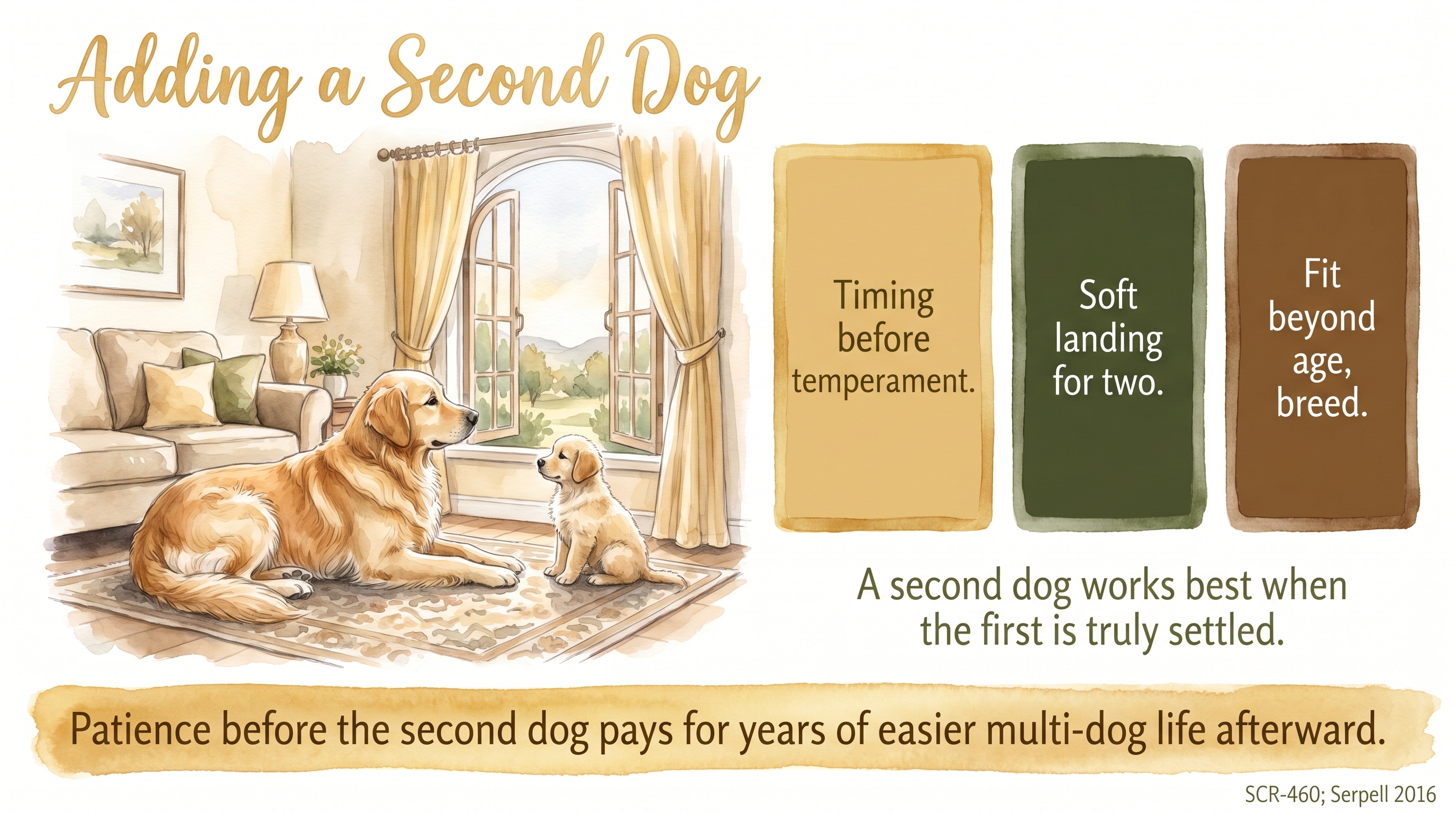
Patience before the second dog pays for years of easier multi-dog life afterward.
Key Takeaways
- The best time to add a second dog is usually when the first dog is mature enough to mentor, not when the household is hoping the second dog will solve a problem.
- A second dog should get its own soft landing rather than being dropped straight into full-speed life.
- Fit means more than age or breed. It includes temperament, energy, and household capacity.
- Patience before adding the second dog often pays for years of easier multi-dog life afterward.
The Evidence
- JB breeder observationGolden Retrievers
Resident dogs are usually at their best as mentors for a new puppy once they are fully settled out of adolescence and into mature adult household life. - JB family practicemulti-dog homes
Second dogs integrate most cleanly when the new arrival receives a soft landing rather than being expected to absorb a full household and resident-dog relationship immediately.
- handler-behavior literaturedomestic dogs
Handler consistency and household organization continue to shape behavior even when more than one dog is present.
No published study directly tests the practical implications of adding a second dog for domestic dog raising programs. The application to household dog raising remains an interpretive synthesis rather than a directly tested intervention finding.
SCR References
Sources
- Sundman, A.-S., Van Poucke, E., Svensson Holm, A.-C., Faresjo, A., Theodorsson, E., Jensen, P., & Roth, L. S. V. (2019). Long-term stress levels are synchronized in dogs and their owners. Scientific Reports, 9, 7391. https://doi.org/10.1038/s41598-019-43851-x
- Payne, E., Bennett, P. C., & McGreevy, P. D. (2015). Current perspectives on attachment and bonding in the dog-human dyad. Psychology Research and Behavior Management, 8, 71-79. https://doi.org/10.2147/PRBM.S74972
- Moyer, B. J., Zulch, H., Ventura, B. A., & Burman, O. (2025). A qualitative exploration of owner experiences following dog adoption. Animal Welfare, 34, e9. https://doi.org/10.1017/awf.2025.4
- Just Behaving program observation disclosure. (2026). Boundary: this internal observation is limited to JB-raised Golden Retrievers whose families continued the JB framework after placement; cohort size, time window, and counting rule are deferred in this revision. Treat as program observation supporting second-dog integration and handler-behavior effects, not as published external evidence.