Introducing the Puppy to Resident Dogs
When a stable adult dog already lives in the home, the resident dog can become the puppy's clearest social teacher from day one. That is a major asset if the humans handle it correctly, and a major liability if they do not. JB's basic position is simple: most calm adult dogs know more about introducing a puppy to the household than excited humans do. The family's job is not to dominate the interaction. The family's job is to preserve safety, reduce unnecessary tension, and allow the adult dog's social competence to do its work. Observed-JB
What It Means
The arrival of a new puppy changes the household for the resident dog too. Observed-JB
That matters because many families make the same mistake in opposite directions.
Some families distrust the adult dog and overprotect the puppy immediately. Observed-JB They hover, tighten leashes, interrupt every sniff, and treat the adult dog as a threat the puppy must be shielded from.
Other families make the opposite error and say, "Let them sort it out," which often means the humans stop reading either dog altogether and allow too much pressure too fast. Observed-JB
JB rejects both extremes.
The adult dog is neither an automatic danger nor a magic babysitter. The adult dog is a social authority whose competence can be preserved or undermined by the humans around it.
Why the Adult Dog Matters So Much
Puppies read dogs differently from the way they read people.
An adult dog can communicate through: posture, stillness, disengagement, spatial claims, brief corrections, and invitation or non-invitation to play.
Those signals are often far more legible to the puppy than the human equivalents. That is one reason JB values adult-dog mentorship so highly. A calm adult dog naturally teaches: proximity rules, interruption thresholds, respect for rest, how much play is too much, and what calm group living feels like. Observed-JB
Humans often mistake this kind of teaching for meanness because they are reading it through human politeness rather than canine communication.
The First Meeting Should Be Small
The first contact should be measured and low drama.
In many homes, the best version looks like this: resident dog has already been exercised and is calm, puppy has already arrived, pottied, and downshifted a little, first meeting happens in a neutral or low-pressure space if possible, both dogs are on loose, non-tightening control if needed, contact is brief, and the interaction ends before either dog is pushed too far.
The family is not trying to produce instant friendship.
It is trying to produce a clean first read.
That means no crowd, no squealing, no forcing dogs nose-to-nose, no making them "say hello" because the humans want a picture. Many good introductions are unremarkable. That is a success, not a disappointment.
What the Humans Should Watch
The humans should be reading: the resident dog's willingness to approach or disengage, whether the puppy respects pauses and space, body softness versus tension, and whether either dog becomes too high too fast.
Good signs often look quieter than people expect: curved approach, brief sniffing and then disengagement, the adult dog moving away and the puppy accepting that movement, a soft body with no fixed stare, and a pause that stays a pause.
The warning signs are also usually simple: stillness with hard eyes, repeated rushes by the puppy that never resolve, tight leash tension feeding into the dogs, adult dog unable to escape pressure, and humans narrating and touching too much.
The Resident Dog Is Not the Obstacle
One of the most damaging household stories is "protect the puppy from the adult dog."
Sometimes there are good reasons for heightened caution, especially with: reactive dogs, resource guarding dogs, dogs with a bite history, and fearful dogs.
But in a home with a generally stable adult dog, overprotecting the puppy often teaches the wrong lesson to both animals.
It teaches the puppy that the adult dog is not to be respected because the humans will intervene before the social lesson lands.
It teaches the adult dog that the puppy is a protected disturbance the dog cannot meaningfully communicate with.
Both of those outcomes make future tension more likely.
JB's position is that a calm adult dog should be allowed to remain the adult. That means the humans preserve the adult dog's authority rather than quietly undermining it.
"Let Them Sort It Out" Is Not JB Either
It is equally important to say what JB is not recommending.
The phrase "let them sort it out" is often used by people who simply do not want to supervise. That approach ignores important truths: some adult dogs are not socially skilled, some puppies are extremely persistent and rude, some households contain resources and spaces that create pressure quickly, and some early signals are subtle and easy for families to miss.
JB is not passive. It is structured. The adult dog should be allowed to communicate. The humans should still protect the interaction from becoming too long, too pressured, or too chaotic.
What a Crash Landing Looks Like Here
The crash-landing version of this introduction often looks like one of three scenes.
Scene one: the puppy comes through the door and the resident dog is released into the moment immediately, while the whole family crowds around and the emotional energy spikes.
Scene two: the puppy is scooped up every time the adult dog gets near, which teaches the puppy to escalate and teaches the adult dog that the puppy's presence suspends normal social order.
Scene three: the humans say, "They'll figure it out," and allow repeated rude contact, relentless chasing, or overstimulation because they assume any dog-to-dog behavior is natural and therefore good. Observed-JB
All three are crash landings because they sacrifice clarity.
The soft landing is quieter. It treats the meeting as the beginning of a social relationship, not the forced proof of one.
Mentorship Starts Very Early
If the resident dog is a good dog for this role, mentorship can begin almost immediately.
That does not mean nonstop contact. In fact, too much contact too early usually lowers the quality of the relationship.
It means the puppy begins to absorb: where calm happens, when movement stops, how adults respond to intrusion, and how to settle near another dog.
That is the real gift of the resident dog. Not entertainment. Not puppy play. Adult social gravity.
Why It Matters for Your Dog
For a puppy, a calm resident dog can make the home readable much faster than the humans alone can.
The adult dog already knows: the room map, the household rhythm, the tone of the adults, and what belongs and what does not.
When the adult dog is stable, the puppy can borrow that certainty.
A calm resident dog is often the puppy's clearest first teacher. The family's job is to let that mentorship happen safely instead of turning the introduction into a human-managed spectacle.
This page also matters because many future household problems begin here: rude interruption of the adult dog's rest, puppy chasing that gets rehearsed as fun, adult-dog resentment, and humans undermining the adult dog's quiet corrections.
If the family protects the relationship properly in week one, the adult dog often becomes the fastest route to a calmer, more socially competent puppy. If the family handles the introduction poorly, it can spend months trying to fix the confusion it created in one weekend.
That is why JB takes the meeting seriously without making it dramatic. The resident dog is not a side detail of the transition. In many homes, the resident dog is the transition.
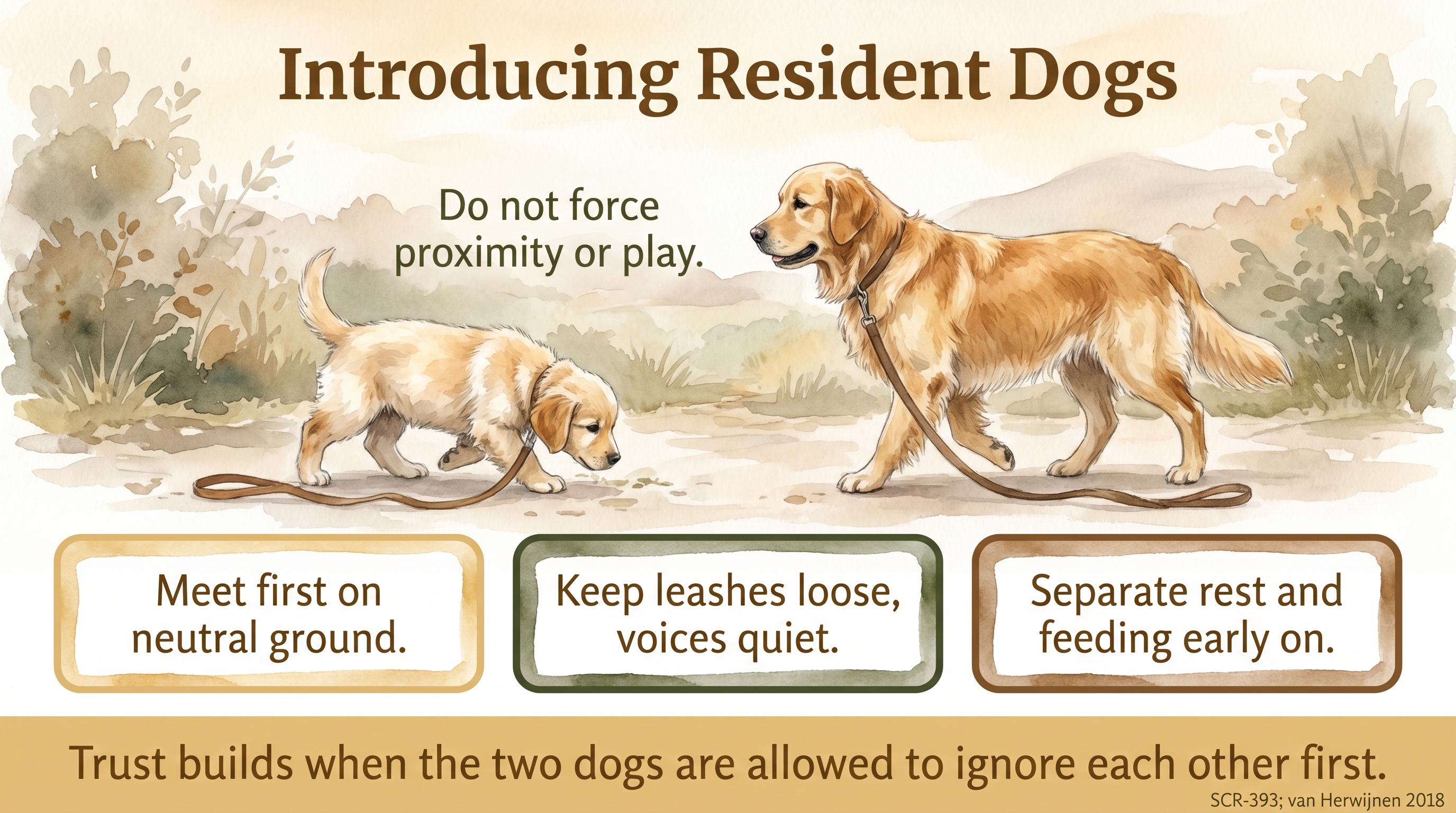
Trust builds when the two dogs are allowed to ignore each other first.
Key Takeaways
- A calm resident dog can become the puppy's most efficient first mentor if the humans preserve that relationship instead of interfering with it.
- The first meeting should be short, quiet, and low pressure rather than treated as a proof of instant friendship.
- Protecting the puppy from every normal adult-dog signal can be just as destabilizing as letting the dogs interact without structure.
- A crash landing happens when the introduction is crowded, rushed, or emotionally noisy instead of allowing the adult dog to communicate clearly.
The Evidence
- Rooney et al. (2000); Horvath et al. (2008); Ward et al. (2008)domestic dogs
Dogs use subtle body-language signals, pauses, disengagement, and escalation thresholds to organize social interaction, and those signals are easily distorted by tense or overinvolved human handling.
- JB multi-dog household practicefamily-raised puppies and resident adult dogs
Brief, calm, protected introductions preserve the adult dog's social authority and allow the puppy to begin reading canine mentorship rather than human excitement. - JB multi-dog household practicefamily-raised puppies and resident adult dogs
Overprotecting the puppy or abandoning supervision both disrupt the formation of a stable adult-dog-to-puppy relationship in the first week.
No published study directly tests the specific Just Behaving guidance on introducing resident dogs. This entry relies on broader canine evidence, breeder observation, and practical synthesis.
SCR References
Sources
- Bauer, E. B., & Smuts, B. B. (2007). Cooperation and competition during dyadic play in domestic dogs, Canis familiaris. Animal Behaviour, 73(3), 489-499.
- Rooney, N. J., Bradshaw, J. W. S., & Robinson, I. H. (2000). A comparison of dog-dog and dog-human play behaviour. Applied Animal Behaviour Science, 66(3), 235-248.
- Horvath, Z., Doka, A., & Miklosi, A. (2008). Affiliative and disciplinary behavior of human handlers during play with their dog affects cortisol concentrations in opposite directions. Hormones and Behavior, 54(1), 107-114.
- Ward, C., Bauer, E. B., & Smuts, B. B. (2008). Partner preferences and asymmetries in social play among domestic dog, Canis lupus familiaris, littermates. Animal Behaviour, 76, 1187-1199.