Environmental Exposures and Dog Health
Compound evidence detail2 SCRs / 5 parts
- Ambiguousany single percentage figure presented as a universal Golden Retriever cancer constant without naming the population, study design, or referral basis
- Documentedthe necropsy and referral cohort findings themselves; cancer as a leading cause of death in Golden Retrievers with honest sourcing and explicit dataset attribution
- Ambiguousthe causal interpretation linking 2,4-D phenoxy herbicide exposure to canine malignant lymphoma - the Hayes 1991 case-control finding of an association versus subsequent methodological reanalyses leaves the causal claim unsettled, supporting precautionary framing rather than a settled assertion that lawn chemicals cause canine lymphoma
- Observed-JBthe documented associations between secondhand cigarette-smoke exposure and canine respiratory disease, and between smoke exposure and nasal or pulmonary neoplasia in some studies - the directional signal is consistent enough to warrant family awareness even where individual studies have been critiqued
- Heuristicbroader household environmental recommendations - fragrance-based air freshener avoidance, intensive cleaning-chemical reduction - presented as precautionary program-level guidance rather than as recommendations evidence-validated at the same level as the secondhand smoke or 2,4-D evidence bases
Environmental-exposure discussions in dogs are prone to two opposite mistakes. One mistake is treating environment as irrelevant because genetics are easier to talk about. The other is treating every plausible exposure as if it has already been proven to cause cancer or chronic disease in dogs. The better position is narrower and more disciplined: environment clearly matters, some exposure questions have real supporting literature, but the strongest Golden Retriever-specific causal conclusions are still more limited than popular rhetoric often suggests. Mixed Evidence
What It Means
Why This Topic Matters in Dogs
Dogs are not little humans in this context. They live closer to the floor, investigate with the nose and mouth, lick paws, and spend time in yards and indoor spaces in ways that create direct contact with surfaces and residues people may barely notice.
That means environmental-health questions are legitimate. It does not mean every exposure pathway has already been mapped cleanly to disease.
What the Golden Retriever Lifetime Study Adds
The Golden Retriever Lifetime Study matters here because it was explicitly designed to track not only disease outcomes but also environmental exposures; lifestyle variables; diet; reproduction; and broader risk-factor architecture. Documented
That is important because most environmental debates are built on weaker evidence than a prospective cohort can provide.
The Strongest Golden-Specific Environmental Message
The most careful Golden-specific conclusion from the source layer is not dramatic. In the GRLS lymphoma case-control work, commonly discussed proximity-based pollution measures did not reach statistical significance overall, though one cumulative-exposure subgroup pattern approached significance. Documented
That means two things at once the topic is scientifically real and worth studying; and current Golden-specific evidence does not justify sweeping causal claims from proximity alone.
This is exactly the kind of result families and breeders should know, because it keeps the conversation honest.
Lawn Chemicals and Yard Treatments
This is one of the most emotionally charged parts of the topic. Some canine studies and broader veterinary discussions suggest concern around pesticide or herbicide exposure and later cancer associations, while other data are weaker, inconsistent, or shaped by exposure-measurement limitations. Documented
The disciplined conclusion is the concern is not imaginary; the causality is not settled enough for dramatic certainty; and avoidance and common-sense caution are still reasonable.
That is very different from saying one lawn treatment definitely causes cancer in every exposed dog.
Tobacco Smoke
Secondhand smoke is another area where caution is more justified than casual dismissal. Dogs share indoor air, inhale residues, and carry particulate material on the coat.
The exact strength of the disease-association literature varies by endpoint, but smoke exposure is one of the easier environmental risks to justify reducing because it is not beneficial; it is modifiable; and plausible respiratory and inflammatory harm is well grounded. Heuristic
This is a good example of a practical precaution that does not require perfect causal mapping to be sensible.
Why It Matters for Your Dog
Household Cleaners and Indoor Chemistry
The literature here is thinner than many social-media claims suggest. It is reasonable to avoid heavy fumes; direct residue contact; poorly ventilated use of strong chemicals; and unsecured storage of cleaning products.
What is not reasonable is talking as though every ordinary household product has already been shown to produce a defined cancer outcome in dogs. The evidence is not that complete.
Why Goldens Make the Topic Feel Bigger
Goldens already carry significant cancer burden, so any environmental-risk discussion naturally feels loaded. Families want leverage over something that feels frightening.
That is understandable. It is also why evidence discipline matters here more than ever. A breed with real cancer vulnerability is exactly where weak environmental claims can spread fastest if no one names the uncertainty.
The Sensible Precaution Standard
A practical family standard does not need perfect certainty to be worthwhile.
Reasonable precautions include limiting unnecessary lawn chemical use where possible, keeping dogs away from freshly treated areas, rinsing paws after obvious environmental exposures when appropriate, maintaining good household ventilation, storing chemicals securely, and avoiding smoke exposure indoors.
Those steps are proportionate. They do not require pretending every exposure pathway has already been conclusively quantified.
What This Page Is Not Saying
This page is not saying environment does not matter; lawn chemicals are proven to cause every canine cancer; and the GRLS has already solved environmental causality.
It is saying the literature supports caution, active study, and proportionate prevention while still requiring humility about what has and has not been proven. Documented
When to See a Veterinarian
See your veterinarian if your dog has known chemical exposure; acute breathing irritation after fumes or smoke; vomiting or neurologic signs after possible toxin contact; persistent skin irritation after yard treatment exposure; and new lumps or unexplained weight loss, regardless of whether an environmental cause is known.
Possible toxin emergencies should be treated urgently rather than watched at home.
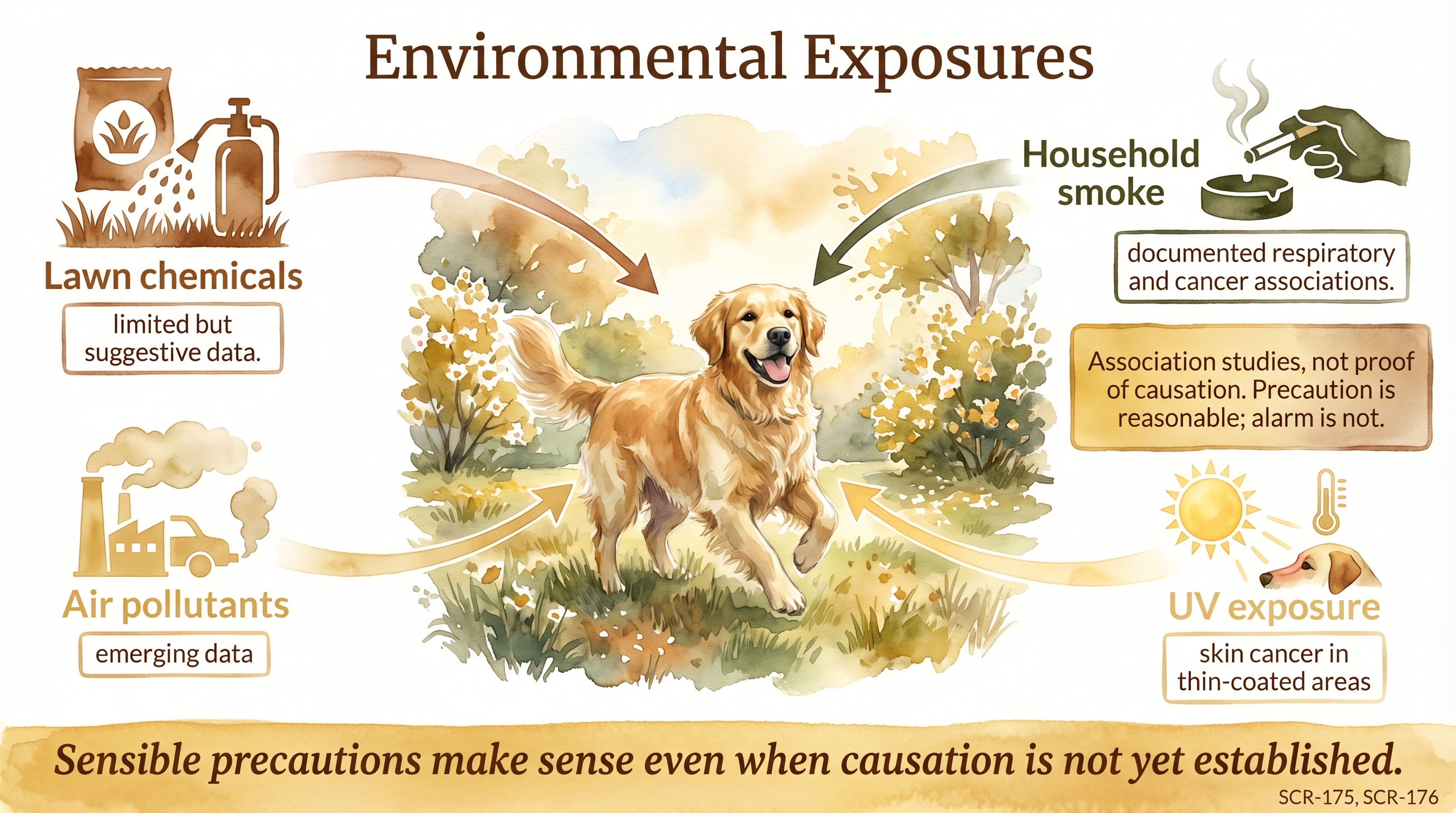
Sensible precautions make sense even when causation is not yet established.
Key Takeaways
- Environmental-health questions in dogs are real, but the strongest Golden-specific causal claims are still narrower than popular rhetoric often suggests.
- The Golden Retriever Lifetime Study supports ongoing concern and active study, but its current pollutant-proximity findings are more cautious than sensational.
- Lawn chemicals, smoke, and strong household exposures are reasonable areas for precaution without pretending the science is fully settled.
- The best family standard is proportionate caution plus good storage, ventilation, and exposure reduction where practical.
The Evidence
This entry uses heuristic claim-level tags beyond the dedicated EvidenceBlocks below. These tags mark JB interpretive application rather than direct study findings.
- Golden-longevity source synthesisGolden Retrievers
The Golden Retriever Lifetime Study was built to evaluate environmental, nutritional, lifestyle, reproductive, and genetic contributors to major disease outcomes. - GRLS lymphoma case-controlGolden Retrievers
In the available Golden-specific proximity analysis, the primary environmental exposure measures were not statistically significant overall, though one cumulative-exposure subgroup pattern approached significance. - Canine environmental-health logicdogs
Dogs have real contact pathways through paws, coat, nose, and low-to-ground living that make environmental exposure questions scientifically legitimate.
- Environmental-cancer literature synthesisdogs
Lawn chemical and pollutant concerns are biologically plausible and partially supported, but the literature remains heterogeneous and does not justify blanket causal certainty in dogs. - Smoke-exposure reasoningdogs
Reducing secondhand smoke exposure is a sensible precaution because respiratory and inflammatory harm is plausible even where disease-endpoint mapping remains incomplete.
- domestic dogs
No published study directly quantifies how current breeding and management decisions will change environmental exposures and dog health across the full Golden Retriever population over multiple generations.
SCR References
Sources
- Labadie, J., Swafford, B., DePena, M., Tietje, K., Page, R., & Patterson-Kane, J. (2022). Cohort profile: The Golden Retriever Lifetime Study (GRLS). PLOS ONE, 17(6), e0269425. https://doi.org/10.1371/journal.pone.0269425
- Luethcke, K. R., Trepanier, L. A., Tindle, A. N., & Labadie, J. D. (2022). Environmental exposures and lymphoma risk: A nested case-control study using the Golden Retriever Lifetime Study cohort. Canine Medicine and Genetics, 9, 10. https://doi.org/10.1186/s40575-022-00122-9
- Hayes, H. M., Tarone, R. E., & Cantor, K. P. (1995). On the association between canine malignant lymphoma and opportunity for exposure to 2,4-dichlorophenoxyacetic acid. Environmental Research, 70(2), 119-125. https://doi.org/10.1006/enrs.1995.1056
- Reif, J. S., Dunn, K., Ogilvie, G. K., & Harris, C. K. (1992). Passive smoking and canine lung cancer risk. American Journal of Epidemiology, 135(3), 234-239. https://academic.oup.com/aje/article-abstract/135/3/234/97261
- Tindle, A. N., Krueger, L. M., Swafford, B., Mani, E., Danielson, C., Labadie, J., & Trepanier, L. A. (2025). Genotoxic herbicide exposures in Golden Retrievers with and without multicentric lymphoma. Veterinary and Comparative Oncology, 23(2), 246-256. https://doi.org/10.1111/vco.13051