Growth Plates and Exercise Limits in the Growing Dog
Compound evidence detail1 SCR / 2 parts
- Documentedorthopedic research on growth-plate closure timelines and exercise-impact effects in growing dogs
- HeuristicJB framing of exercise limits as part of structured leadership during the growing period rather than arbitrary restriction
Adolescent Golden Retrievers often look robust before they are structurally finished. That visual illusion creates one of the most common mistakes of the growing period: families assume the dog is ready for adult-type exercise because the dog has adult-type size. Observed-JB
The skeleton does not care what the dog looks like from across the yard.
Growth plates remain open through much of adolescence, and those plates are the weak links of the immature skeleton. While exact timing varies by individual and by bone, large-breed dogs such as Golden Retrievers commonly remain in a meaningful growth window through roughly twelve to eighteen months. Estimated During that period, repetitive high-impact loading asks more of the joints, long bones, and supporting tissues than the dog may be ready to give.
JB treats this as a prevention problem. The dog will have years to run hard later. The growing months are the wrong place to gamble for the sake of burning energy now.
What It Means
What Growth Plates Are
Growth plates are areas of developing cartilage near the ends of long bones where lengthening occurs before skeletal maturity. Until they close and ossify, they are biologically necessary and structurally vulnerable.
That vulnerability does not mean the dog should live in bubble wrap. It means force and repetition matter.
A young dog moving naturally, varying its pace, and choosing how to use its body on forgiving surfaces is very different from a young dog being asked to repeat the same high-impact task over and over because the family believes more exertion equals better behavior.
The Exercises That Deserve Caution
The practical high-risk list is familiar: forced jogging on pavement, running alongside a bicycle, repetitive jumping drills, repeated launching in and out of vehicles, extended fetch that creates hard stops and twisting turns, and sport-style training built around impact before physical maturity. These are not bad forever. They are bad fits for an unfinished dog.
The orthopedic literature supports the larger principle even when not every home activity has been tested one by one. Documented Growth-phase load, body condition, joint vulnerability, and developmental orthopedic disease all interact. That is enough to justify conservative family guidance.
What JB Recommends Instead
JB does not answer adolescent energy with athletic escalation. It answers it with calmer, safer, and more developmentally appropriate movement. That usually means longer calm walks rather than faster ones, varied ground rather than repetitive pavement mileage, self-paced movement rather than forced endurance, sniffing, exploring, and terrain reading rather than constant ball obsession, and swimming when available and safe because it allows movement with lower impact. The parasympathetic walk matters here. It is not just philosophically aligned with calmness. It is physically aligned with the growing dog. It gives the dog mileage, environmental information, and nervous-system regulation without demanding the sort of repetitive impact that the adolescent skeleton does not need.
Protecting the growing dog from unnecessary impact is the Prevention pillar in physical form. You are not depriving the dog of life. You are preserving the body that life will happen in.
The Mistake Families Make Under Pressure
Most families do not overexercise a growing dog because they are careless. They do it because adolescence is louder than puppyhood and they are trying to help.
The dog is bigger, more energetic, and harder to settle, so the family adds intensity. They run farther, throw longer, jump more, and look for anything that seems likely to empty the dog out.
That logic feels intuitive and can backfire in two ways.
First, it may load an immature skeleton in ways that increase orthopedic cost. Documented
Second, it often produces a fitter but not calmer dog. The dog develops more stamina for high arousal instead of developing better recovery and steadiness.
JB would rather see the family add calm mileage than adrenalized effort.
What About Stairs, Furniture, and Normal Life?
Normal life still happens. Puppies and adolescents climb a few stairs, jump into imperfect positions, and move through a household. The goal is not zero impact. The goal is not routine unnecessary impact.
That distinction keeps the guidance sane.
If a family can minimize repeated jumping off high surfaces, avoid turning every outing into an endurance event, and choose lower-impact movement as the main form of exercise, they have already done most of the useful work.
This is also where body condition matters. A lean growing dog carries less joint load than a heavy one. Exercise guidance and nutrition guidance belong together.
When More Freedom Is Safer Than More Force
There is a useful irony in adolescence: in the right location, some self-directed movement can be safer than imposed movement.
A dog moving off leash in a safe, contained, low-pressure area on natural terrain often self-regulates better than a dog forced to keep pace on a road. The young dog slows, sniffs, arcs, pauses, and changes direction in ways that fit its own body. That does not make all off-leash activity safe. It simply illustrates the larger JB principle that calm, natural movement is usually a better developmental fit than human-driven athleticism.
Why It Matters for Your Dog
Orthopedic problems are not only veterinary problems. They are life-shape problems.
A dog who enters adulthood with healthier joints moves differently, rests more comfortably, ages better, and carries less chronic pain burden into later years. The families biggest opportunity to influence that arc often comes before the dog looks fully adult.
That is why this page belongs in adolescence rather than in a distant health section. Exercise choices during the growing period are happening now, in ordinary daily life, when the dog seems healthy enough that people forget the skeleton is still under construction.
The dog does not need early sports performance. The dog needs a body that will last.
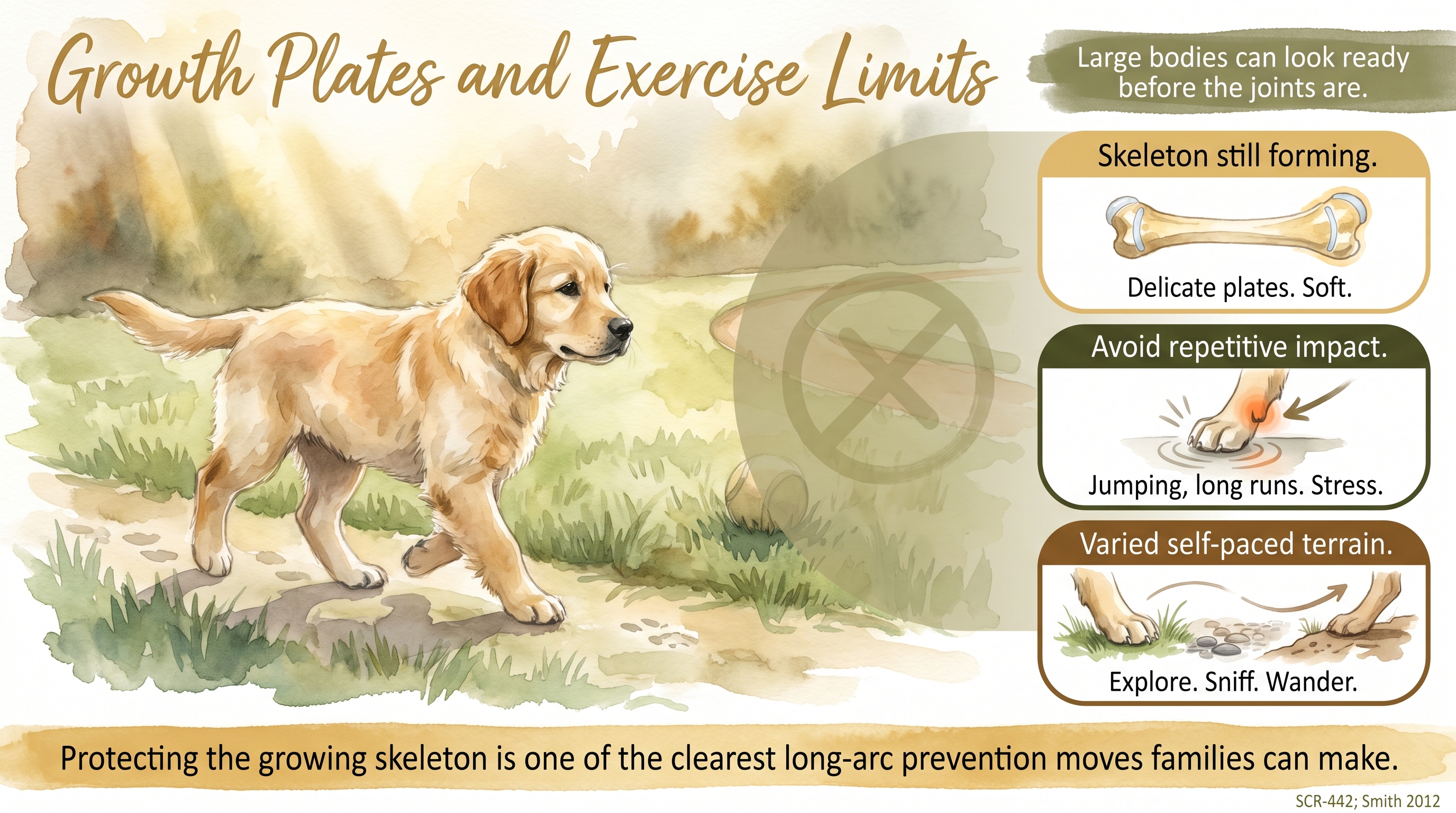
Protecting the growing skeleton is one of the clearest long-arc prevention moves families can make.
Key Takeaways
- A large adolescent dog can look physically ready before the skeleton is actually mature.
- Growth plates make repetitive high-impact exercise a poor fit for much of the Golden Retriever growing period.
- JB prefers calm mileage, varied terrain, and self-paced movement over forced endurance or repetitive jumping.
- Protecting the body during adolescence is one of the clearest long-arc prevention choices a family can make.
The Evidence
This entry uses estimated claim-level tags beyond the dedicated EvidenceBlocks below. These tags mark approximate ranges or timing claims that should remain bounded by the cited sources.
- canine orthopedic development literaturedomestic dogs
Large-breed skeletal growth continues through adolescence, and open growth plates remain a period of structural vulnerability. - hip and elbow dysplasia screening sciencedomestic dogs
Developmental orthopedic outcomes are influenced by growth rate, body condition, and mechanical loading during immature periods.
- JB breeder observationGolden Retrievers
Growing dogs usually do better with calm distance, self-paced movement, and lower-impact routines than with repetitive high-intensity exercise. - JB household practicefamily-raised Goldens
Long calm walks and natural exploration tend to support both regulation and orthopedic caution better than forced mileage.
- JB synthesisgrowing family dogs
The safest working rule is to increase duration and environmental quality before increasing impact or intensity.
No published study directly tests the practical implications of growth plates and exercise limits in the growing dog for domestic dog raising programs. The application to household dog raising remains an interpretive synthesis rather than a directly tested intervention finding.
SCR References
Sources
- Hedhammar, A., Wu, F. M., Krook, L., Schryver, H. F., de Lahunta, A., Whalen, J. P., Kallfelz, F. A., Nunez, E. A., Hintz, H. F., Sheffy, B. E., & Ryan, G. D. (1974). Overnutrition and skeletal disease: An experimental study in growing Great Dane dogs. Cornell Veterinarian, 64(Suppl 5), 1-160.
- Kealy, R. D., Lawler, D. F., Ballam, J. M., Mantz, S. L., Biery, D. N., Greeley, E. H., Lust, G., Segre, M., Smith, G. K., & Stowe, H. D. (2002). Effects of diet restriction on life span and age-related changes in dogs. Journal of the American Veterinary Medical Association, 220(9), 1315-1320. https://doi.org/10.2460/javma.2002.220.1315
- Smith, G. K., Paster, E. R., Powers, M. Y., Lawler, D. F., Biery, D. N., Shofer, F. S., McKelvie, P. J., & Kealy, R. D. (2006). Lifelong diet restriction and radiographic evidence of osteoarthritis of the hip joint in dogs. Journal of the American Veterinary Medical Association, 229(5), 690-693. https://doi.org/10.2460/javma.229.5.690
- von Pfeil, D. J. F., & DeCamp, C. E. (2009). The epiphyseal plate: Physiology, anatomy, and trauma. Compendium: Continuing Education for Veterinarians, 31(8), E1-E11. https://pubmed.ncbi.nlm.nih.gov/19753989/
- Torres de la Riva, G., Hart, B. L., Farver, T. B., Oberbauer, A. M., Messam, L. L. M., Willits, N., & Hart, L. A. (2013). Neutering dogs: Effects on joint disorders and cancers in Golden Retrievers. PLOS ONE, 8(2), e55937. https://doi.org/10.1371/journal.pone.0055937