Indirect Correction in the First Month
Many families arrive at the first month with a false choice in mind. If they do not want to punish the puppy, they think they must have no correction vocabulary at all. JB rejects that completely. The first month can be full of correction without becoming fearful, forceful, or punitive. That is what Indirect Correction names: the calm communication of disapproval through body position, spacing, tempo, brief vocal markers, and quiet disengagement. In JB language, correction is communication and punishment is imposed suffering. Those are not the same thing, and the difference is load-bearing. Observed-JB
A note on the parent pillar's evidence ceiling. This entry operationalizes Indirect Correction during the first month after placement. The framing in the parent pillar entry holds: the program's view that mechanically similar interventions function differently inside a calm parental relationship is interpretive rather than experimentally settled, and the Relational Modulation Claim remains held at Heuristic confidence with RF-Flagged verification status. The practices below are how the Just Behaving program applies the pillar in the first month. They are not a claim that the relational-context distinction has been controlled-tested in dogs.
What It Means
Indirect correction starts from a different picture of the dog.
The puppy is not a machine doing wrong behaviors that need to be shut down by stronger consequences.
It is a social learner reading: body movement, spatial access, tone, stillness, and withdrawal of social availability.
That gives the family a much richer early vocabulary than people often realize.
Body Blocking
Sometimes the cleanest correction is stepping calmly into the space the puppy is moving toward.
Not lunging.
Not chasing.
Not dragging backward.
Just occupying the line the puppy was about to take.
That can communicate: not through here, not onto this person, and not into this room.
Spatial Pressure
This phrase needs care because JB is not talking about intimidation.
It means calm approach and bodily placement that ask the puppy to yield or reorient without emotional flooding. In canine social terms, space itself carries information. The family does not need to make a speech when a small shift in posture already says enough.
Calm Vocal Markers
A low, neutral marker can be useful.
But it must stay informational.
If the voice rises into anger, panic, or repeated emotional noise, the marker stops functioning as correction and starts functioning as added arousal. Observed-JB
The puppy does not need a lecture. Observed-JB
It needs clarity.
Quiet Disengagement
Sometimes the clearest correction is leaving the loop.
Turn away.
Stand up.
End the access.
Pause the contact.
That is still correction.
It communicates: that behavior closes this door and calm reopens it.
The Operant Honesty
JB does not need to pretend these mechanics fall outside learning theory. Some of them can certainly be described in operant terms. Quiet disengagement can function like removal of attention. Body blocking can function like antecedent management or spatial consequence. JB is honest about that.
What JB insists on is that the label does not capture the whole event.
The emotional register and relationship change the meaning.
Why It Matters for Your Dog
This page matters because the first month is too important to leave families stuck between permissiveness and punishment. Puppies need boundaries early. They do not need fear early.
The family does not have to choose between doing nothing and punishing the puppy. A full correction vocabulary already exists inside calm movement, brief markers, spatial boundaries, and quiet disengagement. In JB language, correction is communication and punishment is imposed suffering.
This is also one of the places where the soft landing protects the future most directly. A puppy corrected through readable, low-drama social information learns something very different from a puppy corrected through startling force or emotional intimidation. Observed-JB
The first dog learns: adults are clear, boundaries are real, and the relationship remains safe. Observed-JB
That is what JB wants written first.
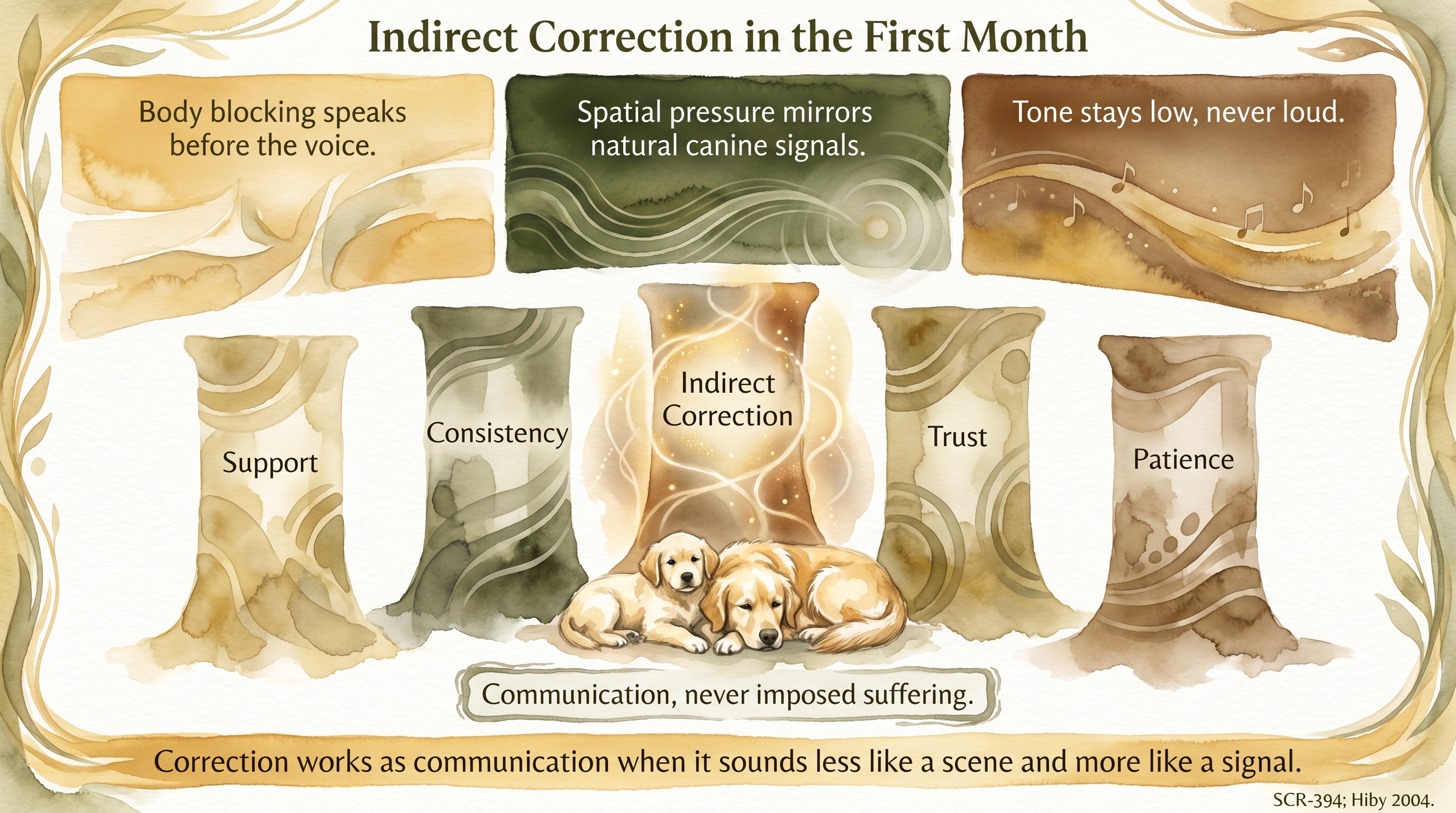
Correction works as communication when it sounds less like a scene and more like a signal.
Key Takeaways
- Indirect correction gives families a full early boundary vocabulary without requiring punishment.
- Body blocking, spatial pressure, calm vocal markers, and quiet disengagement all communicate clearly when they stay emotionally neutral.
- JB is honest that some of these mechanics can be described in operant terms, while still insisting that relational context changes the lived outcome.
- The first month should teach the puppy that correction can be readable and safe rather than loud or frightening.
The Evidence
- Byosiere et al. (2016); Firnkes et al. (2017); Horowitz (2009); Goodwin et al. (1997)domestic dogs and comparative canids
Dogs use postural change, distance-regulating behavior, disengagement, and ritualized signals to manage access, conflict, and social pressure without constant physical escalation. - Hiby et al. (2004); Herron et al. (2009); Vieira de Castro et al. (2020); Ziv (2017)domestic dogs
Punishment-heavy and aversive methods carry measurable welfare costs, supporting the need for low-threat alternatives when families need to set boundaries.
- JB transition practicefamily-raised puppies
Families who use body blocking, calm vocal markers, spatial pressure, and quiet disengagement as their primary correction language usually get clearer early boundaries with less emotional fallout than families who either punish hard or do nothing.
No published study directly tests the specific Just Behaving guidance on indirect correction in the first month within a breeder-to-family transition, so this entry relies on broader canine evidence, breeder observation, and practical synthesis rather than a direct trial of the full protocol.
SCR References
Sources
- Byosiere, S.-E., Espinosa, J., & Smuts, B. (2016). Investigating the function of play bows in adult pet dogs (Canis lupus familiaris). Behavioural Processes, 125, 106-113. https://doi.org/10.1016/j.beproc.2016.02.007
- Firnkes, A., Bartels, A., Bidoli, E., & Erhard, M. (2017). Appeasement signals used by dogs during dog-human communication. Journal of Veterinary Behavior, 19, 35-44. https://doi.org/10.1016/j.jveb.2016.12.012
- Horowitz, A. (2009). Attention to attention in domestic dog (Canis familiaris) dyadic play. Animal Cognition, 12(1), 107-118. https://doi.org/10.1007/s10071-008-0175-y
- Goodwin, D., Bradshaw, J. W. S., & Wickens, S. M. (1997). Paedomorphosis affects agonistic visual signals of domestic dogs. Animal Behaviour, 53(2), 297-304. https://doi.org/10.1006/anbe.1996.0370
- Hiby, E. F., Rooney, N. J., & Bradshaw, J. W. S. (2004). Dog training methods: Their use, effectiveness and interaction with behaviour and welfare. Animal Welfare, 13(1), 63-69.
- Herron, M. E., Shofer, F. S., & Reisner, I. R. (2009). Survey of the use and outcome of confrontational and non-confrontational training methods in client-owned dogs showing undesired behaviors. Applied Animal Behaviour Science, 117(1-2), 47-54. https://doi.org/10.1016/j.applanim.2008.12.011
- Vieira de Castro, A. C., Fuchs, D., Morello, G. M., Pastur, S., de Sousa, L., & Olsson, I. A. S. (2020). Does training method matter? Evidence for the negative impact of aversive-based methods on companion dog welfare. PLOS ONE, 15(12), e0225023. https://doi.org/10.1371/journal.pone.0225023
- Ziv, G. (2017). The effects of using aversive training methods in dogs - A review of the current evidence. Journal of Veterinary Behavior, 19, 50-60.