Adolescent Exercise: Quality Over Quantity
The adolescent dog needs more movement than the puppy. That part is true. Where families go wrong is assuming that more movement means more intensity. They see a larger, more energetic dog and answer with harder running, longer fetch, more high-speed output, and whatever else seems likely to empty the tank.
JB thinks that is often the wrong question. Observed-JB The better question is not, How much exercise can this dog survive? It is, What kind of exercise moves this dog toward calm, durable adulthood?
What It Means
Quality Before Quantity
For JB, exercise quality means movement that supports the body and the nervous system at the same time. That usually looks like steady walking rather than frantic sprinting, varied terrain rather than repetitive straight-line pounding, environmental exploration rather than obsessional repetition, self-regulated motion rather than forced pace, and moderate retrieve or swim opportunities rather than endless arousal loops.
A forty-minute calm walk can do more developmental good than a shorter burst of intensity that leaves the dog fitter but more activated. Observed-JB
Why More Intensity Often Backfires
High-intensity exercise can create the illusion of improvement because the dog looks tired afterward. Observed-JB But tired is not always regulated.
Some adolescent dogs become calmer with appropriate movement. Others become physically fatigued and behaviorally more charged because the exercise itself has elevated sympathetic tone. The body got a workout. The nervous system got practice living higher.
This is one reason JB is suspicious of exercise plans built around chasing exhaustion. A dog can be drained and still not be settled.
The Orthopedic Side Still Matters
This page sits next to the growth-plate page for a reason. Exercise quality is not only about arousal. It is also about physical maturity. A calmer, lower-impact program respects the fact that adolescence is still a growing period.
A young dog who spends months doing repetitive high-arousal work is paying both nervous-system cost and potential structural cost. Observed-JB JB would rather spend those months building mileage, body awareness, and calmer environmental participation.
The Parasympathetic Walk as the Main Tool
The parasympathetic walk remains the backbone of adolescent exercise in JB. It is long enough to matter, calm enough to regulate, and gives the dog a job that resembles adult companionship rather than an athletic event. It exposes the dog to the real world in a state closer to the state we actually want. That does not mean every walk is perfect or every adolescent moves beautifully. It means the family is not accidentally training the dog to believe that exercise always arrives as speed and frenzy.
What About Fetch and High-Energy Games
They are not automatically forbidden. They are simply demoted.
Brief, thoughtful retrieve games can be fine. Endless repetitive retrieve, especially on hard surfaces or in a state of obsession, is a different thing. The same is true of rough running and intense chase games. JB wants movement to enrich and regulate the dog, not to teach the dog that the main form of fun is sympathetic escalation.
Why It Matters for Your Dog
Families usually think exercise is a way of solving adolescence. JB thinks it is a way of shaping adolescence.
If exercise teaches the dog to live in charge, the family will own a highly conditioned version of the same dysregulation problem.
If exercise teaches the dog to move through the world with steadier body and steadier nervous system, the family is building the adult it actually wants.
That is why quality comes first. The dog needs movement, but it needs the right kind of movement.
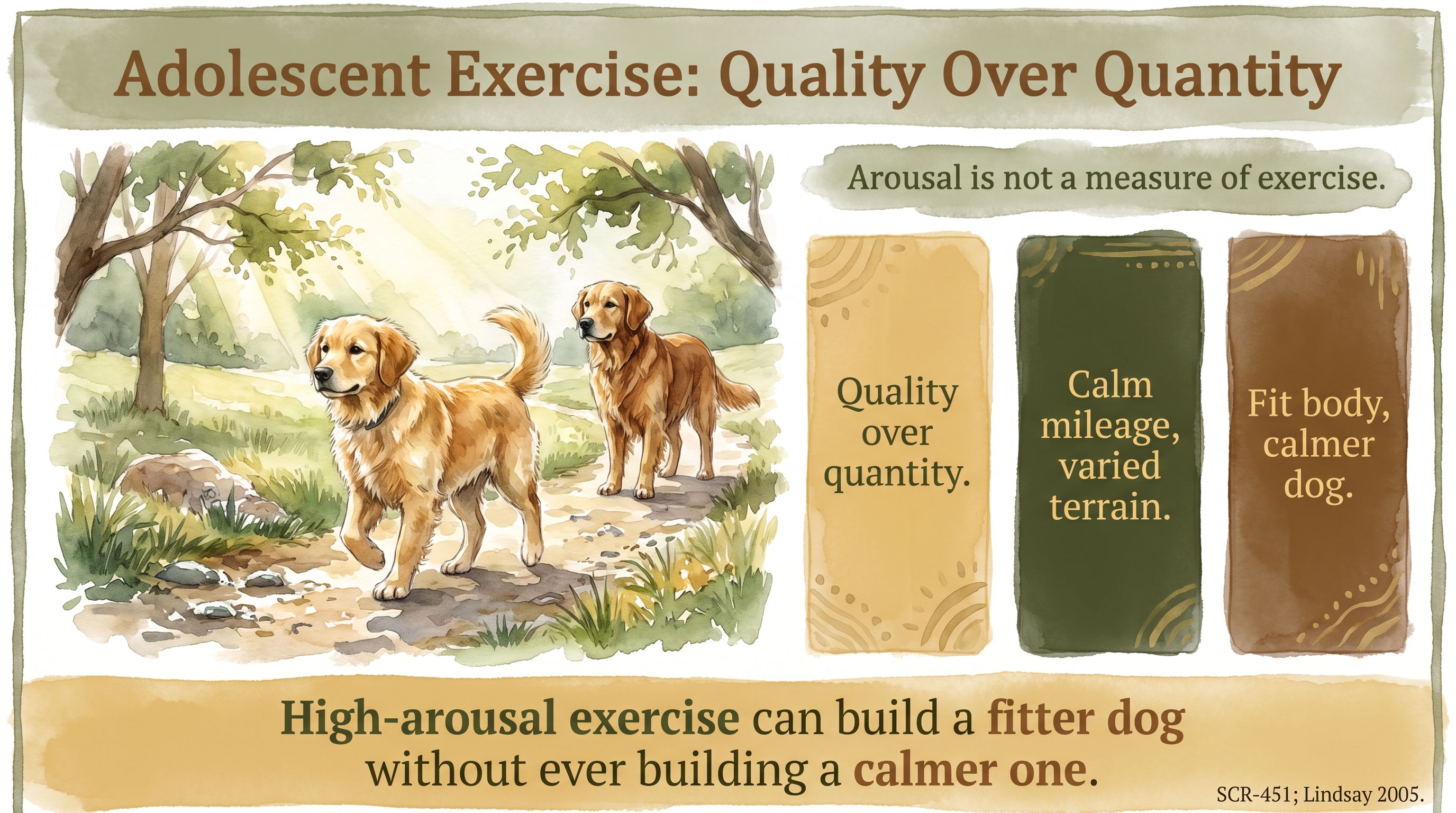
High-arousal exercise can build a fitter dog without ever building a calmer one.
Key Takeaways
- Adolescent exercise should be judged by what it builds, not only by how thoroughly it exhausts the dog in the moment.
- JB prefers calm mileage, varied terrain, and self-regulated movement over repeated high-intensity output.
- High-arousal exercise can create a fitter dog without creating a calmer one.
- Exercise quality matters for both orthopedic development and behavioral regulation.
The Evidence
- Yerkes-Dodson framing in dogsdomestic dogs
Higher arousal does not endlessly improve behavior or performance. Beyond the usable zone it degrades regulation. - orthopedic development literaturedomestic dogs
Exercise choices during growth affect structural load and should not be treated as behavior-only decisions.
- JB breeder observationGolden Retrievers
Adolescents tend to do better on longer calm movement and environmental exploration than on repeated high-intensity exertion aimed at exhaustion. - JB household practicefamily dogs
The parasympathetic walk remains the primary exercise tool because it supports both regulation and ordinary companionship.
- JB synthesisfamily dogs
The right adolescent exercise plan should produce a dog that is more settled after weeks and months, not only a dog that is tired for an hour.
No published study directly tests the practical implications of adolescent exercise: quality over quantity for domestic dog raising programs. The application to household dog raising remains an interpretive synthesis rather than a directly tested intervention finding.
SCR References
Sources
- Asher, L., England, G. C. W., Sommerville, R., & Harvey, N. D. (2020). Teenage dogs? Evidence for adolescent-phase conflict behaviour and an association between attachment to humans and pubertal timing in the domestic dog. Biology Letters, 16(5), 20200097. https://doi.org/10.1098/rsbl.2020.0097
- Kinsman, R., Owczarczak-Garstecka, S., Casey, R., Knowles, T., Tasker, S., Woodward, J., Da Costa, R., & Murray, J. (2020). Sleep duration and behaviours: A descriptive analysis of a cohort of dogs up to 12 months of age. Animals, 10(7), 1172. https://doi.org/10.3390/ani10071172
- Kealy, R. D., Lawler, D. F., Ballam, J. M., Mantz, S. L., Biery, D. N., Greeley, E. H., Lust, G., Segre, M., Smith, G. K., & Stowe, H. D. (2002). Effects of diet restriction on life span and age-related changes in dogs. Journal of the American Veterinary Medical Association, 220(9), 1315-1320. https://doi.org/10.2460/javma.2002.220.1315
- Smith, G. K., Paster, E. R., Powers, M. Y., Lawler, D. F., Biery, D. N., Shofer, F. S., McKelvie, P. J., & Kealy, R. D. (2006). Lifelong diet restriction and radiographic evidence of osteoarthritis of the hip joint in dogs. Journal of the American Veterinary Medical Association, 229(5), 690-693. https://doi.org/10.2460/javma.229.5.690
- Bray, E. E., MacLean, E. L., & Hare, B. A. (2015). Context specificity of inhibitory control in dogs. Animal Cognition, 18(1), 15-31. https://doi.org/10.1007/s10071-015-0901-1
- Beerda, B., Schilder, M. B. H., van Hooff, J. A. R. A. M., de Vries, H. W., & Mol, J. A. (1998). Behavioural, saliva cortisol and heart rate responses to different types of stimuli in dogs. Applied Animal Behaviour Science, 58(3-4), 365-381. https://doi.org/10.1016/S0168-1591(97)00145-7