Meeting Strangers in the First Month
Stranger exposure is one of the easiest first-month topics to get wrong because the wider culture uses the word socialization as if it means "let everyone greet the puppy." JB makes a sharper distinction. Exposure to people matters. Forced interaction does not. The first month should teach the puppy that unfamiliar people are calm, neutral, and non-threatening, not that strangers automatically create a performance. Observed-JB
What It Means
When most people imagine a well-socialized puppy, they imagine a puppy that runs toward everyone. Observed-JB
JB imagines something different: a puppy who can notice strangers without strain, a puppy who does not need to launch into them, and a puppy who can choose contact without pressure.
That difference is important because neutrality is far more durable than excitement.
Exposure Is Not Forced Interaction
The puppy can learn a great deal from seeing people calmly at a distance.
It does not need: every passerby to bend over it, every visitor to talk at face level, and every child in a store to touch it. Observed-JB
Those moments are often described as "good socialization" when they are actually just social intensity.
How Puppies Read Stranger Encounters
Puppies do not only read the strangers themselves. They also read the family during the encounter.
If the adults tense up, chirp, encourage, coax, or over-manage, the puppy learns that stranger moments are important events. If the adults stay calm and let the puppy orient at its own pace, the puppy learns that strangers can simply exist in the environment without demanding anything. Observed-JB
That is the baseline JB wants.
The Practical Script
Most families need an actual sentence here.
The cleanest one is something like:
"Please let her come to you if she wants, and if she doesn't that's fine."
That sentence protects the puppy, the family, and the stranger all at once.
It also trains the adults to stop making the puppy responsible for meeting other people's expectations.
Why Neutrality Beats Enthusiasm
Dogs who stay calm around people in adulthood are rarely the dogs who were taught that every new person was exciting. More often, they were puppies who learned that unfamiliar humans were part of the world, not the center of it.
That is not anti-social.
It is pro-stability.
Why It Matters for Your Dog
Stranger meetings matter because they become self-reinforcing quickly. If the puppy learns that unfamiliar people predict high voices, bent bodies, touch, and excitement, it begins seeking or bracing for that whole package. Observed-JB If the puppy learns that strangers are mostly calm, the nervous system starts from a quieter place in every later encounter.
The adults do not owe the world an accessible puppy. Their job is to help the puppy learn that unfamiliar people can exist without pressure, performance, or social flooding.
This page often relieves families more than they expect. They do not have to produce a puppy who loves everyone in month one. They only have to avoid teaching the puppy that every stranger is an event.
That alone does a great deal to protect later confidence.
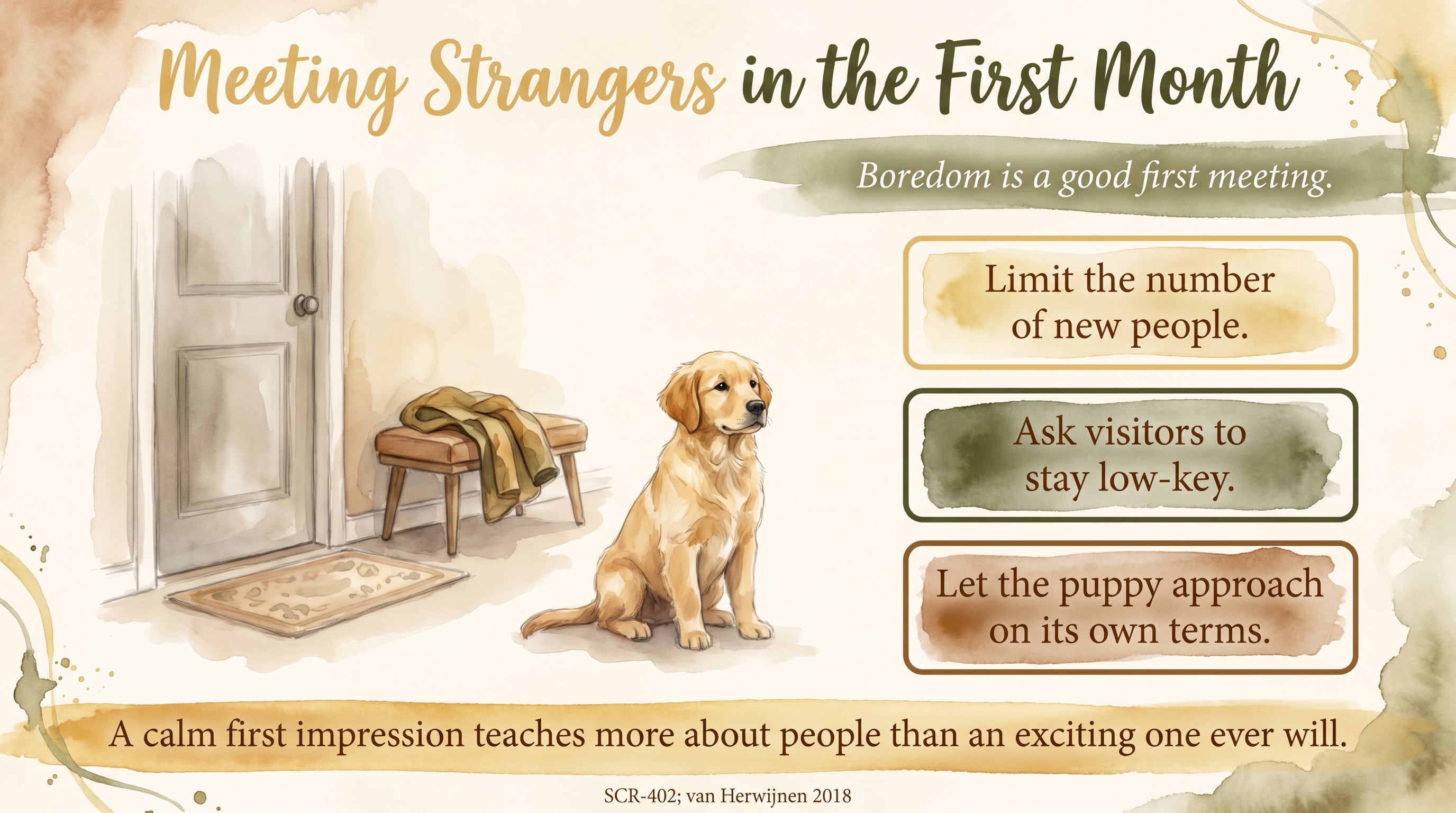
A calm first impression teaches more about people than an exciting one ever will.
Key Takeaways
- Socialization with people does not require strangers to greet the puppy enthusiastically.
- The first-month goal is neutrality and safety, not a puppy who performs sociability for everyone it meets.
- Families help most by staying calm themselves and allowing the puppy to approach or not approach without pressure.
- A dog that is neutral to strangers in adulthood often began as a puppy whose first stranger encounters were low-drama and optional.
The Evidence
- Freedman et al. (1961); Scott & Fuller (1965); Morrow et al. (2015); Howell et al. (2015)domestic dogs
Early controlled exposure to people matters developmentally, but the literature does not require enthusiastic, high-intensity greeting as the form that exposure must take. - Vaterlaws-Whiteside & Hartmann (2017); Stolzlechner et al. (2022); Howell et al. (2015); Freedman et al. (1961)domestic dogs
Puppies frightened by people in early life showed worse stranger-related outcomes later, reinforcing the importance of how human exposure is handled during development.
- JB transition practicefamily-raised puppies
Calm observation at a manageable distance and optional interaction produce steadier stranger baselines than enthusiastic greeting rituals that flood the puppy's channel with arousal.
No published study directly tests the specific Just Behaving guidance on meeting strangers in the first month. This entry relies on broader canine evidence, breeder observation, and practical synthesis.
SCR References
Sources
- Freedman, D. G., King, J. A., & Elliot, O. (1961). Critical period in the social development of dogs. Science, 133(3457), 1016-1017.
- Scott, J. P., & Fuller, J. L. (1965). Genetics and the Social Behavior of the Dog. University of Chicago Press.
- Morrow, M., Ottobre, J. S., Ottobre, A. C., Neville, P., St-Pierre, N., Dreschel, N. A., & Pate, J. L. (2015). Breed-dependent differences in the onset of fear-related avoidance behavior in puppies. Journal of Veterinary Behavior, 10(4), 286-294. https://doi.org/10.1016/j.jveb.2015.03.002
- Howell, T. J., King, T., & Bennett, P. C. (2015). Puppy parties and beyond: The role of early age socialization practices on adult dog behavior. Veterinary Medicine: Research and Reports, 6, 143-153. https://doi.org/10.2147/VMRR.S62081
- Vaterlaws-Whiteside, H., & Hartmann, A. (2017). Improving puppy behavior using a new standardized socialization program. Applied Animal Behaviour Science, 197, 55-61.
- Stolzlechner, L., Bonorand, A., & Riemer, S. (2022). Optimising Puppy Socialisation-Short- and Long-Term Effects of a Training Programme during the Early Socialisation Period. Animals, 12(22), 3067. https://doi.org/10.3390/ani12223067