Habituation
Habituation is the gradual reduction of response to a repeated stimulus that turns out to be unimportant. It is one of the simplest forms of learning and one of the most important for puppies. When a sound, surface, person, or ordinary household event keeps showing up without harm, the nervous system can learn that it does not deserve a full alarm response every time. Documented
What It Means
Habituation is called non-associative learning because the animal is not necessarily learning a cue-reward or cue-threat relationship. The animal is learning something simpler: this repeated thing is not significant enough to keep reacting to at the original intensity. Classic features of habituation include decreased response across repetition, stronger habituation to low-intensity than overwhelming stimuli, recovery of response after time passes, and faster rehabituation if the stimulus returns. It is important to distinguish habituation from sensory adaptation. Sensory adaptation is a change in the receptors themselves, such as eyes adjusting to light. Documented Habituation is a learning process in the nervous system. The animal is not merely sensing less. The animal is learning to respond less.
In dogs, the most developmentally important place habituation shows up is the socialization window. During roughly 3 to 14 weeks, puppies are unusually able to form broad safe associations with novelty. Estimated That does not mean every exposure is good. It means the nervous system is especially open to learning what belongs to ordinary life.
This is why exposure quality matters. Calm, repeated, manageable exposure gives habituation a chance to develop. High-intensity flooding can do the opposite and tip the system toward sensitization instead.
The socialization-window literature also helps correct a common misunderstanding. Documented Habituation is not about maximizing volume, quantity, or spectacle. It is about giving the puppy enough neutral or positive contact with ordinary life that the ordinary becomes unremarkable.
Why It Matters for Your Dog
Habituation is part of how a dog learns that the world is livable.
Vacuum cleaners, dishwashers, footsteps, visitors, car rides, surfaces, grooming routines, and neighborhood sounds do not have to remain emotionally expensive. But they usually stop being expensive through ordinary calm repetition, not through a single dramatic proving session.
Good habituation is one reason calm, structured early exposure matters so much. The goal is not to overwhelm the puppy with novelty. The goal is to let novelty become ordinary before fear takes over the frame.
That is why the socialization window is so relevant here. A puppy that calmly habituates to normal household life during that period starts adulthood with a very different baseline than a puppy that meets the world mainly through startle, chaos, or overstimulation. Documented
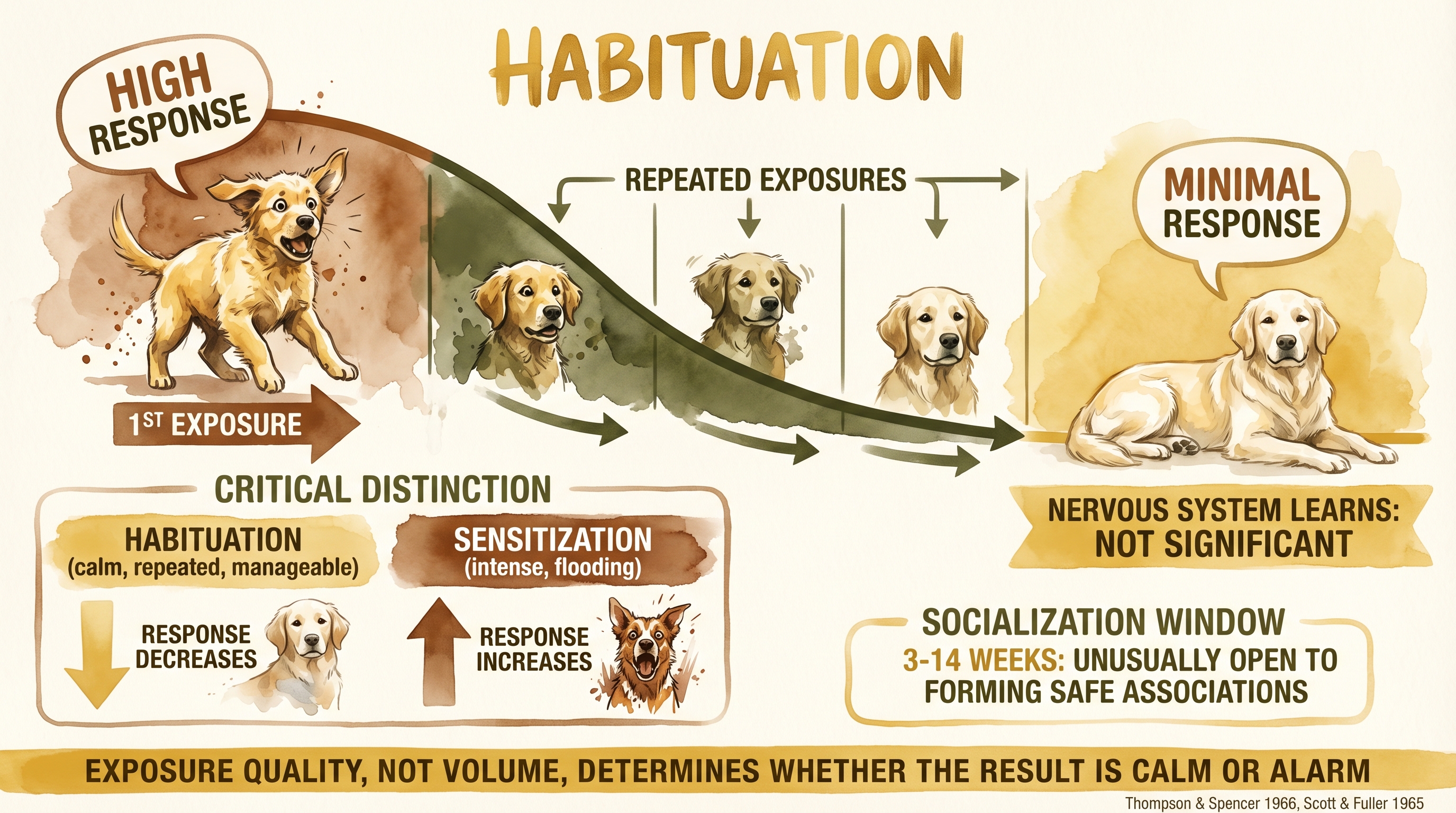
Habituation is the simplest form of learning - response strength declines with repeated exposure to insignificant stimuli.
Key Takeaways
- Habituation is learning to respond less to repeated, non-significant stimuli.
- It is not the same thing as sensory adaptation or emotional shutdown.
- The socialization window is a major developmental opportunity for habituation to ordinary life.
- Calm, manageable exposure supports habituation better than overwhelming stimulation does.
The Evidence
This entry uses estimated claim-level tags beyond the dedicated EvidenceBlocks below. These tags mark approximate ranges or timing claims that should remain bounded by the cited sources.
- Thompson, R. F., & Spencer, W. A. (1966)multiple species
Established the classic response features that distinguish habituation as a basic form of learning rather than mere sensory fatigue. - Rankin, C. H. et al. (2009)multiple species
Updated the operational characteristics of habituation across species and experimental contexts.
- Scott, J. P., & Fuller, J. L. (1965)domestic dogs
Foundational work on the puppy socialization period, showing that early exposure conditions strongly shape later responses to novelty. - Freedman, D. G., King, J. A., & Elliot, O. (1961)domestic dogs
Early experimental validation that puppies pass through a sensitive developmental period in which social and environmental exposures have disproportionate long-term effects. - Morrow, M. et al. (2015)domestic dogs
Showed breed-dependent timing in the onset of fear-related avoidance, reinforcing that the window for easy habituation is real but not identical across breeds.
No published study has directly compared optimal habituation methods or protocols during the socialization window to establish whether calm, structured exposure produces better long-term outcomes than other approaches.
SCR References
Sources
- Freedman, D. G., King, J. A., & Elliot, O. (1961). Critical period in the social development of dogs. Science, 133(3457), 1016-1017.
- Morrow, M., Ottobre, J. S., Ottobre, A. C., Neville, P., St-Pierre, N., Dreschel, N. A., & Pate, J. L. (2015). Breed-dependent differences in the onset of fear-related avoidance behavior in puppies. Journal of Veterinary Behavior, 10(4), 286-294.
- Rankin, C. H., Abrams, T., Barry, R. J., et al. (2009). Habituation revisited: An updated and revised description of the behavioral characteristics of habituation. Neurobiology of Learning and Memory, 92(2), 135-138.
- Scott, J. P., & Fuller, J. L. (1965). Genetics and the social behavior of the dog. University of Chicago Press.
- Thompson, R. F., & Spencer, W. A. (1966). Habituation: A model phenomenon for the study of neuronal substrates of behavior. Psychological Review.v