Acute vs Chronic Stress in Dogs
Stress is not a single thing. One of the most important distinctions in physiology is the difference between acute stress and chronic stress. Acute stress is brief, time-limited, and often adaptive. Chronic stress is stress that is repeated, prolonged, poorly resolved, or layered so densely that the organism does not recover cleanly between activations. In dogs, that distinction matters because the health and welfare consequences are much stronger on the chronic side than on the acute side. Documented
What It Means
Acute Stress
Acute stress is the normal short-term activation of the dog's stress systems in response to meaningful challenge. Novel places, mild restraint, transportation, training demand, social separation, or sudden sounds can all produce an acute response.
That response is not automatically harmful. In broad mammalian biology, short-term stress can be adaptive. Documented It reallocates attention and energy, and in some contexts may briefly sharpen certain forms of readiness. The important feature is that the challenge ends and the dog has enough conditions to return toward baseline.
Chronic Stress
Chronic stress is what happens when activation becomes a state rather than an event. That can happen because the stressor persists, stressors recur too frequently, the environment stays unpredictable, the dog cannot control or understand what is happening, or recovery periods are too short or too poor. Documented At that point, the issue is not just that the dog was stressed. The issue is that the stress-response machinery remains engaged often enough to start changing other systems.
Why Recovery Is the Real Divider
In practice, the line between acute and chronic stress is less about a stopwatch and more about recovery. Observed-JB A dog can have a meaningful acute cortisol spike and recover well. A dog can also experience a series of individually modest challenges that become physiologically chronic because the system never has time or safety to come down fully.
This is why transition contexts matter so much. SCR-060 documents that intake, transport, sheltering, and rehoming can raise cortisol markedly, with normalization depending on what happens next. Stable environments help. That does not mean all transitions are chronic stress by definition. It means transitions become risk periods when recovery is poor or instability continues.
The Chronic Side Is Where Costs Accumulate
The downstream evidence is most convincing on the chronic side. SCR-045 documents that chronic environmental stress in dogs alters immune-related outcomes. SCR-093 adds a more specific mucosal-immune piece by linking salivary cortisol and secretory IgA in canine stress contexts. Documented
Chronic stress can be accompanied by altered leukocyte profiles, changed mucosal immune markers, blunted T-cell expansion, higher apoptosis in immune cells, and broader allostatic burden. Documented These effects are strongest in documented chronic-stress paradigms such as sheltering, social restriction, adverse housing, and other sustained stress environments. The evidence is real, but it also needs the correct stress-type framing.
Acute Stress Is Not the Villain
One reason this page matters is that popular discussion often treats all stress as if it were equally pathological. That flattens the science too much.
Brief, resolved activation is part of ordinary mammalian life. Chronic unresolved activation is where the more serious physiological burdens accumulate. A dog should not be described as biologically damaged simply because it had a cortisol response to novelty or transport. The more useful question is whether the dog can recover, and whether the environment allows that recovery.
Why It Matters for Your Dog
The JB calmness argument is about preventing chronic overactivation, not about pretending dogs should never experience challenge. The physiology supports that distinction clearly.
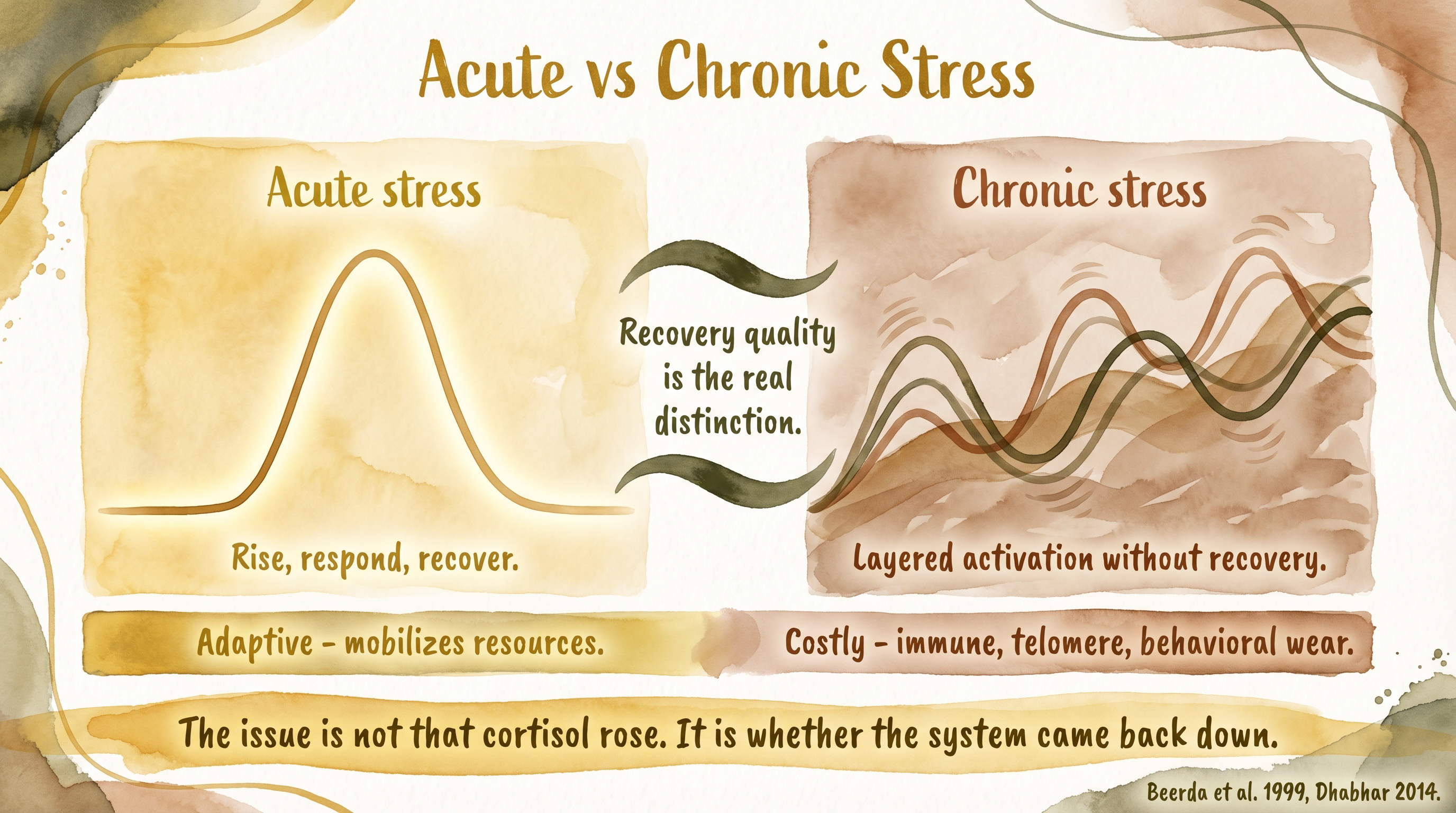
Acute stress mobilizes and recovers; chronic stress layers activation without return to baseline.
Key Takeaways
- Acute stress is brief and can be adaptive when recovery occurs cleanly.
- Chronic stress is repeated or sustained activation without adequate recovery.
- The major physiological costs in dogs, especially immune-related ones, appear most clearly on the chronic side.
- Recovery quality is often more informative than the mere fact that cortisol rose at all.
The Evidence
This entry uses observed claim-level tags beyond the dedicated EvidenceBlocks below. These tags mark JB program observation or practice-derived claims that need dedicated EvidenceBlock coverage in a later content pass.
- Hennessy, M. B. et al. (1997)domestic dogs
Shelter entry elevated cortisol, showing acute transition activation with trajectories that changed over time. - Beerda, B. et al. (1999)domestic dogs
Chronic social and spatial restriction altered hormonal and immunological measures in dogs. - Dudley, E. S. et al. (2015) and Kulka, M. et al. (2026)domestic dogs
Longer-duration adverse environments were accompanied by immune-marker shifts and altered cellular immune function. - Skandakumar, S. et al. (1995) and Svobodova, I. et al. (2014)domestic dogs
Cortisol and sIgA relationships in dogs support the link between stress physiology and mucosal immune dynamics.
- Dhabhar, F. S. (2009, 2014)multiple mammals
Differentiated adaptive short-term stress effects from the more suppressive or dysregulating consequences of chronic activation. - Sapolsky, R. M. et al. (2000)multiple mammals
Explained how glucocorticoid actions differ across context, timing, and chronicity.
- SCR-045 and SCR-015 boundariesdomestic dogs
The strongest chronic-stress evidence in dogs comes from documented adverse-environment paradigms and should not be silently rewritten as proof about every kind of household excitement or stimulation.
No published study has measured the long-term behavioral and physiological recovery trajectories in dogs transitioning from chronic to stable environments, making it difficult to quantify how rapidly the chronic stress signature resolves.
No controlled study in dogs has isolated the effect of gradual versus sudden environmental improvement on recovery time or long-term stress physiology.
SCR References
Sources
- Beerda, B., et al. (1999). Chronic stress in dogs subjected to social and spatial restriction. II. Hormonal and immunological responses. Physiology & Behavior.
- Dhabhar, F. S. (2009). Enhancing versus suppressive effects of stress on immune function. Neuroimmunomodulation.
- Dhabhar, F. S. (2014). Effects of stress on immune function: the good, the bad, and the beautiful. Immunologic Research.
- Dudley, E. S., et al. (2015). Effects of repeated petting sessions on leukocyte counts, parasite prevalence, and plasma cortisol concentration of dogs housed in a county animal shelter. JAVMA.
- Hennessy, M. B., et al. (1997). Plasma cortisol levels of dogs at a county animal shelter. Physiology & Behavior.
- Kulka, M., et al. (2026). Stress-related immunomodulation of canine lymphocyte responses and hematologic profiles. International Journal of Molecular Sciences.
- Sapolsky, R. M., Romero, L. M., & Munck, A. U. (2000). How do glucocorticoids influence stress responses? Endocrine Reviews, 21(1), 55-89.