Yerkes-Dodson and Arousal-Performance Curves
The Yerkes-Dodson relationship is the classic idea that performance changes with arousal in an inverted-U pattern. Too little activation can mean disengagement. Too much can mean dysregulation or loss of control. Somewhere in between lies the best zone for a given task. In dogs, the relationship is supported in a bounded way: arousal can help or harm depending on baseline temperament, task type, and when the arousal occurs. Documented-Cross-Species
What It Means
The Original Idea
The original 1908 Yerkes-Dodson work was not dog research. It came from mice and showed that the relation between arousal and performance depends partly on task difficulty. Simpler tasks may tolerate more activation than complex ones. Harder tasks usually deteriorate sooner when arousal becomes too high. Documented-Cross-Species
Modern discussion often compresses this into a simple inverted-U, which is useful as long as it is not treated as a universal exact curve. Observed-JB
What It Looks Like in Dogs
The dog literature keeps the same basic intuition but adds an important twist: baseline state matters. SCR-047 captures that increased arousal can improve performance in calmer dogs while impairing inhibitory control or learning in more excitable dogs. Documented
That means the question is not "is arousal good or bad?" The question is "where is this dog starting from, what task is being asked, and when is the arousal happening?"
Bray and colleagues showed that more excitable dogs were more likely to degrade under added activation, while lower-baseline dogs could sometimes benefit. Later work on post-training arousal and retention added another timing nuance: arousal immediately after learning can affect consolidation differently than arousal during learning itself.
Why Task Complexity Changes the Curve
The inverted-U idea becomes more understandable when tasks are separated by demand. Simple motor output may tolerate more activation, inhibitory control fails earlier at high arousal, discrimination and flexible learning degrade when the dog is too activated, and memory consolidation can be influenced differently before, during, and after acquisition. Documented
This is why "high energy improves performance" is too broad. High energy may improve output in one context while impairing cognition in another.
Why It Matters for Your Dog
Baseline Matters More Than the Stimulus Alone
One of the most important implications of SCR-047 is that the same added arousal can have opposite effects in different dogs. Documented A dog beginning from a calm, low-arousal state may still be inside its functional zone when activation rises. A dog that already runs hot may be pushed over the top by the very same event.
That makes arousal-performance science inherently individualized. It also helps explain why some dogs seem to "work better excited" while others appear to fall apart under the same level of stimulation. The relevant variable is not just the event. It is event plus baseline plus task.
Why This Matters for Learning and Welfare
The behavioral-science conclusion is modest but important: if a dog is learning, inhibiting, problem solving, or being asked to regulate itself at the top of its arousal range, it is operating below its real cognitive ceiling. That is not ideology. It is a performance principle.
This is also why window-of-tolerance language became so useful in applied settings. The phrase is broader than Yerkes-Dodson, but the overlap is real. Both frameworks are trying to describe the zone in which the organism remains behaviorally available rather than shut down, scattered, or overactivated.
The pillar layer uses this science to argue for building a calm floor first. This page keeps the claim narrower: canine performance changes with arousal in ways that depend on baseline temperament, task type, and timing.
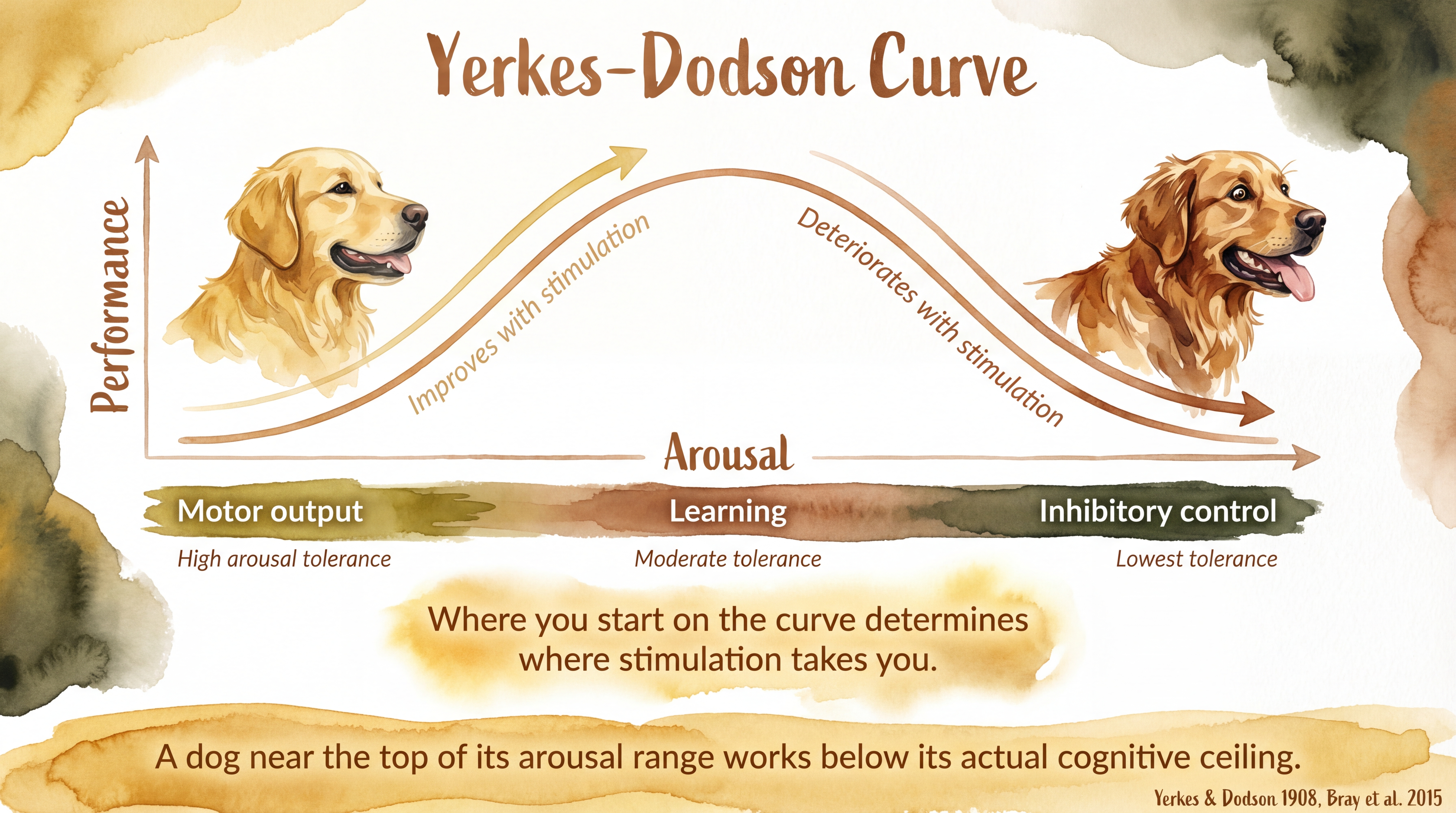
Performance peaks at moderate arousal and degrades at both extremes - the inverted-U that explains why calm dogs learn better.
Key Takeaways
- The Yerkes-Dodson model says performance depends on arousal, but the relationship is not one-size-fits-all.
- In dogs, higher arousal can help calmer dogs and impair more excitable dogs.
- Task complexity and timing matter, especially for inhibition and learning.
- A dog working near the top of its arousal range is often operating below its actual cognitive ceiling.
The Evidence
This entry uses observed claim-level tags beyond the dedicated EvidenceBlocks below. These tags mark JB program observation or practice-derived claims that need dedicated EvidenceBlock coverage in a later content pass.
- Yerkes, R. M., & Dodson, J. D. (1908)mice
Introduced the classic arousal-performance relationship and showed that task difficulty modifies the shape of the effect.
- Bray, E. E., MacLean, E. L., & Hare, B. (2015)domestic dogs
Arousal improved some performance outcomes in calmer dogs but impaired inhibitory control in more excitable dogs. - Affenzeller, N. et al. (2017, 2020)domestic dogs
Showed that arousal timing matters, with different effects before, during, and after learning. - Collins-Pisano, C. et al. (2025)domestic dogs
Showed that post-training heart-rate and arousal effects differed by the dog's baseline arousal profile.
- SCR-047 boundarydomestic dogs
The relevant effect is not a one-size-fits-all arousal optimum. Baseline temperament, task complexity, and timing all change how activation affects performance.
No study has systematically measured the Yerkes-Dodson relationship (arousal-performance curve) across the full range of canine personalities and task difficulties in a large dog sample.
No longitudinal study has tracked whether a dog's optimal arousal level for performance remains stable or shifts as the dog develops from puppyhood through adulthood.
SCR References
Sources
- Affenzeller, N., et al. (2017). Post-training arousal enhances memory consolidation in companion dogs. Applied Animal Behaviour Science, 196, 76-82.
- Affenzeller, N., et al. (2020). Post-training arousal, learning task complexity, and consolidation in domestic dogs. Frontiers in Veterinary Science, 7, 579506.
- Bray, E. E., MacLean, E. L., & Hare, B. (2015). Context specificity of inhibitory control in dogs. Animal Cognition, 18(6), 1317-1329.
- Collins-Pisano, C., et al. (2025). Post-training heart rate recovery predicts retention differently in high- and low-arousal dogs. Journal of Applied Behavior Analysis.
- Yerkes, R. M., & Dodson, J. D. (1908). The relation of strength of stimulus to rapidity of habit formation. Journal of Comparative Neurology and Psychology, 18, 459-482. https://doi.org/10.1002/cne.920180503