Attachment Research in Dogs
Compound evidence detail1 SCR / 2 parts
- Documentedthe human attachment evidence base together with the canine-direct secure-base findings (Topal 1998, Horn 2013) and Schoberl-documented physiological effects of secure caregiving in dogs
- Heuristicthe full attachment-theory apparatus transfer to canine relationships, including internal working models and attachment-classification systems
Attachment research in dogs asks a precise question: do dogs treat human caregivers as true attachment figures, or do they simply prefer familiar people because those people are useful, rewarding, or routine? The modern answer is that dogs do form attachment bonds functionally analogous to infant-caregiver bonds, and that those bonds change exploration, reunion behavior, and stress regulation in measurable ways. Documented
That answer matters because attachment science is more specific than affection. A dog that is fond of a person is not necessarily attached to that person in the Bowlby-Ainsworth sense. Attachment research looks for a patterned system: proximity seeking under strain, distress on separation, recovery on reunion, and freer exploration when the caregiver is present. The dog literature now documents that system.
What It Means
Attachment theory began in human developmental psychology, but its logic was always ethological. Bowlby argued that attachment is a behavioral system shaped by evolution in young, dependent mammals. The caregiver is not important only because the caregiver provides food. The caregiver organizes security. When the young organism feels uncertain, tired, threatened, or overloaded, it seeks contact. When the caregiver is available and reliable, exploration becomes possible again.
Ainsworth turned that theory into an observable method. In the Strange Situation Procedure, the question was not whether the infant "liked" the caregiver. The question was whether the caregiver altered behavior in a coherent way across separation, reunion, and novelty. That operational move is why attachment science became so influential. It translated a broad developmental theory into measurable behavior.
Canine attachment research inherits that same structure. Documented The core claim is not that dogs love their caregivers. It is that dogs use caregivers as a secure base for exploration and as a safe haven under stress. If that is true, then the relationship should show up in standardized testing and in real-world outcomes.
How the Human Framework Was Adapted to Dogs
The foundational canine turn came with Topal and colleagues in 1998, who adapted Ainsworth's Strange Situation for dog-human dyads. The basic idea was elegant. Place the dog in an unfamiliar environment. Vary the presence and absence of the attachment figure and a stranger. Watch whether reunion behavior, proximity seeking, contact maintenance, and exploration differ depending on who is present. Documented
The adapted procedure showed that dogs did not respond to caregivers as if caregivers were simply familiar people. They behaved toward caregivers in attachment-relevant ways. In later work, Horn and colleagues demonstrated the secure-base effect even more directly: dogs explored and engaged more effectively with a challenging task when the attachment figure was present than when they were alone or with another person.
That matters because attachment is not measured only by clinginess. A secure attachment often looks like balanced outward movement. The attached dog is not necessarily glued to the caregiver. Instead, the caregiver's presence makes exploration safer.
Subsequent work widened the picture. Solomon and colleagues adapted attachment-classification procedures more rigorously and showed that canine attachment patterns can be coded with substantial inter-rater agreement. Thielke and Udell extended secure-base testing into shelter and foster contexts. Schoberl and colleagues linked attachment quality to cortisol reactivity. Brubaker and Udell showed that caregiving style covaries with both attachment-related behavior and problem-solving persistence. Across designs and settings, the same basic conclusion holds: the dog-human bond is not only social preference. It has the structure and consequences of attachment.
What the Dog Literature Shows
Several findings are now on firm ground.
First, dogs form attachment bonds that are functionally analogous to infant-caregiver bonds. That does not mean dogs are human infants, and it does not mean every detail of human attachment theory transfers unchanged across species. It means the central behavioral architecture is present: dogs differentiate caregiver from stranger, use the caregiver as a secure base, and show attachment-relevant reunion and separation responses.
Second, attachment quality predicts more than reunion enthusiasm. Dogs that test as more secure tend to show stronger exploratory balance, better task persistence, and lower stress reactivity in standardized settings. In other words, attachment is not a sentimental side variable. It is tied to how the dog regulates itself in the face of uncertainty.
Third, caregiving style matters. Human developmental psychology has long shown that consistent, predictable, sensitively responsive caregiving supports secure attachment. The dog literature now supports a bounded canine extension of that idea. Brubaker and Udell, Bouma and colleagues, and related caregiver-style studies show that warmth plus structure is associated with more secure attachment-like behavior and better behavioral outcomes in dogs. Documented
Fourth, the relationship variable continues to matter after puppyhood. Shelter, foster, and commercial-breeding research indicates that attachment-related patterns can still be measured in dogs living under highly variable conditions. Documented This is important because it means attachment science is not limited to ideal household pets. The bond remains behaviorally relevant in welfare-critical environments too.
Why It Matters for Your Dog
What Attachment Research Predicts
One reason attachment science matters so much is that it explains several different kinds of findings at once.
- exploration findings: a caregiver can increase confidence in a novel environment
- stress findings: secure attachment is associated with lower cortisol reactivity in standardized procedures
- reunion findings: dogs do not treat reunion as generic social excitement only
- outcome findings: caregiver style and relational quality covary with persistence, sociability, and some behavior-problem profiles
These are not separate stories that happen to point in the same direction. They are what attachment theory predicts a priori. If the caregiver functions as both secure base and safe haven, then exploration, stress recovery, and reunion organization should all shift together. That is why the convergence is meaningful.
The Five Pillars interpret this literature through the language of secure base, safe haven, and parental guidance. This page stays at the science layer: attachment research documents the bond architecture itself, while the pillar pages argue about what kind of raising best builds and maintains it.
Limits and Boundaries
The dog attachment literature is strong, but it is not limitless.
The first boundary is taxonomic. Saying that dogs form attachment bonds analogous to infant-caregiver bonds is not the same as saying that canine attachment is identical to human infant attachment in every respect. Dogs are a different species with a different social ecology, different developmental timetable, and different behavior repertoire. The analogy is functional, not total.
The second boundary is methodological. The existence of canine attachment behavior is documented. The stricter project of sorting every individual dog cleanly into the full Ainsworth typology remains less settled. Solomon's work significantly advanced this effort, but the field still includes debate about category stability, order effects, canine-specific instruments, and how far human-derived categories should be imported without revision.
The third boundary concerns mechanism. The literature documents secure-base effects, proximity seeking, reunion behavior, and stress buffering. It does not directly prove that dogs possess internal working models in the same sense human attachment theorists use that term. That stronger cognitive layer remains theoretical for canine application.
The fourth boundary is specific to JB. The claim that JB's raising methodology produces secure attachment at higher rates than industry-typical raising is not what the current literature has directly tested. Heuristic The science supports the importance of attachment, caregiver consistency, and regulatory presence. The stronger "our method yields more secure dogs" claim remains a separate empirical question.
No published comparative trial has directly tested whether JB-style raising produces measurably higher secure-attachment rates in puppies than standard or alternative breeding/transition approaches.
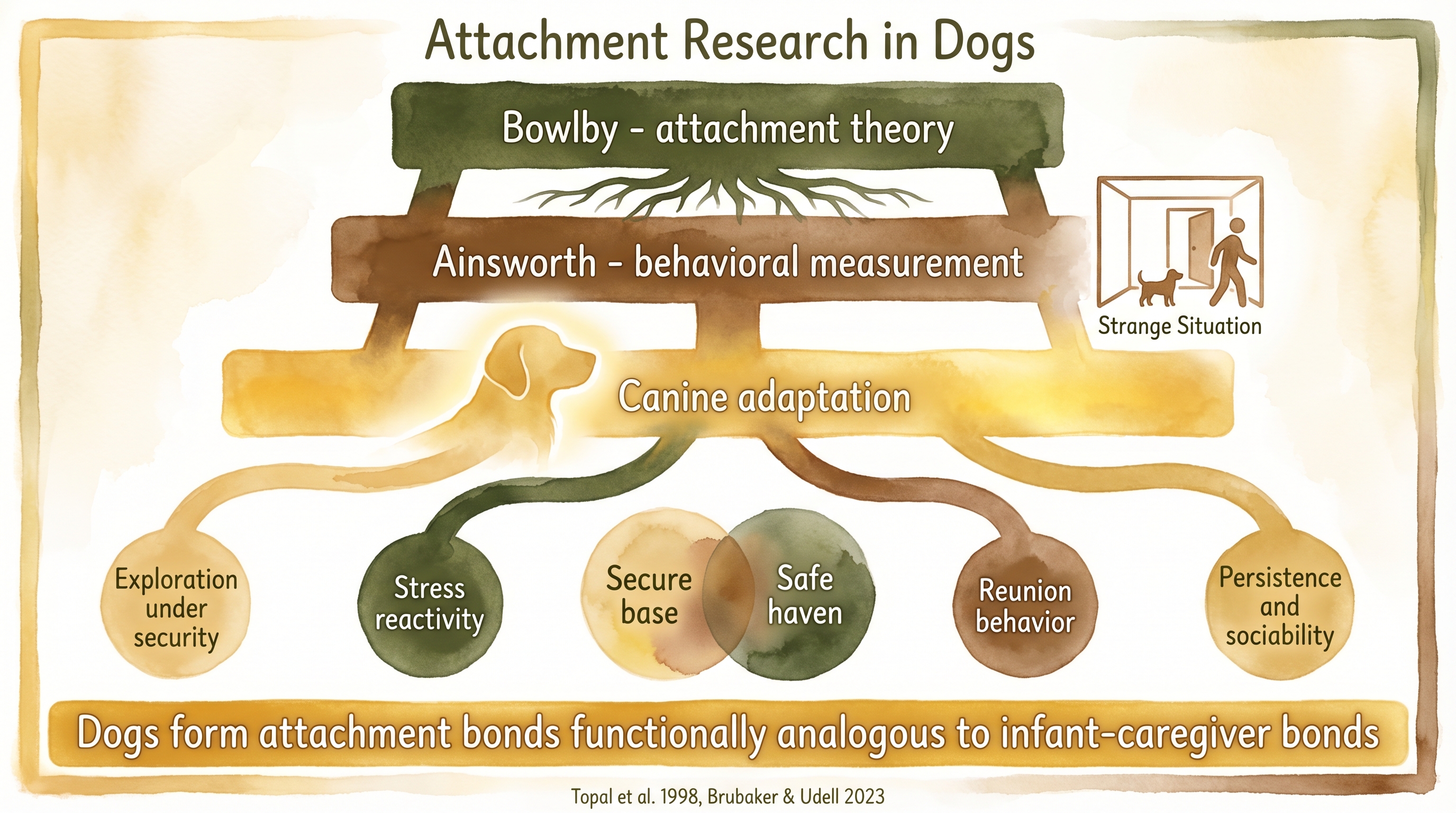
Two decades of research confirm dogs form genuine attachment bonds measurable through standardized protocols.
Key Takeaways
- Dogs form attachment bonds with caregivers that are functionally analogous to infant-caregiver bonds.
- The core documented outputs are proximity seeking, reunion organization, secure-base exploration, and stress buffering.
- Attachment research in dogs measures more than affection. It measures how the caregiver changes behavior under novelty and strain.
- The broader attachment framework is strong, but exact human-style category transfer and JB-specific outcome claims still require tighter evidence boundaries.
The Evidence
- Topal, J. et al. (1998)domestic dogs
Adapted Ainsworth's Strange Situation to dogs and showed attachment-relevant behavior toward owners rather than undifferentiated familiarity responses. - Horn, L., Huber, L., & Range, F. (2013)domestic dogs
Documented a secure-base effect in dogs: owner presence changed exploration and task engagement in a novel setting. - Solomon, J. et al. (2018/2019)domestic dogs
Adapted attachment classification procedures for dogs and found substantial inter-rater agreement plus meaningful links to caregiver sensitivity and dog personality. - Schoberl, I. et al. (2016)domestic dogs and humans
Securely attached dogs showed lower cortisol reactivity during Strange Situation stress procedures. - Thielke, L. E., & Udell, M. A. R. (2019)domestic dogs
Secure-base testing in shelter and foster contexts linked attachment security to lower neuroticism and stronger task persistence. - Brubaker, L., & Udell, M. A. R. (2023)domestic dogs
Owner caregiving style covaried with attachment security, sociability, and problem-solving performance.
- Bowlby, J. (1969)humans
Defined attachment as an organized behavioral system in which the caregiver functions as an anchor for protection and exploration. - Ainsworth, M. D. S. et al. (1978)humans
Operationalized attachment quality through separation, reunion, proximity seeking, and exploratory balance in the Strange Situation.
- SCR-017 boundarydomestic dogs and humans
Secure attachment from responsive care is one of the strongest findings in human developmental psychology; the full canine transfer is supported but not identical in method or mechanism. - Attachment source synthesisdomestic dogs
The existence of canine attachment behavior is documented, but strict four-category Ainsworth classification and internal-working-model language remain methodologically more tentative in dogs. - JB application boundarydomestic dogs
The stronger claim that JB-style raising produces secure attachment at higher rates than standard industry practice has not been directly tested.
SCR References
Sources
- Ainsworth, M. D. S., Blehar, M. C., Waters, E., & Wall, S. (1978). Patterns of attachment: A psychological study of the strange situation. Erlbaum.
- Bowlby, J. (1969). Attachment and loss. Vol. 1: Attachment. Basic Books.
- Brubaker, L., & Udell, M. A. R. (2023). Does pet parenting style predict the social and problem-solving behavior of pet dogs? Animal Cognition, 26(1), 345-356.
- Horn, L., Huber, L., & Range, F. (2013). The importance of the secure base effect for domestic dogs. PLoS ONE, 8(1), e65296.
- Schoberl, I., Beetz, A., Solomon, J., Gee, N., Kotrschal, K., & Wedl, M. (2016). Social factors influencing cortisol modulation in dogs during a strange situation procedure. Journal of Veterinary Behavior, 11, 77-85.
- Solomon, J., Beetz, A., Schoberl, I., Gee, N., & Kotrschal, K. (2018/2019). Attachment security in companion dogs: Adaptation of Ainsworth's strange situation and classification procedures to dogs and their human caregivers. Attachment & Human Development, 21(4), 389-417.
- Thielke, L. E., & Udell, M. A. R. (2019). Evaluating cognitive and behavioral outcomes in conjunction with the secure base effect for dogs in shelter and foster environments. Animals, 9(11), 932.
- Topal, J., Miklosi, A., Csanyi, V., & Doka, A. (1998). Attachment behavior in dogs (Canis familiaris): A new application of Ainsworth's Strange Situation Test. Journal of Comparative Psychology, 112(3), 219-229. https://doi.org/10.1037/0735-7036.112.3.219