Ectopic Ureters
Compound evidence detail2 SCRs / 7 parts
- DocumentedGolden Retriever over-representation in ectopic-ureter case series, anchored on the Holt and Moore 1995 175-case epidemiologic review and consistent with subsequent treatment-cohort occurrence patterns
- Documentedcanine-wide surgical and clinical findings - cystoscopic-guided laser ablation as current standard of care for intramural EU, intramural predominance at 91-96% across cohorts, urogenital comorbidity patterns, and Kaplan-Meier late-relapse trajectories
- Observed-JBthe Golden Retriever familial and heritable basis acknowledged by the GRCA and active Cambridge research, presented as ongoing inheritance-pattern investigation rather than as a documented genetic mechanism
- DocumentedEntlebucher Mountain Dog genetics including 65% heritability, 6 GWAS loci (Wiedmer 2015), and the 24% to 1.4% phenotype-screening reduction (Merz 2022), all within-EMD findings
- Heuristicany extension of EMD genetic architecture or screening success to Golden Retrievers - the breeds have different genetic architectures and EMD findings cannot be extrapolated to GR without breed-specific replication
- Documentedthe absence of any commercially validated, peer-reviewed DNA screening test for juvenile renal dysplasia or ectopic ureters in Golden Retrievers as of April 2026; downstream citations must carry an explicit date qualifier
- Observed-JBongoing GRCA, University of Cambridge, and Broad Institute research efforts soliciting samples and investigating inheritance patterns - presented as active research rather than as imminent test availability
Ectopic ureters are one of the clearest examples of a medical problem that can be mistaken for a behavior problem. A puppy who dribbles urine constantly, leaks while resting, or seems unable to stay dry despite patient housetraining may not need stricter management. That puppy may need a urinary workup. In Golden Retrievers, that is not a remote possibility. It is one of the breed's well-known congenital predispositions. Documented
What It Means
What the Condition Is
Normally, urine travels from the kidneys to the bladder through the ureters and enters the bladder at the trigone, where it can be stored until urination. In ectopic ureters, one or both ureters bypass that normal insertion point and open farther downstream, often into the urethra or reproductive tract. Observed-JB
The result is straightforward: some urine never reaches normal storage. It leaks.
The condition can involve one ureter or both, intramural ureters, which tunnel within the bladder wall before opening abnormally, and extramural ureters, which bypass the bladder wall more directly. Documented
In Golden Retrievers, intramural forms are especially important.
Why Goldens Matter
Goldens are one of the most predisposed breeds for ectopic ureters. Females are affected more often than males, which is clinically important because the classic presentation is a female puppy who is loving, bright, and otherwise normal but never truly dry.
This is why the condition has such practical relevance for breeders and families. It shows up at exactly the stage when everyone is already thinking about housebreaking. If the medical possibility is missed, the puppy can be treated as stubborn, delayed, or poorly managed when the real problem is anatomical.
What Families Usually Notice
The typical signs include constant or intermittent urine dribbling, wet bedding, damp rear feathers or inner thighs, urine scalding around the vulva or skin, a puppy who improves with routine but never becomes reliably continent, and recurrent urinary tract infections.
Some affected dogs can still urinate normally because part of the urine stream does reach the bladder. Documented That can make the condition easier to miss. Families assume the puppy can squat and void, so the housetraining problem must be behavioral. It is precisely this mixed picture that makes ectopic ureters deceptive.
Why Diagnosis Gets Delayed
Many puppies with urinary leakage are initially assumed to have slow housetraining; excitement urination; submissive urination; juvenile vaginitis; and simple UTI.
Those are not unreasonable first thoughts. The problem is staying with them too long.
If the pattern is persistent, especially in a female Golden, the threshold for structural evaluation should be low.
Why It Matters for Your Dog
How Diagnosis Is Made
Diagnosis may involve several tools careful history and physical examination; urinalysis and urine culture; ultrasound; contrast studies; cystoscopy; and CT urography in some cases. Documented
Cystoscopy is especially valuable because it can both identify intramural ectopic ureters and, in some cases, allow minimally invasive laser treatment at the same sitting.
One practical point matters a great deal: recurrent UTI does not exclude ectopic ureters. Documented It may actually support the suspicion.
Treatment
Treatment aims to redirect or functionally correct the abnormal urine flow. Depending on the anatomy and resources available, this may involve cystoscopic laser ablation for intramural ectopic ureters, open surgical correction, management of concurrent infection, and ongoing continence support in dogs who remain partially incontinent.
The outcome is often improved but not always perfectly normal. Some dogs become fully continent. Some improve dramatically but still need additional management. Some have concurrent sphincter-mechanism weakness that complicates the picture.
That is why realistic counseling matters. "Surgically fixable" is often true. "Guaranteed completely cured" is too confident.
The Breeder and Family Lesson
Ectopic ureters are one of the best examples of why punishment-minded or pressure-based housetraining is so dangerous. When a puppy has a structural urinary problem, no amount of correction solves it. The only result of more pressure is confusion and distress.
The calm lesson is this if the pattern does not fit normal learning; if the puppy seems unable, not unwilling; and if urine dribbling is continuous or sleep-related.
then the next step is not training harder. It is seeing the veterinarian.
Prognosis
The prognosis depends on the exact anatomy, whether one or both ureters are affected, whether the dog has recurrent infection, and whether other continence mechanisms are compromised.
Many dogs improve substantially after intervention. Some become fully continent. Others still need medication or long-term management. Even when continence is not perfect, getting the diagnosis right usually improves both comfort and fairness to the dog.
When to See a Veterinarian
Veterinary evaluation is warranted for persistent urine dribbling in a puppy, a female puppy who cannot stay dry despite structured housetraining, recurrent urinary tract infections, wet bedding or resting leakage, and urine scalding around the skin or vulva.
The earlier the workup happens, the faster families can stop treating an anatomical problem like a training problem.
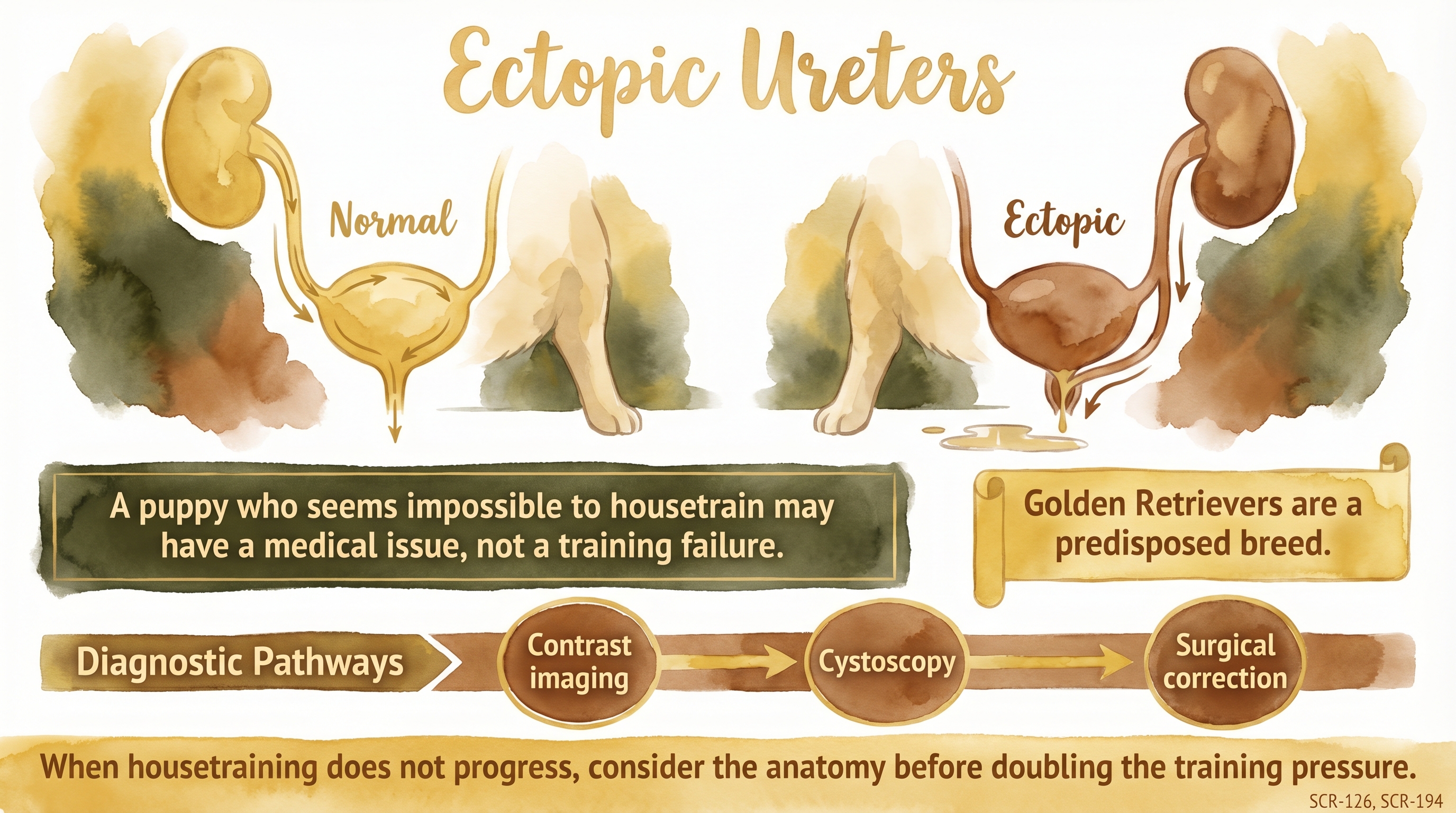
When housetraining does not progress, consider the anatomy before doubling the training pressure.
Key Takeaways
- Ectopic ureters are a structural urinary disorder, not a housetraining failure.
- Golden Retrievers, especially females, are a predisposed breed, so persistent dribbling deserves a real medical workup.
- Diagnosis commonly requires advanced urinary evaluation such as cystoscopy or contrast imaging.
- Many dogs improve after treatment, but complete continence is not guaranteed in every case.
The Evidence
This entry uses observed claim-level tags beyond the dedicated EvidenceBlocks below. These tags mark JB program observation or practice-derived claims that need dedicated EvidenceBlock coverage in a later content pass.
- SCR-090 supportGolden Retrievers
Golden Retrievers are strongly predisposed to ectopic ureters, especially females, making persistent puppy incontinence a legitimate breed-specific medical concern. - Veterinary urology literaturedogs
The classic presentation is early-life urinary incontinence from abnormal ureteral insertion, with cystoscopy and advanced imaging central to diagnosis. - Surgical and cystoscopic literaturedogs
Many dogs improve after corrective intervention, although full continence is not universal.
- SCR-134 boundaryGolden Retrievers
No validated DNA test currently exists for ectopic ureters in Golden Retrievers, so breed risk must not be confused with a solved genetic screen. - Outcome boundarydogs
Successful intervention often improves continence markedly, but coexisting sphincter dysfunction can limit complete normalization.
No direct canine research located for this specific topic. Current understanding relies on related research, clinical observation, and cross-species inference.
SCR References
Sources
- Holt, P. E., & Moore, A. H. (1995). Canine ureteral ectopia: An analysis of 175 cases and comparison of surgical treatments. Veterinary Record, 136(14), 345-349. https://doi.org/10.1136/vr.136.14.345
- Smith, A. L., Radlinsky, M. A., & Rawlings, C. A. (2010). Cystoscopic diagnosis and treatment of ectopic ureters in female dogs: 16 cases (2005-2008). Journal of the American Veterinary Medical Association, 237(2), 191-195. https://doi.org/10.2460/javma.237.2.191
- Berent, A. C., Weisse, C., Mayhew, P. D., Todd, K., Wright, M., & Bagley, D. (2012). Evaluation of cystoscopic-guided laser ablation of intramural ectopic ureters in female dogs. Journal of the American Veterinary Medical Association, 240(6), 716-725. https://doi.org/10.2460/javma.240.6.716
- Visser, J., Fieten, H., van Velzen, H. W., Zaal, M. D., & Kummeling, A. (2022). Prognostic factors for continence after surgical correction of ectopic ureters of 51 dogs with long-term follow-up. Acta Veterinaria Scandinavica, 64, 37. https://doi.org/10.1186/s13028-022-00648-9
- Samii, V. F., McLoughlin, M. A., Mattoon, J. S., Drost, W. T., Chew, D. J., DiBartola, S. P., & Hoshaw-Woodard, S. (2004). Digital fluoroscopic excretory urography, digital fluoroscopic urethrography, helical computed tomography, and cystoscopy in 24 dogs with suspected ureteral ectopia. Journal of Veterinary Internal Medicine, 18(3), 271-281. https://doi.org/10.1111/j.1939-1676.2004.tb02545.x
- Boundary approved by Queue1-DecisionTree: current Golden Retriever ectopic-ureter genetics materials remain research-stage. GRCA and UC Davis materials request samples for ectopic-ureter genetics research and state that results may lead to a DNA-based test; they do not document a validated clinical DNA test for Golden Retriever ectopic ureters. Underlying SCRs: SCR-090 Pending PSV and SCR-134 Pending PSV.