Juvenile Renal Dysplasia (JRD)
Compound evidence detail3 SCRs / 6 parts
- Documentedthe existence of juvenile renal dysplasia in Golden Retrievers, established by the Peeters 1996 12-case retrospective series and Maxie and Robinson 1995 pathological confirmation
- Ambiguousany frequency or population-level claim about JRD in Golden Retrievers - no systematic biopsy screening study exists in the breed; framings such as 'rare' or 'common' have no evidentiary basis and family communications must explicitly state that no population-level data exists
- Ambiguousthe Whiteley 2011 COX-2 promoter variant association with renal dysplasia susceptibility, which received an Expression of Concern from PLOS ONE and has not been resolved as a validated screening basis
- Documentedthe Safra 2015 rebuttal demonstrating that the proposed variants are neutral DNA sequence polymorphisms found across breeds and in gray wolves; downstream communications must direct breeders asking about commercial COX-2 testing to this rebuttal
- Documentedthe absence of any commercially validated, peer-reviewed DNA screening test for juvenile renal dysplasia or ectopic ureters in Golden Retrievers as of April 2026; downstream citations must carry an explicit date qualifier
- Observed-JBongoing GRCA, University of Cambridge, and Broad Institute research efforts soliciting samples and investigating inheritance patterns - presented as active research rather than as imminent test availability
Juvenile renal dysplasia is one of the diagnoses families almost never think about until a young dog starts drinking too much, urinating too much, losing weight, and failing to thrive. It is not common enough to dominate everyday Golden Retriever conversation, but it is serious enough that the breed needs a clear reference page. When it occurs, the stakes are high because the disease affects kidneys that never developed normal mature tissue architecture in the first place. Mixed Evidence
What It Means
What Juvenile Renal Dysplasia Is
Juvenile renal dysplasia describes abnormal kidney development in which the kidneys retain immature structures rather than maturing into normal functional tissue. The result is reduced renal reserve and progressive kidney dysfunction in a dog who is still young.
The important distinction is that this is not simply "kidney failure in a young dog." It is developmental malformation. The kidneys were built incorrectly from the start.
That is why the disease often presents early in life, commonly between puppyhood and early adulthood.
What Families Usually Notice
The most common signs are drinking much more than usual; urinating large volumes or very frequently; poor weight gain or weight loss; reduced appetite; vomiting; poor coat quality; and lethargy or failure to thrive.
Because these signs can initially look vague, families sometimes spend a few weeks thinking the dog is simply going through a funny stage, recovering from a stomach bug, or drinking more because of weather. Mixed Evidence A young dog with persistent polyuria and polydipsia should not be brushed off that way.
Why This Diagnosis Matters in Goldens
The SCR already supports that juvenile renal dysplasia is documented in Golden Retrievers. Documented It also supports an important caution: the prevalence is unknown, which means the disease is real without being easy to quantify neatly.
That combination matters. A disease can be too uncommon for casual conversation while still being common enough to justify awareness in breeders and veterinarians. JRD sits in that category.
How Diagnosis Happens
The workup usually begins with the same things that identify many kidney problems blood chemistry showing azotemia; urinalysis showing poor urine concentration; SDMA or other renal markers; blood pressure assessment; urine protein evaluation; and renal ultrasound. Observed-JB
Small irregular kidneys in a young dog raise suspicion, but definitive diagnosis often depends on histopathology. That usually means biopsy or necropsy evidence demonstrating immature glomeruli or tubules that should not still be present at that age.
This is part of why the diagnosis can be so difficult emotionally. Families may be hearing increasingly concerning lab work before they have tidy certainty.
Why It Matters for Your Dog
Prognosis
The prognosis is highly variable, but it is never trivial.
Some dogs deteriorate quickly and die young. Others can be medically managed for a period of time with renal diet, hydration support, anti-nausea care, phosphorus control, and blood pressure management as needed. The disease is still fundamentally serious because there is no way to make a malformed kidney mature after the fact.
The humane clinical focus therefore becomes slowing progression where possible; controlling nausea and dehydration; preserving appetite and comfort; and monitoring quality of life honestly.
The DNA-Testing Problem
This is one of the most important parts of the page.
Families and breeders often want a simple genetic answer: is there a test for this or not? The careful answer is that the widely discussed COX-2 promoter test has been scientifically contested and should not be treated as a validated rule-out or breeding-screen solution. Ambiguous
The SCR supports two boundaries here JRD is a real documented Golden diagnosis; and there is no validated DNA test that solves screening for it.
Those two statements can both be true. The disease is real, and the genetics are not yet operationally solved in a way families are often led to believe.
What Breeders Should Take From This
JRD is a reminder that health stewardship cannot be reduced to a stack of easy DNA certificates.
For diseases like this, responsible breeding still depends on tracking affected dogs and close relatives; recording age and cause of renal failure; being honest about suspected cases; avoiding breeding affected animals; and being cautious with close family members when pattern suggests inherited risk. Documented
This is less tidy than a clear recessive-panel answer, but it is more honest.
What Families Should Take From This
A young Golden who drinks excessively, urinates excessively, loses weight, and seems unwell needs veterinary attention. That is true even if the breeder did many things right. It is also true even if the dog is still cheerful in between episodes.
Kidney disease in a juvenile dog is not common enough to be the first thing every family should panic about. It is serious enough that persistent signs should trigger prompt workup.
When to See a Veterinarian
Veterinary evaluation is warranted for excessive drinking, excessive urination, weight loss in a growing or young dog, chronic vomiting, poor appetite, failure to thrive, and dehydration or weakness.
The younger the dog, the lower the threshold should be for taking these signs seriously.
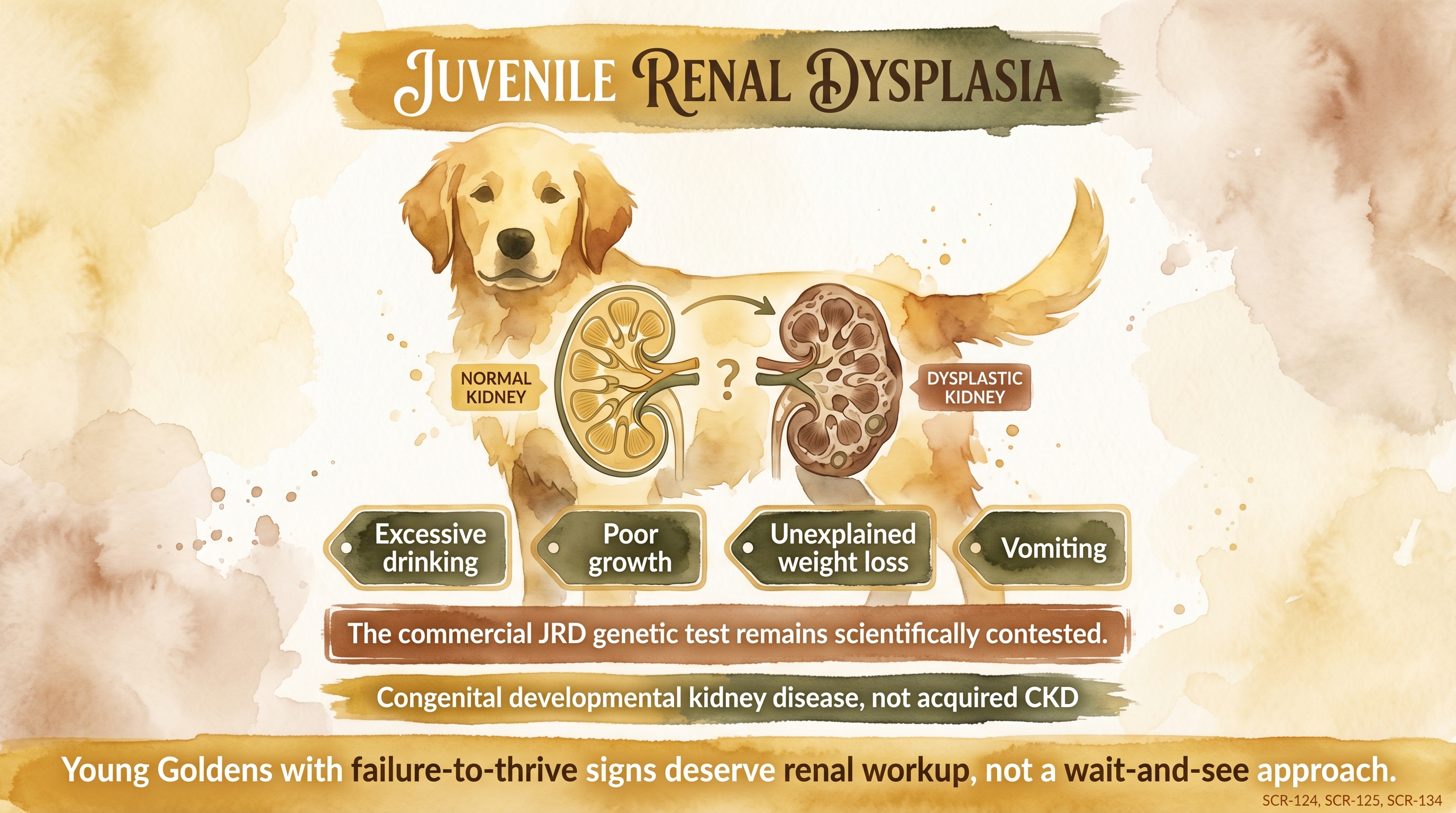
Young Goldens with failure-to-thrive signs deserve renal workup, not a wait-and-see approach.
Key Takeaways
- Juvenile renal dysplasia is a real developmental kidney disease in young dogs, including Golden Retrievers.
- The classic signs are excessive drinking, excessive urination, poor growth, weight loss, and progressive renal decline.
- The disease is documented, but the genetics are not cleanly solved by a validated DNA screening test.
- Young dogs with persistent kidney-type signs deserve prompt veterinary workup rather than wait-and-see reassurance.
The Evidence
This entry uses observed claim-level tags beyond the dedicated EvidenceBlocks below. These tags mark JB program observation or practice-derived claims that need dedicated EvidenceBlock coverage in a later content pass.
This entry uses mixed-evidence claim-level tags beyond the dedicated EvidenceBlocks below. These tags mark claims that combine documented findings with observed practice, heuristic application, or unresolved gaps.
- SCR-124 supportGolden Retrievers
Juvenile renal dysplasia is documented in Golden Retrievers, even though prevalence is not well established. - Veterinary nephrology literaturedogs
The disease reflects malformed renal development with immature nephron structures persisting beyond normal developmental windows. - Clinical nephrology literaturedogs
Young dogs commonly present with polyuria, polydipsia, weight loss, poor growth, and progressive renal insufficiency.
- SCR-125 boundaryGolden Retrievers
The commonly discussed COX-2 JRD test is scientifically contested and should not be treated as a validated diagnostic or breeding-screen solution. - SCR-134 boundaryGolden Retrievers
No validated DNA test currently solves JRD screening in Golden Retrievers.
No direct canine research located for this specific topic. Current understanding relies on related research, clinical observation, and cross-species inference.
SCR References
Sources
- International Renal Interest Society. (2023). IRIS staging of CKD. https://www.iris-kidney.com/iris-staging-system
- Morais, H. S. A. de, DiBartola, S. P., & Chew, D. J. (1996). Juvenile renal disease in Golden Retrievers: 12 cases (1984-1994). Journal of the American Veterinary Medical Association, 209(4), 792-797. https://doi.org/10.2460/javma.1996.209.04.792
- Kerlin, R. L., & Van Winkle, T. J. (1995). Renal dysplasia in Golden Retrievers. Veterinary Pathology, 32(3), 327-329. https://doi.org/10.1177/030098589503200319
- Whiteley, M. H., Bell, J. S., & Rothman, D. A. (2011). Novel allelic variants in the canine cyclooxygenase-2 (Cox-2) promoter are associated with renal dysplasia in dogs. PLOS ONE, 6(2), e16684. https://doi.org/10.1371/journal.pone.0016684
- The PLOS ONE Editors. (2012). Expression of concern: Novel allelic variants in the canine cyclooxygenase-2 (Cox-2) promoter are associated with renal dysplasia in dogs. PLOS ONE, 7(11), e49703. https://doi.org/10.1371/journal.pone.0049703