Hypothyroidism in Dogs
Compound evidence detail1 SCR / 3 parts
- Documentedthe multi-analyte diagnosis combining total T4, free T4 by equilibrium dialysis, TSH, and thyroglobulin autoantibody testing; TgAA positivity as the basis for breeding-stock screening; and the demonstrated insufficiency of single-total-T4 interpretation given euthyroid sick syndrome and sighthound physiology
- DocumentedGolden Retriever elevated autoimmune-thyroiditis prevalence in OFA thyroid-registry analyses, supporting periodic rather than one-time TgAA rescreening of breeding stock
- Heuristicthe optimal interval for TgAA rescreening in clinically normal breeding stock - reflective of breeding-program consensus rather than outcome-validated published cohort data
Hypothyroidism is one of the most familiar endocrine diagnoses in middle-aged dogs, but it is also one of the most commonly oversimplified. Families often hear "low thyroid" and imagine an easy explanation for weight gain, lethargy, or skin problems. Sometimes that is exactly right. Other times the dog has a non-thyroid illness that suppresses thyroid values secondarily, and the dog risks being labeled hypothyroid too casually. Good thyroid medicine depends on context, not just one lab number. Mixed Evidence
What It Means
What Hypothyroidism Is
In dogs, hypothyroidism usually means primary thyroid gland failure. The thyroid does not produce enough hormone, and the body slows in recognizable ways. The most common underlying mechanisms are lymphocytic thyroiditis; and idiopathic thyroid atrophy.
The autoimmune form matters most in breeding conversations because it is the one most clearly associated with heritable immune vulnerability. Documented
What Families Notice
The classic signs are familiar but not perfectly specific lethargy; weight gain without major appetite increase; exercise intolerance; poor coat quality; hair thinning; recurrent skin or ear problems; and cold intolerance.
Some dogs also develop slower heart rate; facial expression changes; neuropathic weakness; and reproductive abnormalities. Mixed Evidence
The reason diagnosis gets muddy is that none of these signs belongs only to hypothyroidism.
Why Goldens Matter
Goldens are one of the breeds that show up regularly in hypothyroidism discussions, especially the autoimmune form. The evidence does not justify treating Goldens as uniquely defined by thyroid disease, but it does justify taking thyroid screening and thyroid-history questions seriously in breeding stock. Documented
That is one reason OFA maintains a thyroid database and why some responsible breeders rescreen breeding dogs over time rather than treating one normal early result as the end of the story.
Why Diagnosis Is Harder Than Families Expect
The key problem is that total T4 alone is not specific.
Many sick dogs with no primary thyroid failure have low thyroid values because illness suppresses circulating hormone. This is sometimes called euthyroid sick syndrome. If a clinician anchors too quickly on a low total T4, the dog can be overdiagnosed and started on lifelong medication it may not actually need. Mixed Evidence
That is why thyroid interpretation usually works better when it includes clinical signs, total T4, free T4 by equilibrium dialysis, TSH, and sometimes thyroglobulin autoantibody testing.
No single combination is perfect, but the full pattern is much stronger than one number in isolation.
Why It Matters for Your Dog
Thyroglobulin Autoantibodies and Autoimmune Disease
In breeding stock, thyroglobulin autoantibody testing matters because it can identify autoimmune thyroiditis before a dog becomes clinically hypothyroid. That does not mean every TgAA-positive dog is immediately sick. It does mean the immune system is showing a relevant signal, and that has breeding significance in a heritable autoimmune process.
This is exactly why thyroid screening for breeding dogs is a different conversation from diagnosing an itchy pet at a family clinic. The breeder question is not only "is the dog sick right now?" It is also "is this dog showing evidence of the heritable pathway we are trying not to propagate?"
Treatment
Treatment is usually straightforward once the diagnosis is sound. Dogs receive levothyroxine replacement and are monitored over time for clinical response and appropriate blood values.
The important caution is that response to treatment does not prove the original diagnosis was correct. Families sometimes report that the dog seems a little brighter after starting medication, but that kind of nonspecific improvement can happen for many reasons. The diagnosis should still rest on a proper workup.
Prognosis
When true hypothyroidism is correctly diagnosed and treated, the prognosis is usually good. Many dogs regain energy, coat quality, and metabolic stability. The harder problems come from delayed diagnosis; overdiagnosis; assuming every overweight or itchy dog has thyroid disease; and missing a different illness while focusing on thyroid numbers. Documented
The Breeding-Stock Angle
This page overlaps with a screening problem as much as a pet-diagnosis problem.
A breeding dog can pass hips, elbows, eyes, and heart, yet still matter genetically in the autoimmune space. That is why thyroid screening has a place in responsible breeding even though it does not dominate public breed-health conversation the way cancer does.
The honest frame is thyroid disease is relevant in Goldens; autoimmune thyroiditis is the important breeding-screen target; and one normal result does not end the story permanently.
When to See a Veterinarian
Veterinary evaluation is warranted for unexplained weight gain, chronic lethargy, hair thinning or poor coat quality, recurrent skin or ear problems, cold intolerance, and unexplained slowing in a middle-aged dog.
Thyroid disease is rarely a same-day emergency, but it is worth discussing when these signs persist and especially when several of them appear together.
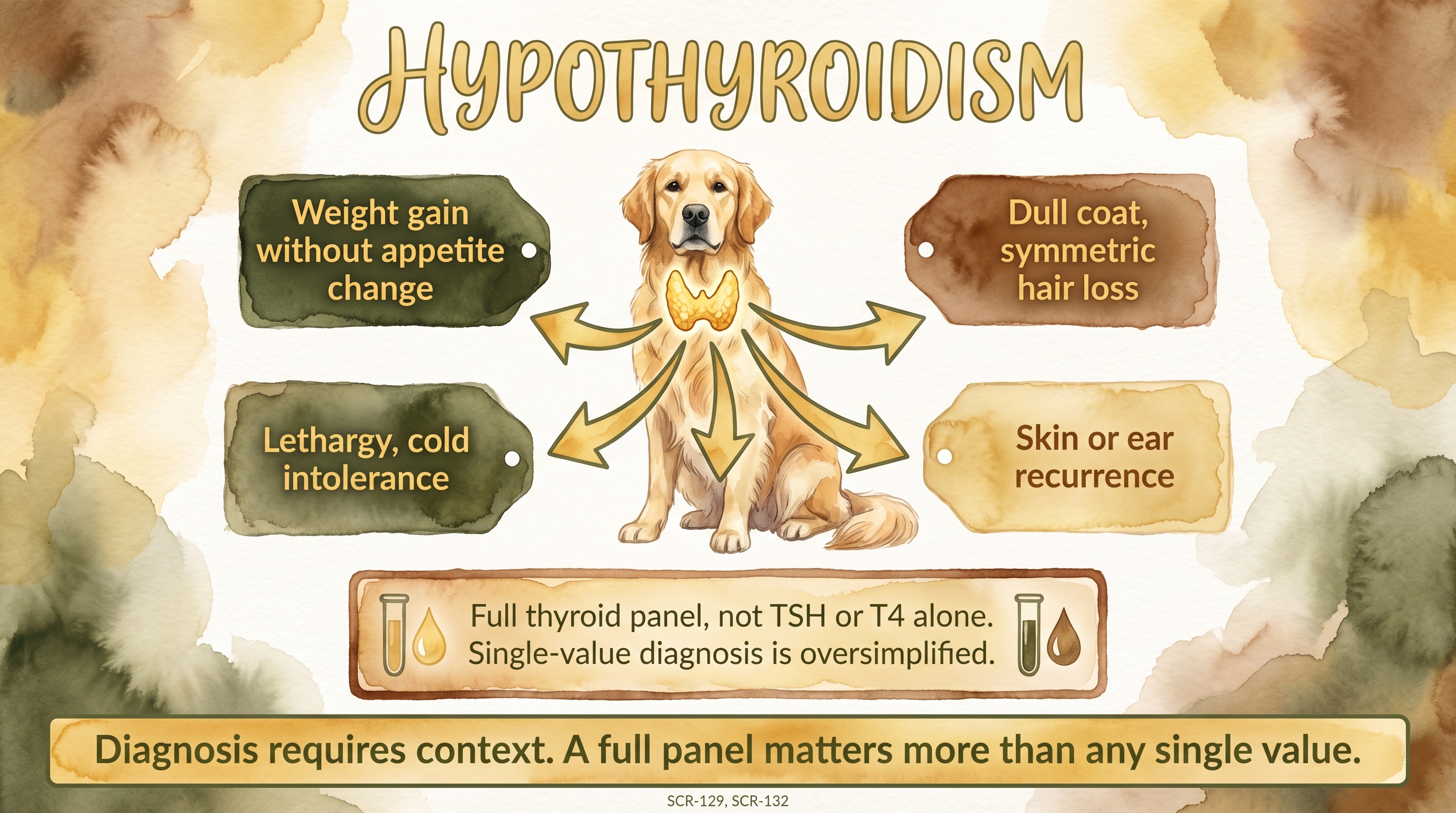
Diagnosis requires context - a full panel matters more than any single value.
Key Takeaways
- Hypothyroidism is a common middle-aged-dog endocrine diagnosis, but it is easy to oversimplify if one low thyroid value is treated as definitive.
- The most useful diagnostic pattern combines clinical signs with total T4, free T4, TSH, and sometimes thyroglobulin autoantibodies.
- Treatment is usually effective once the diagnosis is solid, but overdiagnosis is a real problem.
- In breeding stock, the autoimmune-thyroiditis question matters because screening is about heritable risk, not only whether the dog looks sick today.
The Evidence
This entry uses documented claim-level tags beyond the dedicated EvidenceBlocks below. These claims should remain tied to the entry Sources and SCR references during the next evidence-chain authoring pass.
- Canine endocrinology literaturedogs
Primary hypothyroidism in dogs is most often associated with lymphocytic thyroiditis or idiopathic thyroid atrophy and typically presents in middle age. - Diagnostic consensus sourcesdogs
Interpretation of thyroid disease should not rest on total T4 alone because non-thyroid illness can suppress thyroid values secondarily. - OFA thyroid protocol literaturedogs
Thyroglobulin autoantibody testing is especially relevant in breeding stock because autoimmune thyroiditis can precede overt hormone failure.
- Population-genetics source synthesisdogs
Hypothyroidism and autoimmune thyroid disease have breed-pattern associations, but Golden-specific risk rhetoric should stay restrained unless directly tied to documented screening context. - Breeding interpretation boundaryGolden Retrievers
Goldens are relevant enough to justify thyroid screening conversations, but they should not be described as a thyroid-dominant breed without stronger direct prevalence framing.
- domestic dogs
No published study directly compares the most effective long-term management paths for hypothyroidism in dogs in dogs across breeds and ordinary home settings.
SCR References
Sources
- American Animal Hospital Association. (2023). 2023 AAHA selected endocrinopathies of dogs and cats guidelines. Journal of the American Animal Hospital Association, 59(3), 113-135. https://doi.org/10.5326/JAAHA-MS-7368
- Orthopedic Foundation for Animals. (n.d.). Thyroid database. https://ofa.org/diseases/other-diseases/thyroid/
- Bugbee, A., Rucinsky, R., Cazabon, S., Kvitko-White, H., Lathan, P., Nichelason, A., & Rudolph, L. (2023). 2023 AAHA selected endocrinopathies of dogs and cats guidelines. Journal of the American Animal Hospital Association, 59(3), 113-135. https://doi.org/10.5326/JAAHA-MS-7368