Heritability of Cardiac Disease in Golden Retrievers
When Golden Retriever breeders talk about hereditary cardiac disease, the central concern is usually subaortic stenosis, or SAS. The literature supports that SAS has a meaningful inherited component in the breed, but it does not behave like a simple one-gene destiny story, and that complexity is part of why cardiac screening is so often misunderstood by families who want cleaner answers than the biology currently supports. The strongest current tools are still phenotype-based, and that matters because cardiac risk in Goldens is best managed at the population level rather than promised away in individual puppies through language that overstates what any current test can actually deliver. Documented
What It Means
What SAS actually is
Subaortic stenosis is a congenital narrowing of the left ventricular outflow tract, which is the anatomical pathway blood follows as it leaves the left ventricle and enters the aorta on its way to the rest of the body. In practical terms, the heart has to push blood through a tighter opening than it should, which creates turbulent flow as the blood accelerates through the narrowed region, altered pressure dynamics as the ventricle works harder against increased resistance, and in some dogs serious clinical consequences including exercise intolerance, syncope, and in severe cases sudden cardiac death.
The narrowing itself can take several anatomical forms. The obstruction can be a discrete fibrous ridge below the aortic valve, a longer fibromuscular tunnel of narrowed tissue, or a more diffuse thickening of the outflow tract tissue. These different forms produce different clinical pictures and different severity grades, and the disease is typically classified on a spectrum from mild (where the obstruction is present but clinically subtle and may never produce significant symptoms) to severe (where the obstruction is substantial enough to cause significant clinical disease and reduce life expectancy). Observed-JB
That spectrum is load-bearing for understanding both the screening conversation and the breeding implications. A mild SAS case may be compatible with a normal-looking life for the affected dog, while a severe case can be life-limiting. Breeders evaluating screening results have to think not only about whether SAS is present but about where on the severity spectrum any identified finding sits.
The familial component
Golden Retrievers are one of the breeds in which SAS matters enough to be a standing breeding conversation. The evidence supports a familial component and a heritable risk structure, meaning that SAS clusters in certain pedigrees in ways that are not consistent with random occurrence, and that dogs from affected lines are at higher risk of producing affected offspring than dogs from lines with no known history of the disease. Documented That familial pattern is exactly what would be expected if the condition has a meaningful genetic component, and multiple studies in the breed support this conclusion.
The underlying architecture, however, is more complex than a simple binary Mendelian mutation. Attempts to map SAS to a single clean causal locus in Golden Retrievers have not produced a validated test that would let breeders sort all dogs into clear, carrier, and affected categories with confidence. The current scientific picture suggests that SAS in the breed involves multiple genetic factors with variable expressivity, and the phenotype may also be influenced by developmental factors that are not yet fully understood. That does not mean the disease is not heritable; it means the heritability is real but distributed across a polygenic architecture that current molecular tools cannot yet resolve into a definitive test.
Why the familial picture does not fit the test-and-done model
Families often want hereditary disease to behave one of two ways. Either there is a definitive DNA test that sorts dogs into categories and ends the discussion, or the disease is not really genetic and can be written off as bad luck. SAS in Goldens does not fit that tidy model, and the refusal to fit is not a failure of the science but an accurate reflection of how polygenic traits with variable expression actually work.
The better-supported picture is that inherited liability is real, phenotype matters, and current screening still depends on evaluating the actual cardiovascular phenotype rather than reading one definitive locus-level answer. A breeder managing SAS risk in a line has to think in terms of pedigree history, screening results across multiple generations, and the careful exclusion of affected dogs and their close relatives from the breeding program rather than in terms of a clean carrier-clear-affected sort.
The screening tools
That is why auscultation and echocardiographic phenotype remain central to responsible cardiac management in the breed. Auscultation, done by a veterinarian listening to the dog's heart with a stethoscope, can detect the murmurs that often accompany SAS, and the skill of the auscultator matters because subtle murmurs can be missed by less experienced ears and because normal variation in heart sounds can sometimes be misidentified. The OFA cardiac database recognizes different levels of cardiac examination, with examinations by board-certified veterinary cardiologists carrying more weight than those by practitioners with less specialized training, and the reason is precisely that the detection of subtle findings depends on the examiner's experience.
Echocardiography, which uses ultrasound to image the heart directly, is more sensitive and more specific than auscultation alone and can detect structural abnormalities and measure blood flow characteristics with more precision. For dogs being evaluated for breeding in lines with any cardiac concern, echocardiographic evaluation adds meaningful information that auscultation alone can miss. Doppler echocardiography can measure the velocity of blood flow through the outflow tract, and increased velocities are a key indicator of obstruction severity.
The breeder is not only asking whether a dog carries a named variant. The breeder is asking what the dog's heart is actually doing, and the answer comes from direct phenotypic evaluation by qualified practitioners rather than from any currently available DNA test.
Keeping SAS separate from the DCM conversation
The literature also forces a second distinction that is easy to blur. SAS should not be carelessly merged with the diet-associated dilated cardiomyopathy conversation that has appeared in nutrition discussions over the past several years. Both involve the heart, and both have been written about extensively in the Golden Retriever community, but they are not the same inherited-risk question and treating them as interchangeable produces confused family conversations.
SAS is a congenital structural outflow-tract problem with a familial inheritance pattern. It is present from birth, though the clinical consequences may develop over time as the growing dog's heart works against the narrowing. The inherited component is well established, and breeding decisions can meaningfully reduce risk in families where the pedigree has been managed carefully.
Diet-associated dilated cardiomyopathy involves a different disease pattern, different mechanisms, and a separate evidence debate that centers on the possible relationship between certain grain-free or legume-rich diets and the development of DCM in dogs that would not otherwise be expected to develop the disease. Ambiguous The scientific conversation about DCM and diet is ongoing, and the causal mechanisms are not yet fully resolved. What is clear is that DCM in the diet-associated context is a different clinical entity from congenital SAS, and the two should not be conflated in breeder-family conversations or in the site's own content. Conflating them would misrepresent both conditions and could lead families to misunderstand what screening actually covers and what risks actually apply to their dog.
Why It Matters for Your Dog
What This Cannot Predict
Cardiac heritability in Golden Retrievers cannot tell you that one puppy will or will not develop disease, because the polygenic architecture and variable expression leave real individual variation around any parental profile. Documented
It cannot make a normal screening result into a lifetime guarantee, because cardiac screening captures the state of the heart at the time of examination rather than predicting all future cardiac events across the dog's life.
It cannot replace phenotype-based cardiac examination with simple marketing language about "clear hearts," because the phrase oversimplifies what screening actually measures and can lead families to expect certainty the underlying biology does not support.
And it cannot justify conflating congenital SAS risk with unrelated cardiac discussions such as diet-associated DCM, because the two are different clinical entities with different mechanisms and different evidence bases. Documented
The same population-level rule applies here as elsewhere in the heritability literature. Inherited cardiac risk describes liability in a breed and in a pedigree structure. It does not let anyone predict any one puppy with certainty, and it does not let anyone substitute simple labels for the careful phenotypic evaluation the condition actually requires.
Families evaluating breeders often focus on hips and eyes first because those are the health conversations they hear most often in casual breeder discussions and in breed club materials. But in a breed with documented cardiac relevance, thoughtful cardiac screening is part of the same stewardship pattern, and its absence from a breeder's disclosure list is a signal worth paying attention to even when families are not sure what specific questions to ask.
The key family question is not "Did the breeder say the hearts were fine?" That question accepts whatever answer the breeder offers without providing any way to evaluate whether the answer is based on a meaningful examination or on casual reassurance. The better questions are specific. What phenotype-based cardiac evaluation was used, and was it auscultation alone or did it include echocardiographic evaluation. Who performed the examination, and did a board-certified veterinary cardiologist participate or was the evaluation done by a general practitioner without specialized cardiac training. Is the breeder speaking about cardiac risk as a population problem that can be managed through responsible screening and pedigree awareness, or pretending the issue can be guaranteed away through language that sounds reassuring but does not actually reflect what any test can deliver.
A breeder who can answer those questions in specific terms, including the names of the examining practitioners, the types of examinations performed, and the findings recorded in a searchable database like OFA, is practicing the level of transparency the breed deserves. A breeder who cannot, or who deflects the questions with generic reassurance, may be undertesting or overclaiming, and families should weigh that signal along with other indicators of program quality.
For JB, the answer needs to stay sober and precise. Cardiac screening informs breeding decisions. It reduces risk at the population level by ensuring that affected dogs and dogs from high-risk lines are excluded from the breeding program. It does not offer the kind of certainty families sometimes want to hear, and the program's responsibility is to explain what screening can and cannot do rather than hiding behind language that papers over the complexity. Families who understand the nuance are better equipped to appreciate the effort the program puts into cardiac responsibility, and they are also better equipped to partner with their veterinarian on the dog's ongoing cardiac health throughout life.
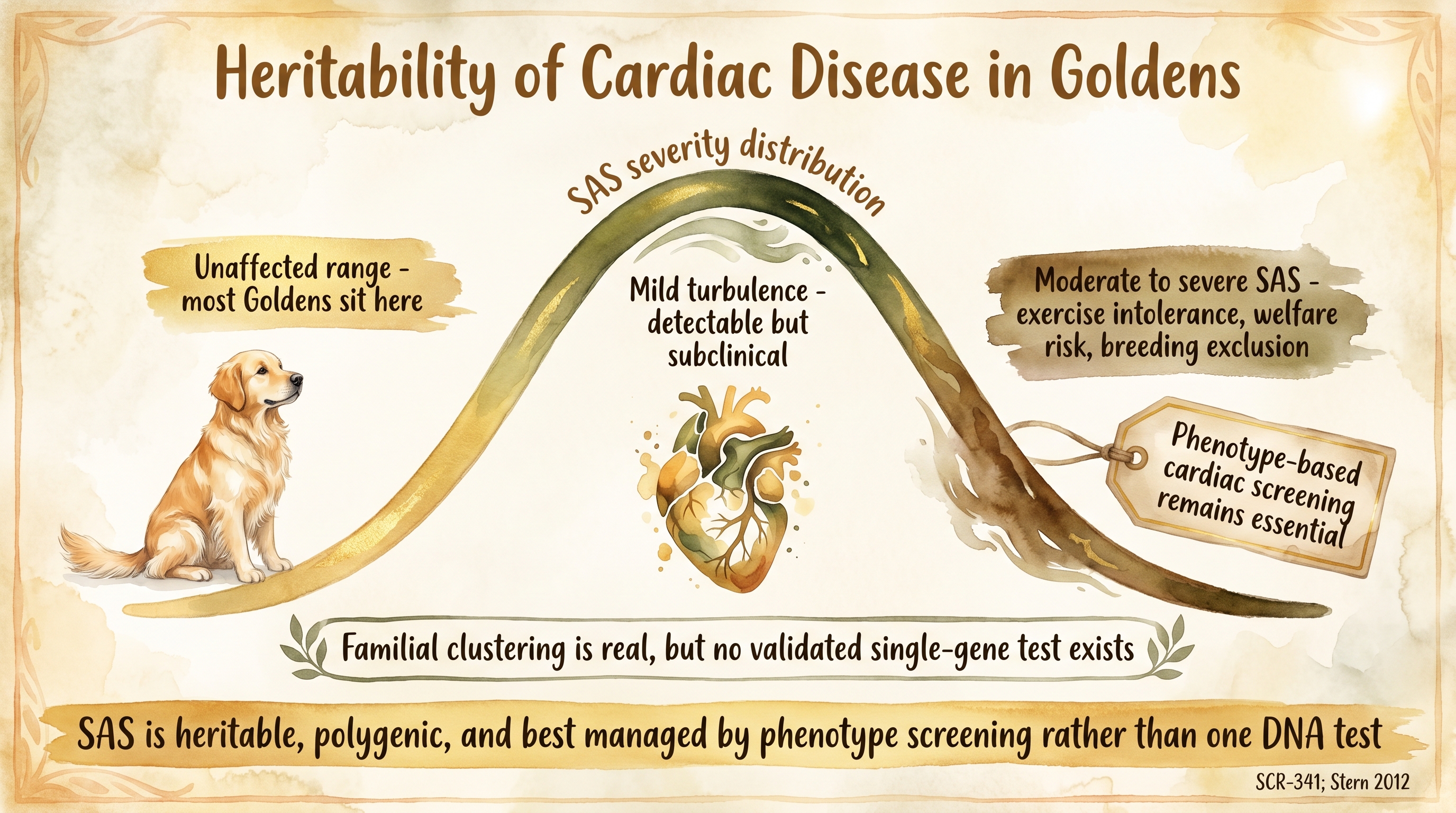
SAS is heritable, polygenic, and best managed by phenotype screening rather than one DNA test.
Key Takeaways
- SAS is the main hereditary cardiac concern in Golden Retriever breeding and has a documented familial component.
- The condition does not currently reduce to a simple one-locus certainty story in the breed.
- Phenotype-based cardiac screening, especially by board-certified cardiologists, remains the key practical breeding tool.
- A normal cardiac screen helps reduce population risk, but it is not a lifetime guarantee for an individual puppy.
- SAS should not be conflated with diet-associated DCM; they are different clinical entities with different evidence bases.
The Evidence
This entry uses observed claim-level tags beyond the dedicated EvidenceBlocks below. These tags mark JB program observation or practice-derived claims that need dedicated EvidenceBlock coverage in a later content pass.
This entry uses ambiguous claim-level tags beyond the dedicated EvidenceBlocks below. These tags mark claims where the literature remains unsettled or multiple interpretations coexist.
- Canine cardiac screening and Golden Retriever literaturedogs and Golden Retrievers
Subaortic stenosis is a breed-relevant hereditary cardiac condition in Golden Retrievers with documented familial structure and clinically meaningful screening implications. - Cardiac methodology source synthesisdogs
Phenotype-based cardiac assessment remains central because the inherited risk picture is not reduced to a simple, universally decisive single-gene test in the breed.
- Canine cardiology and breeding literaturedogs
Cardiac screening improves breeding decisions at the population level, but it does not let breeders predict with certainty whether any one puppy will remain free of disease.
No published study has identified a complete genetic architecture for SAS in Golden Retrievers that would allow a DNA-based carrier test comparable to what exists for PRA or ICH.
SCR References
Sources
- Kienle R.D., Thomas W.P., & Pion P.D. (1994). The natural clinical history of canine congenital subaortic stenosis. Journal of Veterinary Internal Medicine, 8(6), 423-431. doi:10.1111/j.1939-1676.1994.tb03262.x
- Stern J.A., Meurs K.M., Nelson O.L., Lahmers S.M., & Lehmkuhl L.B. (2012). Familial subvalvular aortic stenosis in golden retrievers: inheritance and echocardiographic findings. Journal of Small Animal Practice, 53(4), 213-216. doi:10.1111/j.1748-5827.2011.01187.x
- Ontiveros E.S., Fousse S.L., Crofton A.E., Hodge T.E., Gunther-Harrington C.T., Visser L.C., & Stern J.A. (2019). Congenital Cardiac Outflow Tract Abnormalities in Dogs: Prevalence and Pattern of Inheritance From 2008 to 2017. Frontiers in Veterinary Science, 6, 52. doi:10.3389/fvets.2019.00052
- Belanger M.C., Cote E., & Beauchamp G. (2014). Association between Aortoseptal Angle in Golden Retriever Puppies and Subaortic Stenosis in Adulthood. Journal of Veterinary Internal Medicine, 28(5), 1498-1503. doi:10.1111/jvim.12390
- Bélanger M.C., Di Fruscia R., Dumesnil J.G., & Pibarot P. (2005). Usefulness of the indexed effective orifice area in the assessment of subaortic stenosis in the dog. Journal of Veterinary Internal Medicine, 19(5), 625-630. doi:10.1111/j.1939-1676.2005.tb02737.x
- Javard R., Belanger M.C., Cote E., Beauchamp G., & Pibarot P. (2014). Comparison of peak flow velocity through the left ventricular outflow tract and effective orifice area indexed to body surface area in Golden Retriever puppies to predict development of subaortic stenosis in adult dogs. Journal of the American Veterinary Medical Association, 245(12), 1367-1374. doi:10.2460/javma.245.12.1367
- Bagardi M., Zamboni V., Locatelli C., Galizzi A., Ghilardi S., & Brambilla P.G. (2025). Congenital heart diseases in dogs: epidemiology, clinical findings, and outcomes. Journal of Veterinary Cardiology, 53, 23-38.
- van Staveren M.D.B., & Szatmari V. (2020). Detecting and recording cardiac murmurs in clinically healthy puppies in first opinion veterinary practice at the first health check. Acta Veterinaria Scandinavica, 62, 37. doi:10.1186/s13028-020-00535-1
- Kaplan J.L., Stern J.A., Fascetti A.J., Larsen J.A., Skolnik H., Peddle G.D., et al. (2018). Taurine deficiency and dilated cardiomyopathy in golden retrievers fed commercial diets. PLOS ONE, 13(12), e0209112. doi:10.1371/journal.pone.0209112
- Pradelli D., Quintavalla C., Crosta M.C., Mazzoldi C., Bussadori C.M., Bussadori R.G., Troìa L., & Domenech O. (2014). The influence of emotional stress on Doppler-derived aortic peak velocity in boxer dogs. Journal of Veterinary Internal Medicine, 28(5), 1724-1730.