Spay Timing and Urinary Incontinence
Compound evidence detail2 SCRs / 8 parts
- EstimatedUSMI prevalence figures across spayed large-breed female populations and the body-weight odds ratio derived from multi-breed retrospective and case-control samples
- Observed-JBthe Golden-Retriever-specific timing pattern in which incontinence clusters in females spayed before approximately 6-12 months versus intact and late-spayed cohorts
- Estimatedthe VetCompass target-trial-emulation odds reduction for later neutering, presented as a recent causal-inference result whose magnitude remains under refinement
- DocumentedGolden Retriever over-representation in ectopic-ureter case series, anchored on the Holt and Moore 1995 175-case epidemiologic review and consistent with subsequent treatment-cohort occurrence patterns
- Documentedcanine-wide surgical and clinical findings - cystoscopic-guided laser ablation as current standard of care for intramural EU, intramural predominance at 91-96% across cohorts, urogenital comorbidity patterns, and Kaplan-Meier late-relapse trajectories
- Observed-JBthe Golden Retriever familial and heritable basis acknowledged by the GRCA and active Cambridge research, presented as ongoing inheritance-pattern investigation rather than as a documented genetic mechanism
- DocumentedEntlebucher Mountain Dog genetics including 65% heritability, 6 GWAS loci (Wiedmer 2015), and the 24% to 1.4% phenotype-screening reduction (Merz 2022), all within-EMD findings
- Heuristicany extension of EMD genetic architecture or screening success to Golden Retrievers - the breeds have different genetic architectures and EMD findings cannot be extrapolated to GR without breed-specific replication
Urinary incontinence is one of the more practically important consequences in the spay-timing literature because it affects everyday life, often appears in otherwise healthy dogs, and lands squarely in the female large-breed decision space. The science is not perfectly uniform on every timing threshold, but it is strong enough to support one broad conclusion: spayed larger females carry more urinary-incontinence risk than intact females, and very early timing is not a medically neutral choice in Golden Retrievers. Mixed Evidence
What It Means
What This Page Is About
This page focuses on urethral sphincter mechanism incompetence, usually shortened to USMI. That is the classic acquired-incontinence pattern most often discussed in relation to spay timing.
It is not the same thing as ectopic ureters in a young dog; a urinary tract infection; and house-training failure.
That distinction matters because families often see leakage and initially think in behavioral language. In the USMI story, the dog is showing a medical sign, not making a choice.
What USMI Is
USMI means the urethral sphincter is not maintaining closure pressure effectively enough to keep urine contained at all times. The typical presentation is urine leakage while sleeping; damp bedding; dribbling without obvious awareness; and a dog that otherwise seems healthy and normally house-trained.
The timing is often adult or middle-aged onset rather than immediate post-surgical onset.
Why Spay Is Part of the Story
The most common mechanistic explanation is that removal of ovarian hormone exposure contributes to reduced urethral closure tone. Estrogen is the hormone people hear about most in this context, though the actual biology is broader than one single molecule.
The practical point is simpler than the endocrine details: once the ovaries are removed, continence physiology changes, and that change matters most in larger females.
The Strongest Evidence Line
The strongest stable finding is not that one exact age has been proven universally ideal. The strongest finding is that spayed larger females are overrepresented in acquired incontinence datasets, and Goldens sit directly inside that size-risk reality. Documented
The SCR reflects this in a careful way the larger-dog and spayed-female association is real; the Golden-specific clustering exists; and the exact timing gradient is improving in clarity but still not as settled as the orthopedic signal. Documented
That is why this page is marked mixed rather than treating every timing phrase as equally documented. Ambiguous
What the Studies Actually Suggest
Across the literature, several patterns recur larger females are much more vulnerable than smaller females; spayed status carries more risk than intact status; some datasets show little clean age-at-spay effect; and newer causal-inference work suggests later spay lowers early-onset incontinence odds compared with earlier juvenile timing. Heuristic
That means the family-facing conclusion should be careful but useful. The evidence does not justify pretending timing does not matter. Documented It also does not justify absolute certainty around one single magic threshold.
Why It Matters for Your Dog
Why Goldens Matter Here
Golden Retrievers are directly relevant because they exceed the large-breed weight range where risk rises; early-spay clustering has been observed in Golden-specific cohorts; and the breed already has enough urinary discussion due to ectopic ureters that leakage needs careful differential thinking.
This is why urinary incontinence belongs in the Golden spay conversation, not as a niche footnote but as a real quality-of-life consideration.
What This Means for Timing Conversations
The evidence supports a more cautious and individualized timing discussion for Golden females than the old early-spay default allowed.
The safe, evidence-led way to say that is very early spay carries more continence concern than older guidance once admitted; delaying out of the earliest juvenile window is a reasonable part of the discussion; and many Golden families and veterinarians now include the first-heat question because the continence trade-off is real.
That is not the same as claiming every Golden female must follow one exact timeline. It is a more modest and more defensible conclusion.
Treatment and Management
USMI is often medically manageable. Common treatment paths include phenylpropanolamine, estriol in selected females, and additional diagnostics when the picture is not straightforward.
Good management starts by ruling out simpler or confounding causes first, especially urinary tract infection and structural abnormality.
Distinguishing USMI From Other Leakage Problems
Families should think through three broad buckets young dog with congenital or structural problem, including ectopic ureters; dog with infection or inflammatory urinary disease; and spayed larger female with acquired sphincter incompetence.
The symptom can look similar. The cause and treatment are not.
When to See a Veterinarian
Any new urinary leakage deserves veterinary evaluation, especially if the dog had previously been reliably house-trained; is leaving wet spots while asleep; is licking the vulva more than usual; is urinating more often; seems uncomfortable or is straining; and is a young dog where ectopic ureters remain possible.
Same-day or urgent evaluation is appropriate if leakage is accompanied by fever, pain, repeated straining, blood in the urine, or inability to pass urine normally.
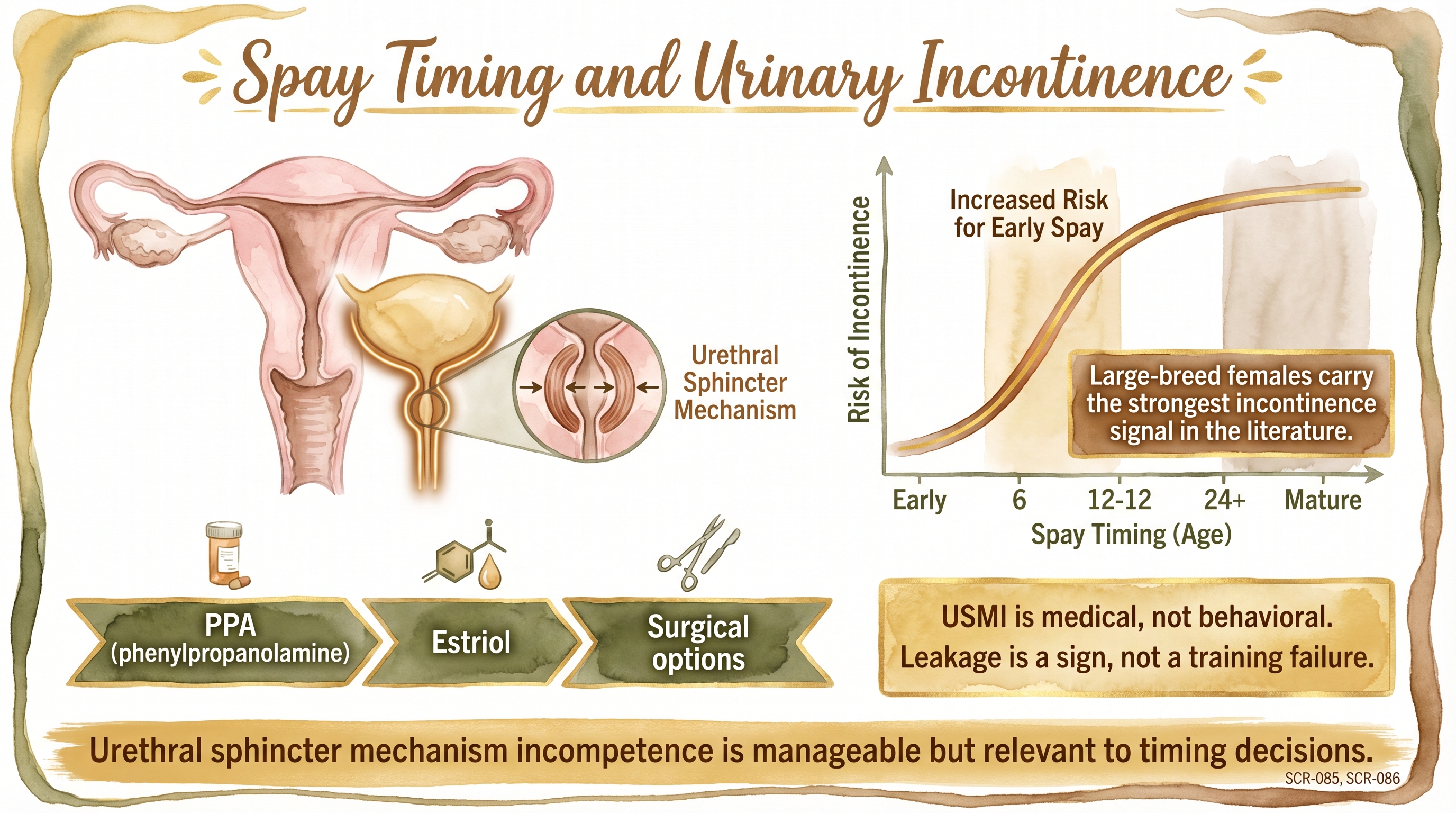
Urethral sphincter mechanism incompetence is manageable but relevant to timing decisions.
Key Takeaways
- USMI is the classic acquired incontinence pattern linked to spayed larger females, and Goldens are directly relevant to that risk profile.
- The strongest evidence says spayed large-breed females carry more incontinence risk than intact females, while the exact timing gradient is still less settled than the orthopedic literature.
- Very early spay is not medically neutral for continence, so timing deserves real discussion rather than defaulting to habit.
- Any new urine leakage should be treated as a veterinary issue first, not as a house-training failure.
The Evidence
This entry uses heuristic claim-level tags beyond the dedicated EvidenceBlocks below. These tags mark JB interpretive application rather than direct study findings.
This entry uses ambiguous claim-level tags beyond the dedicated EvidenceBlocks below. These tags mark claims where the literature remains unsettled or multiple interpretations coexist.
- SCR-085 supportdogs and Golden Retrievers
Acquired urinary incontinence disproportionately affects spayed large-breed females, and Golden-specific clustering has been observed in earlier-spayed groups. - Spay-timing source synthesisdogs
Newer causal-inference work suggests later spay may reduce early-onset incontinence odds compared with earlier juvenile timing, though not every older dataset showed a clean age-at-spay effect. - Canine urology literaturedogs
USMI is the main acquired-spay-related incontinence pattern and should be distinguished from infection and congenital structural disease.
- SCR-090 supportGolden Retrievers
Goldens carry real ectopic-ureter relevance, which is why young-dog leakage should not be reflexively labeled USMI. - Clinical urinary workup logicdogs
A proper leakage workup starts with ruling out urinary infection and structural causes before settling on sphincter incompetence.
- domestic dogs
No published study directly resolves every practical trade-off families face when using spay timing and urinary incontinence across sex, breed, household, and management contexts.
SCR References
Sources
- Forsee, K. M., Davis, G. J., Mouat, E. E., Salmeri, K. R., & Bastian, R. P. (2013). Evaluation of the prevalence of urinary incontinence in spayed female dogs: 566 cases (2003-2008). Journal of the American Veterinary Medical Association, 242(7), 959-962. https://doi.org/10.2460/javma.242.7.959
- Byron, J. K., Taylor, K. H., Phillips, G. S., & Stahl, M. S. (2017). Urethral sphincter mechanism incompetence in 163 neutered female dogs: Diagnosis, treatment, and relationship of weight and age at neuter to development of disease. Journal of Veterinary Internal Medicine, 31(2), 442-448. PMID: 28256023.
- Pegram, C., O'Neill, D. G., Church, D. B., Hall, J. L., Owen, L., & Brodbelt, D. C. (2024). Later-age neutering causes lower risk of early-onset urinary incontinence than early neutering: A VetCompass target trial emulation study. PLOS ONE, 19(7), e0305526. https://doi.org/10.1371/journal.pone.0305526
- Holt, P. E., & Moore, A. H. (1995). Canine ureteral ectopia: An analysis of 175 cases and comparison of surgical treatments. Veterinary Record, 136(14), 345-349. https://doi.org/10.1136/vr.136.14.345
- Weese, J. S., Blondeau, J. M., Boothe, D., Guardabassi, L. G., Gumley, N., Papich, M., Jessen, L. R., Lappin, M., Rankin, S., Westropp, J. L., & Sykes, J. E. (2019). International Society for Companion Animal Infectious Diseases guidelines for the diagnosis and management of bacterial urinary tract infections in dogs and cats. The Veterinary Journal, 247, 8-25. https://doi.org/10.1016/j.tvjl.2019.02.008