Alternatives to Traditional Gonadectomy
Compound evidence detail1 SCR / 3 parts
- Documentedthe anatomy and residual-risk profiles of the principal hormone-sparing alternatives - ovary-sparing spay (hysterectomy with ovarian preservation; mammary tumor risk dynamics retained, stump pyometra possible if uterine tissue retained), vasectomy (testicular tumor and prostatic disease risks retained), and tubal ligation
- Observed-JBlimited U.S. veterinary uptake of these procedures and the inconsistent surgical training across general practice that constrains family access to surgeons experienced in the techniques
- AmbiguousGolden-Retriever-specific long-term outcome data for hormone-sparing alternatives - absent from currently published prospective cohort literature and therefore not yet citable as breed-specific outcome evidence
Alternatives to traditional gonadectomy became more interesting only after the timing conversation stopped being simple. Once breeders and families began asking whether sterilization and hormone removal really had to be bundled together, procedures like ovary-sparing spay and vasectomy moved from fringe curiosities into serious discussion. The science here is promising, but thinner than the literature around traditional spay and neuter because these procedures are newer, less common, and far less widely studied. Observed-JB
What It Means
Why These Alternatives Exist
Traditional gonadectomy solves two things at once reproduction; and gonadal hormone exposure.
Alternative procedures ask whether those questions always need the same answer.
That matters because some families want reliable sterilization; less orthopedic or behavioral concern from early hormone removal; and an option that fits newer evidence without staying fully intact. Documented
Ovary-Sparing Spay
An ovary-sparing spay, technically closer to hysterectomy, removes the uterus while leaving the ovaries in place.
The intended result is no pregnancy; no classic pyometra risk from an intact uterus; and ongoing ovarian hormone exposure.
That makes OSS the best-known female hormone-sparing option.
Vasectomy
In males, vasectomy interrupts sperm transport while leaving the testes in place. The dog is sterilized but continues to produce testosterone.
The attraction is obvious reproduction is prevented; hormone-dependent developmental and adult physiology are preserved more closely; and some families see it as a compromise between intact and castrated status.
Why People Are Interested
The basic appeal of these procedures is not mysterious. They appear to offer a way to control reproduction without fully accepting the long-term profile associated with traditional gonadectomy. Documented
The SCR now reflects one strong version of that idea: dogs in hormone-sparing groups can look more intact-like in long-term health and behavior datasets than traditionally gonadectomized dogs. Observed-JB
That is important. It is also not the same as saying the answer is already solved.
What the Evidence Supports
The best current outcome literature suggests hormone-sparing procedures preserve a more intact-like profile in several domains, including orthopedic and behavior-adjacent outcomes. Documented
That is a meaningful signal, but families should keep three caveats in view the studies are not randomized long-term trials; procedure numbers are smaller than traditional spay-neuter cohorts; and availability and operator experience vary a great deal.
So this is an encouraging evidence area, not a mature universal standard.
Why It Matters for Your Dog
Practical Trade-Offs
Hormone-sparing does not mean consequence-free.
For females after OSS heat cycles continue; attraction of intact males remains a management issue; and families need to understand intact-hormone logistics.
For males after vasectomy testosterone-linked behaviors remain possible; testicular disease risks are not removed the way castration removes them; and management assumptions need to fit an intact-hormone dog.
In other words, these procedures solve fertility. They do not create a traditional-spay-neuter lifestyle by another route.
Access and Training Limitations
One of the biggest real-world barriers is not theory. It is access.
Few veterinarians routinely perform ovary-sparing spay; vasectomy in pet dogs; and hormone-sparing counseling as a routine offering.
That means families often need to search deliberately, travel, and budget more. The procedure may be medically reasonable yet locally difficult to obtain.
The Historical Zeuterin Note
Zeuterin, the injectable chemical sterilization product once used in some male dogs, belongs more to the historical background than to live U. S. decision-making now. It matters mainly because it represents an earlier attempt to separate sterilization from standard surgical castration.
For most families today, the real alternatives worth discussing are OSS and vasectomy rather than chemical sterilization.
Who These Alternatives Fit Best
These procedures tend to be most relevant for families who accept intact-hormone management responsibilities; want sterilization without traditional hormone removal; have access to a veterinarian experienced in the procedure; and have already thought seriously through the trade-space rather than reacting to internet debate. Heuristic
They are usually a poor fit for households that want all reproductive-hormone management concerns removed from daily life.
When to See a Veterinarian
This conversation should happen before scheduling surgery, not in the parking lot after deciding on a date.
Bring up hormone-sparing alternatives early if you have a Golden and are already concerned about timing trade-offs; you want sterilization without classic gonadectomy; you are willing to manage heat cycles or intact-hormone behavior; and you need referral options because your local clinic does not perform these procedures.
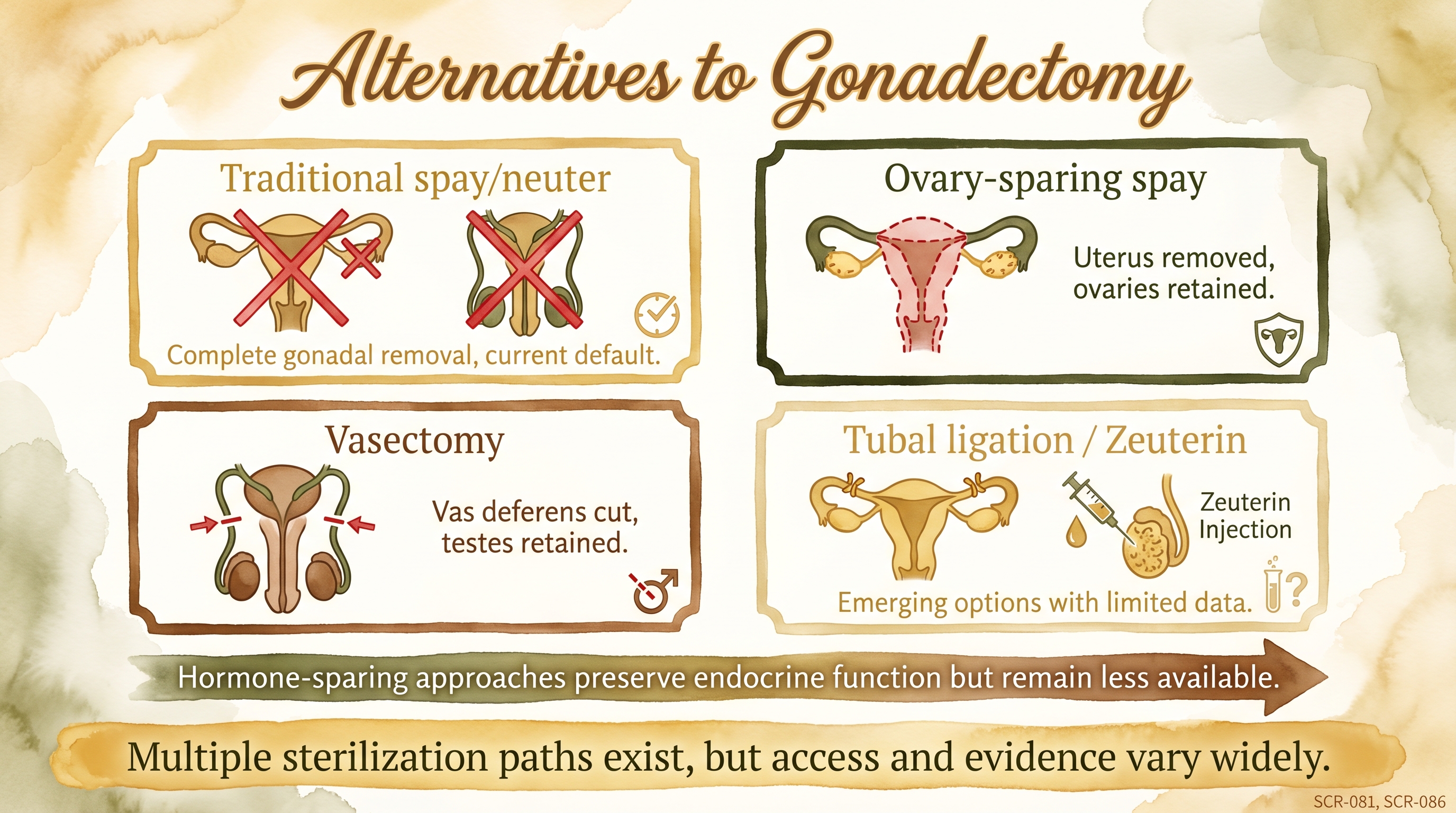
Multiple sterilization paths exist, but access and evidence vary widely.
Key Takeaways
- Hormone-sparing alternatives exist because sterilization and hormone removal do not always need to be the same decision.
- The two main live options are ovary-sparing spay for females and vasectomy for males.
- The evidence is promising and suggests a more intact-like long-term profile, but the literature is still much thinner than for traditional gonadectomy.
- Access, cost, and ongoing intact-hormone management are the biggest practical barriers for most families.
The Evidence
This entry uses heuristic claim-level tags beyond the dedicated EvidenceBlocks below. These tags mark JB interpretive application rather than direct study findings.
- SCR-086 supportdogs
Hormone-sparing procedures preserve a more intact-like long-term profile than traditional gonadectomy in available canine outcome data. - Veterinary reproductive-surgery literaturedogs
OSS and vasectomy separate sterilization from full gonadal removal, which is the central conceptual shift behind their appeal.
- Spay-neuter source synthesisdogs
The long-term literature for hormone-sparing procedures is promising but thinner than the literature for traditional gonadectomy because these procedures remain uncommon. - Clinical practice realitydogs
Availability is limited, procedure cost is often higher, and own​er management demands remain meaningfully different from traditional spay-neuter households. - Procedure-history contextdogs
Chemical sterilization belongs mainly to the historical background rather than the current mainstream U.S. decision landscape.
- domestic dogs
No published study directly resolves every practical trade-off families face when using alternatives to traditional gonadectomy across sex, breed, household, and management contexts.
SCR References
Sources
Hart, B. L., Hart, L. A., Thigpen, A. P., & Willits, N. H. (2020). Assisting decision-making on age of neutering for 35 breeds of dogs: Associated joint disorders, cancers, and urinary incontinence. Frontiers in Veterinary Science, 7, 388. https://doi.org/10.3389/fvets.2020.00388
Kutzler, M. A. (2020). Possible relationship between long-term adverse health effects of gonad-removing surgical sterilization and luteinizing hormone in dogs. Animals, 10(4), 599. https://doi.org/10.3390/ani10040599
Zwida, K. & Kutzler, M. A. (2016). Non-reproductive long-term health complications of gonad removal in dogs as well as possible causal relationships with post-gonadectomy elevated luteinizing hormone (LH) concentrations. Journal of Etiology and Animal Health, 1(1), 1-11.
Howe, L. M. (2015). Current perspectives on the optimal age to spay/castrate dogs and cats. Veterinary Medicine: Research and Reports, 6, 171-180. https://doi.org/10.2147/VMRR.S53264