Ocular Conditions in Golden Retrievers
Compound evidence detail1 SCR / 3 parts
- Documentedthe GRPU clinical phenotype - radial anterior-lens-capsule pigment, mean presentation age 8 to 8.6 years, the Townsend 2013 prospective prevalence of 5.5% overall and 9.9% in dogs eight years and older, and the Holly 2016 longitudinal iridociliary-cyst progression to GRPU of approximately 56.5% in the high-risk subgroup
- AmbiguousGRPU's causative gene, mode of inheritance, true penetrance, and whether secondary glaucoma is driven primarily by trabecular-meshwork mechanical obstruction or by immune-mediated inflammation - all remain unresolved; the condition must not be presented as genetically solved or mechanistically settled
- Documentedthe dual-surveillance principle for serious Golden Retriever breeding programs - annual board-certified ophthalmology examination as a non-negotiable layer alongside any DNA screening, since no current DNA panel addresses GRPU risk
Golden Retriever eye health is one of the clearest places where families can be misled by a partial truth. The partial truth is that DNA testing matters. The fuller truth is that DNA testing does not exhaust ocular risk in this breed. Some Golden eye conditions are panel-testable. Others are late-onset, clinically screened, incompletely mapped, or all three. That is why annual specialist ophthalmology still matters. Documented
What It Means
What Families Should Know First
The Golden ocular story is not one disease. It is a landscape.
The most important parts of that landscape are Golden Retriever Pigmentary Uveitis, or GRPU; hereditary cataracts; progressive retinal atrophy, or PRA; distichiasis and other eyelid or adnexal problems; and entropion and related conformational issues in some dogs.
These do not carry the same weight.
PRA and some cataract-associated risks live more naturally in the DNA-testing conversation. Documented GRPU does not. GRPU is the reason families and breeders need to understand that a dog can be genetically screened and still not be fully cleared of ocular risk.
Golden Retriever Pigmentary Uveitis
GRPU is the most concerning Golden-specific ocular condition in routine breeder discussion because it is progressive, usually adult-onset, and can lead to secondary glaucoma, cataract formation, and eventual vision loss.
Its importance is not just what it does. It is how it hides.
Early GRPU is not something a family reliably rules out from ordinary observation at home. It is often detected only by a trained veterinary ophthalmologist looking for subtle signs that are easy to miss on routine general-practice exam. That is why breeder language such as "eyes looked fine at the regular vet" does not answer the real question.
There is also no current DNA panel that eliminates GRPU risk. This is exactly the kind of condition that makes annual ophthalmology non-negotiable in a serious Golden breeding program.
PRA and Genetic Heterogeneity
Progressive retinal atrophy matters because it is inherited, vision-threatening, and a place where genetic language can become falsely reassuring.
The relevant SCR entry here states that PRA in Golden Retrievers is genetically heterogeneous. At least three causative genes are involved across the known Golden PRA architecture: SLC4A3, TTC8, and PRCD. The practical implication is straightforward: a dog clear on one PRA mutation is not automatically clear on all Golden PRA risk. Documented
This is a good example of why families should ask not only "Was the dog DNA tested?" but also "For what, exactly?"
Why It Matters for Your Dog
Cataracts and Other Ocular Disease
Hereditary cataracts remain part of the Golden eye conversation, though not every cataract in every dog is genetic. Documented The key clinical distinction is that cataracts are a lens-opacity problem and can be congenital, developmental, inherited, or acquired depending on the context.
Distichiasis, entropion, and related eyelid problems matter differently. They are usually more about irritation, tear-film disruption, and corneal comfort than about the retinal-degeneration story of PRA or the inflammatory progression of GRPU. But they still matter because chronic irritation changes daily comfort and can create secondary ocular disease if ignored.
Why DNA Panels Are Not Enough
The present SCR wording is unusually useful because it says exactly what families need:
DNA testing does not exhaust ocular risk in Golden Retrievers. Annual ophthalmoscopic examination remains necessary because late-onset and genetically unresolved conditions, including GRPU, are not ruled out by current DNA panels. Documented
That single principle protects families from a very common misunderstanding. A breeder can be technically truthful when they say a dog is DNA clear on the conditions they tested. But that truth becomes misleading if it is allowed to imply the dog is ocular-risk free.
What Responsible Breeders Do
The defensible Golden eye-health standard includes both genetics and repeat clinical screening.
A serious breeder should use the available DNA tests for the known, validated mutations; understand that PRA is genetically heterogeneous rather than one single toggle; obtain annual specialist eye examinations; treat GRPU risk as a clinical-screening problem, not a solved DNA problem; and retire dogs with meaningful ocular disease findings rather than hoping the next breeding will be fine. Documented
For families, this is one of the easier areas to ask precise questions. Was the dog examined by a board-certified veterinary ophthalmologist? How recently? What DNA conditions were actually tested? Were the parents only DNA screened, or also clinically examined?
When to See a Veterinarian
Veterinary evaluation is appropriate for squinting, eye rubbing, or obvious light sensitivity; persistent tearing or ocular discharge; cloudiness, color change, or a suddenly strange appearance to the eye; signs that vision seems reduced, especially in dim light; and chronic redness or a painful-looking eye.
Same-day evaluation is warranted for acute pain, rapid eye clouding, obvious enlargement of the globe, marked redness, or sudden vision loss.
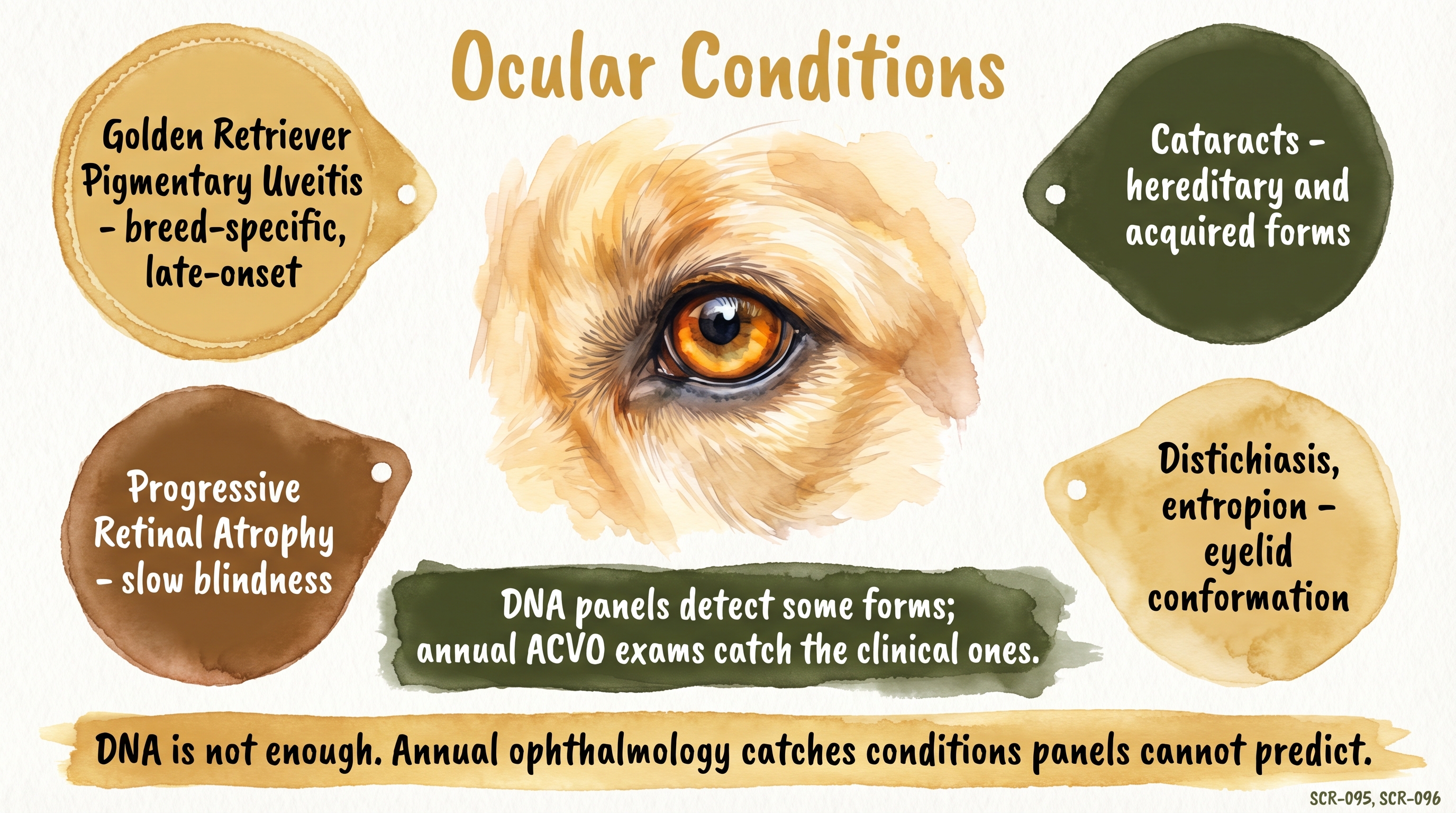
DNA is not enough - annual ophthalmology catches conditions panels cannot predict.
Key Takeaways
- Golden Retriever eye health cannot be reduced to DNA panels alone.
- GRPU is the most practically important Golden-specific ocular screening problem because it is late-onset, progressive, and not ruled out by current DNA testing.
- PRA in Goldens is genetically heterogeneous, so being clear on one mutation is not the same as being clear on all retinal risk.
- Families should ask both about DNA testing and about recent specialist ophthalmology exams.
The Evidence
- Golden ocular disease synthesisGolden Retrievers
Golden Retriever eye disease includes both panel-testable genetic conditions and late-onset clinically screened problems, with GRPU carrying especially high practical importance. - PRA genetics literatureGolden Retrievers
Golden PRA is genetically heterogeneous, which means one normal DNA result does not close the whole PRA question. - Ophthalmology screening consensusdogs
Annual specialist eye exams remain necessary in breeds where late-onset and incompletely resolved ocular conditions are part of the risk landscape.
- Sapienza et al. 2000; Townsend et al. 2020Golden Retrievers
The defining diagnostic hallmark of GRPU is radial pigment on the anterior lens capsule, frequently associated with iridociliary cysts and predictably leading to secondary glaucoma, cataract formation, and vision loss. Mean age of clinical presentation is approximately 8 to 8.6 years. - Townsend and Gornik 2013Golden Retrievers
In a controlled prospective cohort of 164 Golden Retrievers, uveal cysts were found in 34.8 percent of dogs and clinical GRPU in 5.5 percent overall, rising to 9.9 percent in dogs eight years and older. CERF passive-surveillance registry data reported only 5.4 percent and 1.5 percent respectively, which reflects methodological underdetection rather than true breed prevalence. These figures should always be presented as a prospective-versus-registry contrast, not as one breed-wide number. - Holly et al. 2016Golden Retrievers
In a longitudinal 830-dog Canadian cohort, thin-walled attached iridociliary cysts predicted future GRPU and pigmentary or cystic glaucoma, with approximately 56.5 percent progression in the high-risk subgroup over the observation window. - GRPU genetic and mechanistic literatureGolden Retrievers
Despite exhaustive GWAS attempts using post-mortem tissue, the specific causative gene, true inheritance pattern, and complete penetrance mechanism for GRPU remain unknown. Post-mortem histopathology does not consistently align with the intensity of clinical signs, leaving the relative contributions of mechanical trabecular-meshwork obstruction and immune-mediated inflammation unresolved. No current DNA panel eliminates GRPU risk.
- domestic dogs
No published study directly compares the most effective long-term management paths for ocular conditions in golden retrievers in dogs across breeds and ordinary home settings.
SCR References
Sources
- Townsend, W. M., & Gornik, K. R. (2013). Prevalence of uveal cysts and pigmentary uveitis in Golden Retrievers in three Midwestern states. Journal of the American Veterinary Medical Association, 243(9), 1298-1301. https://doi.org/10.2460/javma.243.9.1298
- Townsend, W. M., Huey, J. A., McCool, E., King, A., Schaeffer, D. J., & Lin, C. T. (2020). Golden retriever pigmentary uveitis: Challenges of diagnosis and treatment. Veterinary Ophthalmology, 23(5), 774-784. https://doi.org/10.1111/vop.12796
- Downs, L. M., Wallin-Hakansson, B., Boursnell, M., Marklund, S., Hedhammar, A., Truve, K., Hubinette, L., Lindblad-Toh, K., Bergstrom, T., & Mellersh, C. S. (2011). A frameshift mutation in golden retriever dogs with progressive retinal atrophy endorses SLC4A3 as a candidate gene for human retinal degenerations. PLOS ONE, 6(6), e21452. https://doi.org/10.1371/journal.pone.0021452
- Downs, L. M., Wallin-Hakansson, B., Bergstrom, T., & Mellersh, C. S. (2014). A novel mutation in TTC8 is associated with progressive retinal atrophy in the golden retriever. Canine Genetics and Epidemiology, 1, 4. https://doi.org/10.1186/2052-6687-1-4
- Orthopedic Foundation for Animals. (n.d.). Eye certification. https://ofa.org/diseases/eye-disease/
- Golden Retriever Foundation. (n.d.). Pigmentary uveitis. https://www.goldenretrieverfoundation.org/pigmentary-uveitis
- Sapienza, J. S., Simo, F. J., & Prades-Sapienza, A. (2000). Golden Retriever uveitis: 75 cases (1994-1999). Veterinary Ophthalmology, 3(4), 241-246. https://doi.org/10.1046/j.1463-5224.2000.00151.x
- Holly, V. L., Sandmeyer, L. S., Bauer, B. S., Verges, L., & Grahn, B. H. (2016). Golden Retriever cystic uveal disease: A longitudinal study of iridociliary cysts, pigmentary uveitis, and pigmentary/cystic glaucoma over a decade in western Canada. Veterinary Ophthalmology, 19(3), 237-244. https://doi.org/10.1111/vop.12293
- Townsend, W. M., Huey, J. A., McCool, E., King, A., & Diehl, K. A. (2020). Golden Retriever pigmentary uveitis: Challenges of diagnosis and treatment. Veterinary Ophthalmology, 23(5), 774-784. https://doi.org/10.1111/vop.12796