Hot Spots (Acute Moist Dermatitis)
Compound evidence detail1 SCR / 2 parts
- Documentedthe secondary-trigger pathophysiology of acute moist dermatitis (flea allergy, atopic dermatitis, ear or anal-sac disease, retained wet coat) combined with self-trauma; the two-component treatment combining surface lesion management with underlying-trigger control; and the dense double coat plus water-seeking behavior plus background atopic-dermatitis prevalence as risk factors
- Observed-JBthe breed-pattern of acute moist dermatitis in Goldens described consistently in veterinary dermatology textbooks, though no controlled study has yet provided a breed-specific quantitative frequency estimate
Hot spots are one of the most dramatic-looking skin problems in Golden Retrievers and one of the fastest. A dog can appear normal in the morning and have a red, wet, painful patch by evening. That speed is part of why families find them alarming. The good news is that hot spots are common, understandable, and usually manageable. The important caution is that they are painful, they spread quickly, and they often reflect an underlying trigger that still needs to be addressed. Documented
What It Means
What a Hot Spot Is
Hot spot is the common name for acute moist dermatitis or pyotraumatic dermatitis. The lesion forms when the dog persistently licks, scratches, or chews at a small irritation until the skin barrier breaks down. Documented Once that barrier is disrupted, moisture, inflammation, and bacterial overgrowth amplify the lesion rapidly.
The result is a patch that is often red; wet; painful; sharply demarcated; and foul smelling if advanced.
Why Goldens Get Them So Often
Goldens are almost the archetypal hot-spot breed for practical reasons dense double coat traps heat and moisture; ears and skin disease often create local itch triggers; swimming leaves damp coat close to the skin; and allergic dogs self-traumatize more easily. Observed-JB
That does not mean hot spots are unique to Goldens. It does mean Goldens have the coat and itch pattern that make them very common candidates.
Common Triggers
Hot spots are usually downstream of something else. Common triggers include environmental allergy, flea bite irritation, ear infections, especially around the head and neck, retained moisture after swimming or bathing, minor skin trauma, and anal-gland irritation.
That is why the hot spot itself often needs treatment now while the real trigger needs thought afterward.
What Families Usually Notice
The lesion often seems to appear suddenly, but what families are really seeing is the point where the damage becomes visible through the coat. Observed-JB
Common early clues include repeated scratching or licking at one area, a patch of damp or matted fur, sudden tenderness when touched, and a developing raw red plaque under the coat. Documented
By the time the lesion is obvious, the dog is often uncomfortable enough that home grooming or inspection is difficult.
Why It Matters for Your Dog
Why They Spread So Fast
The itch-pain-moisture cycle is self-reinforcing the dog irritates the area; the skin gets inflamed and wet; bacteria proliferate; the dog feels more irritation; and more self-trauma occurs.
In a dense Golden coat, this cycle accelerates because the surface does not dry easily.
Treatment Logic
Treatment generally revolves around exposing the lesion by clipping surrounding coat; cleaning and drying the surface; controlling pain and itch; treating infection when indicated; and identifying the trigger. Documented
The exact medication choice depends on lesion size, depth, pain, and whether a wider allergic or infectious problem is present.
This is one of the conditions where families often underestimate how helpful clipping is. A hot spot hidden under wet coat stays wet and inflamed.
Prevention
Hot-spot prevention is usually really trigger management keep the coat dry after swimming; stay ahead of allergies; treat ear disease promptly; use reliable flea control; and notice repeated scratching before the skin opens.
For Goldens, coat care is not cosmetic. It is part of skin stewardship.
The Family Framing
Hot spots look awful, but they do not usually mean the dog is globally fragile or medically collapsing. They mean the dog has entered a rapid local skin-inflammation loop that needs to be interrupted.
This is useful emotionally because families often react in one of two unhelpful directions panic, as if the whole dog is suddenly gravely ill; and underreaction, as if it is just a small rash that can be ignored.
The right middle ground is faster than indifference but calmer than panic.
When to See a Veterinarian
Veterinary evaluation is warranted for a rapidly enlarging wet skin lesion, obvious pain when touching the area, strong odor or discharge, repeated recurrence, multiple lesions, and fever or lethargy with skin disease.
Same-day care is reasonable when the lesion is large, very painful, or progressing quickly despite initial basic care.
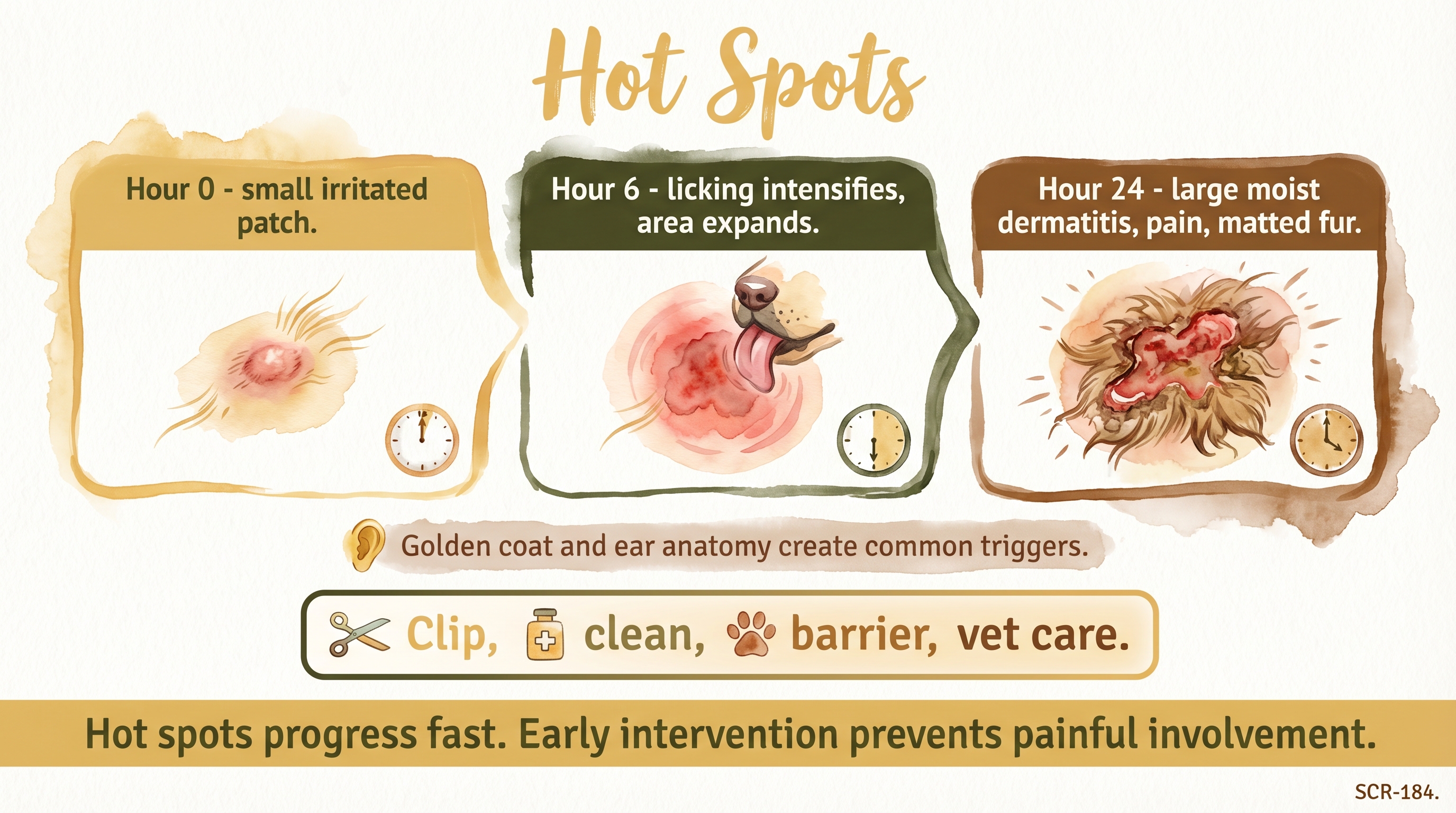
Hot spots progress fast - early intervention prevents painful full-depth skin involvement.
Key Takeaways
- Hot spots are fast, painful, moisture-trapped skin lesions that can develop within hours once self-trauma begins.
- Goldens get them often because dense coat, swimming, ear disease, and allergy commonly overlap.
- The lesion itself needs treatment, but long-term prevention depends on finding and managing the trigger beneath it.
- Large, rapidly spreading, or very painful lesions deserve prompt veterinary attention rather than watchful delay.
The Evidence
This entry uses observed claim-level tags beyond the dedicated EvidenceBlocks below. These tags mark JB program observation or practice-derived claims that need dedicated EvidenceBlock coverage in a later content pass.
- Common puppy health source synthesisdogs
Acute moist dermatitis is a rapidly progressing painful skin lesion driven by self-trauma, moisture retention, and secondary bacterial overgrowth. - Golden-specific clinical contextGolden Retrievers
Dense double coat and common underlying itch triggers make Goldens one of the most familiar hot-spot breeds in practice. - Veterinary dermatology literaturedogs
Management depends on exposing the lesion, controlling infection and inflammation, and identifying the underlying trigger rather than treating the surface alone.
- Dermatology frameworkdogs
Hot spots are usually downstream expressions of underlying itch, moisture retention, or localized pain rather than an isolated primary disease. - Recurrence logicdogs
Repeated lesions should prompt evaluation for allergy, flea exposure, ear disease, or other chronic triggers rather than endless lesion-by-lesion treatment.
- domestic dogs
No published study directly compares the most effective long-term management paths for hot spots (acute moist dermatitis) in dogs across breeds and ordinary home settings.
SCR References
Sources
- Hensel, P., Santoro, D., Favrot, C., Hill, P., & Griffin, C. (2015). Canine atopic dermatitis: Detailed guidelines for diagnosis and allergen identification. BMC Veterinary Research, 11, 196. https://doi.org/10.1186/s12917-015-0515-5
- Favrot, C., Steffan, J., Seewald, W., & Picco, F. (2010). A prospective study on the clinical features of chronic canine atopic dermatitis and its diagnosis. Veterinary Dermatology, 21(1), 23-31. https://doi.org/10.1111/j.1365-3164.2009.00758.x
- Boundary approved by Queue1-DecisionTree: the existing dermatology citations support general allergic-skin and pyotraumatic-dermatitis mechanisms. No controlled Golden Retriever-specific recurrence source was located. Breed-level hot-spot frequency remains an observed clinical pattern rather than a quantified Golden-specific recurrence statistic.