Heritability of Elbow Dysplasia in Dogs
Elbow dysplasia behaves like hip dysplasia in one important way: it is heritable and responds to selection. But it is also more anatomically messy because "elbow dysplasia" is not one lesion. It is an umbrella term covering several developmental pathologies that can converge on the same painful joint outcome, and that umbrella nature makes the genetics meaningfully more complicated than the hip case. That complexity makes honest interpretation especially important, because a breeder or family who treats elbow dysplasia as a single uniform disease will miss the structural subtlety that actually governs how selection works and what phenotypic screening can and cannot tell them. Documented
What It Means
The umbrella nature of the term
Elbow dysplasia is not a single uniform disorder the way many families assume when they hear the phrase. The term usually includes a family of related developmental elbow problems that have distinct anatomical features and at least partly distinct underlying causes. Fragmented medial coronoid process (FMCP) is one of the most common components in many breeds, and it refers to a piece of the coronoid process of the ulna failing to attach or remain attached properly, producing a loose fragment inside the joint. Osteochondritis dissecans (OCD) of the medial humeral condyle is a cartilage disorder in which a fragment of articular cartilage fails to develop normally and can separate from the underlying bone. Ununited anconeal process (UAP) involves the anconeal process of the ulna failing to fuse to the main body of the ulna during development. Elbow incongruity describes a mismatch between the articulating surfaces of the joint, often involving a step between the radius and ulna where the humerus meets them.
These conditions share a practical consequence. They can damage the elbow early in life, trigger inflammatory and mechanical changes within the joint, and lead to osteoarthritis, chronic pain, and reduced function over the dog's lifetime. A dog with any of these lesions can end up with clinical elbow disease that is visibly limiting, and the clinical endpoint often looks similar across different underlying causes even though the starting lesions are biologically different.
Why the mixed pathology complicates the genetics
From a genetic perspective, that mixed pathology matters in ways that breeders and families often miss. Observed-JB If the umbrella term contains multiple partly distinct sub-problems, the heritability estimates will depend on exactly which phenotype is being measured and how the screening system classifies the joint. A heritability estimate for "elbow dysplasia" that pools FMCP, OCD, UAP, and incongruity into one grade is not the same quantity as a heritability estimate for any one of those lesions separately, and the pooled estimate may mask important differences between the sub-problems.
Some evidence suggests that the different elbow lesions have partly overlapping and partly distinct genetic architectures. Documented Fragmented coronoid process appears to be highly polygenic in the breeds where it has been studied most carefully, and the genetic risk factors are not yet mapped to specific loci with the clarity that would support direct genetic testing. Osteochondritis dissecans shares some risk factors with other osteochondroses affecting different joints, suggesting that part of the genetic liability is for cartilage development generally rather than for elbow disease specifically. Ununited anconeal process has breed-specific patterns that suggest the genetic architecture may differ across populations in ways the broader literature has not fully resolved.
None of this is a reason to give up on elbow screening. It is a reason to take the genetics seriously enough to recognize that simple DNA answers are not currently on the table for any of these conditions, and that the umbrella term should not be treated as if it referred to one neat heritable trait with one clean inheritance pattern.
The heritability estimates
Even with that complication, the literature still supports a broad conclusion. Elbow dysplasia is heritable and selection can reduce its prevalence in populations where breeders screen consistently and act on the results. Many published estimates fall in a low-to-moderate range, often around 0.2 to 0.4 depending on population and phenotype definition, which places elbow heritability in roughly the same ballpark as hip heritability even though the underlying architecture is different.
That resemblance to hips is useful as a mental anchor, but it should not hide the extra trait-definition complexity in elbows. A hip grade captures mostly one anatomical question (how well does the ball fit the socket and how much does the joint allow abnormal motion), while an elbow grade is aggregating information about a joint that can go wrong in several distinct ways. The heritability number has to be interpreted against that backdrop, and breeders who treat the two grading systems as perfectly analogous are flattening real biological differences.
The response-to-selection evidence in elbows is also real, which is ultimately the strongest practical support for taking elbow screening seriously. Populations where breeders have consistently screened parents and selected against affected dogs have seen measurable reductions in elbow dysplasia prevalence over generations, and that real-world outcome is what validates the heritability estimates more convincingly than any single statistical analysis.
Why phenotypic screening remains central
This is one reason phenotype-based screening remains central to elbow management. A breeder is not managing a single named gene with a single validated DNA test. The breeder is managing a cluster of developmental joint outcomes whose genetic architecture is real but distributed across multiple loci and multiple related lesions. Direct radiographic evaluation of the elbow joint, through recognized grading systems like the OFA elbow screening protocol or the IEWG (International Elbow Working Group) grades, is currently the most reliable way to identify dogs whose phenotypes should exclude them from breeding.
Phenotypic screening captures the actual state of the joint rather than trying to infer it from a genetic proxy that does not yet exist in adequately validated form. Documented When the genetic architecture is complex and the molecular tools are not mature, direct measurement of the thing being selected for is usually the best available option, and elbow dysplasia is a clear case where that principle applies.
The gene-environment interplay
As with hips, elbow expression is modulated by developmental factors that interact with genetic liability to determine individual outcomes. Growth rate matters, because rapid growth on excessive calories can stress developing joints in ways that worsen expression of underlying predisposition. Documented Body condition matters throughout the growth period for the same reasons it matters in hips, with the added concern that the elbow joint bears different loading patterns than the hip and may respond differently to excess mechanical stress. Exercise patterns during growth can also influence how developmental joint problems progress.
This means that a responsible program treats elbow health as a combined project of genetic selection, phenotypic screening, and developmental husbandry rather than assuming that any one layer alone is sufficient. Families who take home a puppy from a program with strong elbow screening still have a role to play in the developmental phase, and the breeder's guidance on growth management and early exercise is part of the integrated health strategy rather than an afterthought.
Why It Matters for Your Dog
Families often think orthopedic screening is just a breeder checkbox that gets ticked and forgotten once the X-rays come back acceptable. The literature says it is considerably more than that. It is one of the ways population genetics gets translated into practical health improvement over time, and the practice of consistent screening is how breed populations actually move toward better joint health rather than drifting in whatever direction market pressure happens to point.
That means elbow results matter for more than the individual dog being screened. They matter because they inform whether the breeder is moving the line toward more or less orthopedic soundness across generations, and whether the program is contributing to the slow improvement of the wider breed population or free-riding on the screening efforts of others. Families buying from a program with weak or inconsistent elbow screening are not just accepting slightly higher individual risk for their own puppy; they are also supporting a breeding approach that contributes less to the long-term health of the breed they have chosen to love.
That does not mean every elbow-screened parent will produce elbow-perfect puppies. It means that the probability distribution of outcomes is better when the parents and grandparents have been through consistent screening over time, and that the breeder has been selecting against affected dogs rather than ignoring the question.
For JB, the relevance is straightforward and integrated with the broader philosophy. A dog carrying chronic elbow pain is less physically free, less behaviorally stable under stress, and less likely to become the kind of socially useful adult the program is built around. The Five Pillars work best in a body that can actually relax and move without discomfort, and orthopedic soundness is not separate from lived temperament. The program treats elbow screening as part of the same commitment to producing dogs that can live the life the philosophy describes, and the integrated approach to health and temperament is one of the things that distinguishes a serious breeding program from a superficially similar one.
What This Cannot Predict
Elbow heritability cannot tell you whether one puppy's elbows will remain normal throughout its life, because the polygenic architecture and environmental modulation leave meaningful individual variation even around favorable parental phenotypes. Documented
It cannot guarantee that two screened-normal parents will never produce an affected dog, because the umbrella term covers multiple lesions whose full genetic architecture is not transparent to current screening methods and because parental phenotype is not a complete picture of the genetic liability being passed down.
It cannot reduce a multi-lesion developmental problem to one simple genomic answer, because no such answer currently exists and the biology suggests that any future answer will need to respect the distinct genetic contributions to each component of the elbow dysplasia picture.
And it cannot turn population-level improvement into an individual guarantee, because the statistics describe variance structure across dogs in the population rather than the outcome of any specific future puppy.
The rule is the same as elsewhere in the heritability literature: elbow dysplasia heritability describes population variance and selection response. It does not let anyone predict the fate of one puppy with certainty, and it does not let anyone substitute one number for the integrated screening and management strategy the condition actually requires.
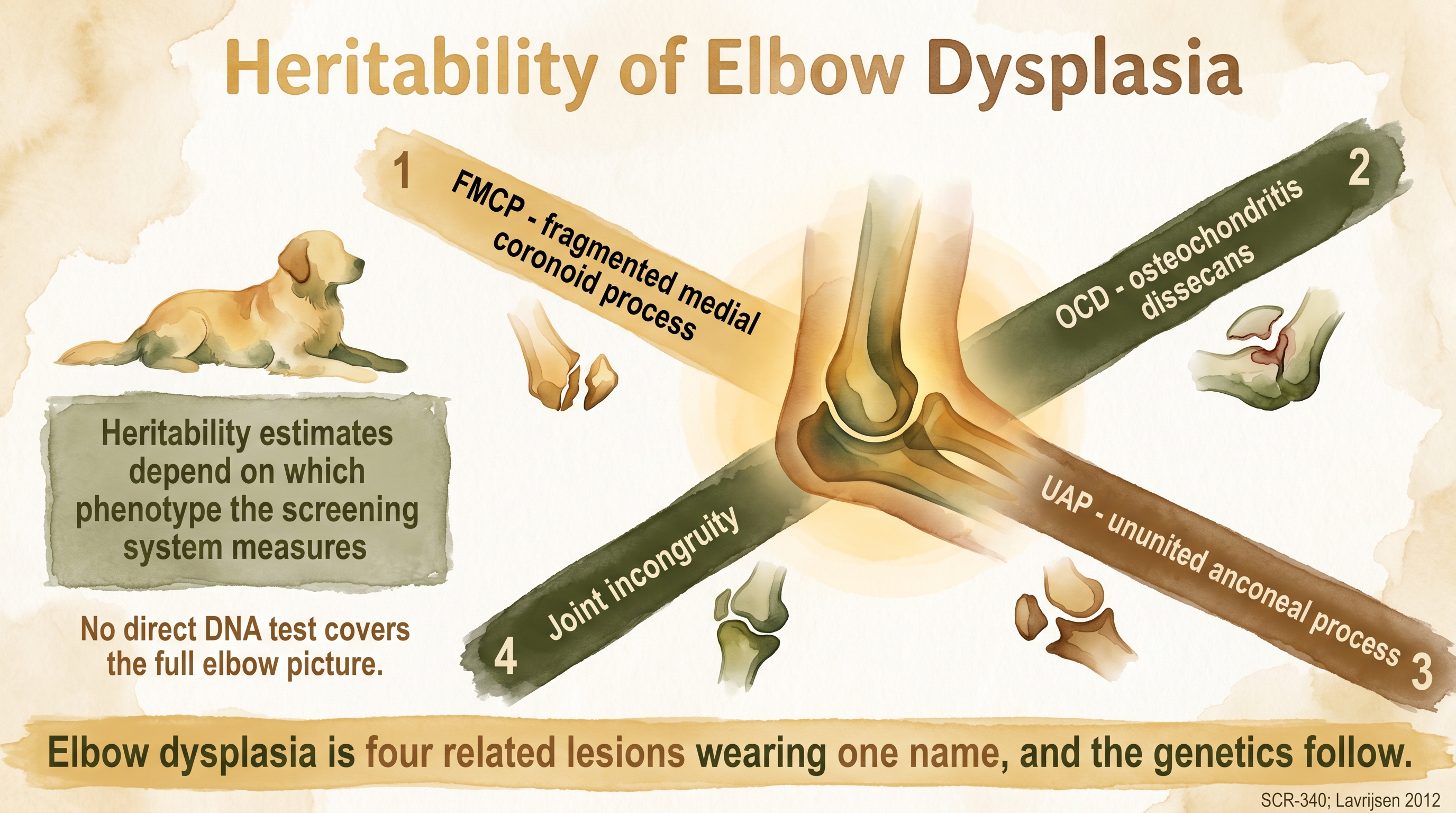
Elbow dysplasia is four related lesions wearing one name, and the genetics follow.
Key Takeaways
- Elbow dysplasia is heritable, but the genetics are complicated by the fact that the umbrella term covers multiple related elbow pathologies.
- Low-to-moderate heritability still supports meaningful selection over time.
- Population-level improvement under screening does not turn parental normality into an individual puppy guarantee.
- Phenotype-based elbow screening remains important because the condition is polygenic and developmentally expressed rather than a simple one-gene trait.
- Integrated orthopedic management combines parental screening, line history, and post-placement growth husbandry for the full health picture.
The Evidence
This entry uses observed claim-level tags beyond the dedicated EvidenceBlocks below. These tags mark JB program observation or practice-derived claims that need dedicated EvidenceBlock coverage in a later content pass.
- Canine orthopedic literaturedogs
Elbow dysplasia and elbow-dysplasia-related phenotypes show documented heritability in dogs, often in a low-to-moderate range depending on the population and phenotype definition. - Retriever and multi-breed elbow studiesdogs
The umbrella nature of elbow dysplasia means heritability estimates can vary because fragmented coronoid process, osteochondrosis, incongruity, and related lesions are not genetically identical problems. - Screening science source synthesisdogs
Population-level reductions under sustained screening support the conclusion that elbow dysplasia responds to breeding selection even though individual outcomes remain variable.
- Developmental orthopedic literaturedogs
Growth rate, body condition, and developmental load can influence expression of elbow disease in genetically predisposed dogs, but they do not erase the heritable component.
No prospective long-term study has directly compared outcomes in dogs from phenotype-screened versus unscreened lines across multiple generations, controlling for other breeding priorities and population structure.
SCR References
Sources
- Lavrijsen I.C.M., Heuven H.C.M., Voorhout G., Meij B.P., Theyse L.F.H., Leegwater P.A.J., & Hazewinkel H.A.W. (2012). Phenotypic and genetic evaluation of elbow dysplasia in Dutch Labrador Retrievers, Golden Retrievers, and Bernese Mountain Dogs. The Veterinary Journal, 193(2), 486-492. doi:10.1016/j.tvjl.2012.01.001
- Carpenter L.G., Schwarz P.D., Lowry J.E., Park R.D., & Steyn P.F. (1993). Comparison of radiologic imaging techniques for diagnosis of fragmented medial coronoid process of the cubital joint in dogs. Journal of the American Veterinary Medical Association, 203(1), 78-83.
- Krontveit R.I., Nødtvedt A., Sævik B.K., Ropstad E., & Trangerud C. (2012). Housing- and exercise-related risk factors associated with the development of hip dysplasia as determined by radiographic evaluation in a prospective cohort of Newfoundlands, Labrador Retrievers, Leonbergers, and Irish Wolfhounds in Norway. American Journal of Veterinary Research, 73(6), 838-846. doi:10.2460/ajvr.73.6.838