Behavioral Effects of Gonadectomy
Behavior is one of the most overconfident parts of the spay-neuter conversation. People routinely say spaying or neutering will calm a dog down, prevent aggression, fix reactivity, or make adolescence easier. Others claim the opposite with equal certainty. The literature does not support that level of confidence in either direction. The safest summary is narrower: gonadectomy can affect some behavior patterns, but the effects are usually modest, inconsistent, and much less decisive than the orthopedic and cancer trade-offs in Golden Retrievers. Mixed Evidence
What It Means
The Most Common Claims
Families usually hear some version of these neutering prevents aggression; spaying or neutering calms dogs down; delaying surgery creates better maturity; and early surgery causes fear and anxiety. Observed-JB
Each of those contains a fragment of the real literature and a great deal of simplification.
What the Evidence Strongly Rejects
The cleanest supported correction is that gonadectomy does not reliably reduce aggression.
That matters because aggression reduction has long been one of the most common justifications offered to families as though it were an established benefit. The SCR says the opposite more carefully familiar-person aggression is not reliably improved; dog-directed aggression is not reliably improved; and any stranger-aggression changes are small and not the same thing as a broad behavioral solution.
That alone should downgrade how confidently this topic is discussed in clinics and online.
Fearfulness and Noise Sensitivity
The second important correction is that early gonadectomy is associated in several datasets with greater fearfulness, noise sensitivity, and related problem behaviors.
This is not a claim that every early-altered dog becomes behaviorally fragile. It is a signal that the old universal reassurance, "there is no downside and behavior will improve," is too casual.
The strongest careful way to say it is some fear-related outcomes increase in several datasets; the mechanism is plausible but not fully settled; and the effect is real enough to include in counseling.
Why the Literature Stays Messy
Behavior studies are hard for reasons that health studies are not. Documented
Major problems include caregiver-report bias, selection bias about who alters early versus later, different environments after surgery, inconsistent outcome definitions, and modest effect sizes.
This is why two studies can both be useful and still not produce a simple universal conclusion. Documented
Why It Matters for Your Dog
What Does Seem More Reliable
The literature is somewhat stronger for a narrow set of sexually dimorphic behaviors, especially male roaming to seek females; some urine-marking reduction; and some reduction in reproductive competition behavior.
Those are real, but they are much narrower than the broad claim that gonadectomy "fixes behavior."
That distinction matters a lot in family counseling.
Why Behavior Is Usually a Secondary Timing Consideration
For Goldens, the orthopedic and cancer timing literature is stronger and more consequential than the behavior literature. Heuristic That is why behavior should usually be treated as a secondary input rather than the primary driver.
This page is not saying behavior is irrelevant. It is saying the evidence weight is lower, the effects are smaller, and the conclusions are less stable.
So if a family is deciding timing mainly because they hope surgery will create a calmer, easier dog, they are leaning too hard on one of the weaker parts of the evidence base.
The Hormone-Sparing Note
Hormone-sparing data matter here too because they suggest a more intact-like behavioral profile than traditional gonadectomy in available datasets.
Again, that is interesting and relevant. It still does not justify sweeping claims that hormones alone explain mature behavior. Documented Raising, environment, sleep, structure, learning history, and human consistency remain much more powerful day-to-day determinants.
The Most Honest Family-Level Conclusion
The best current conclusion is do not expect gonadectomy to solve aggression; do not ignore the fear-related caution signal; do not overweight behavior compared with joint and cancer evidence; and make behavior part of the discussion, not the whole decision.
That is less dramatic than the folklore. It is also more useful.
When to See a Veterinarian
Talk with a veterinarian or qualified behavior professional if behavior is a major reason you are considering surgery timing; your dog is showing aggression, fearfulness, or noise sensitivity already; you are hoping surgery will fix an existing behavior problem; and you need help separating developmental adolescence from clinically meaningful distress.
Behavior problems usually need behavior treatment, environmental change, and management, not only endocrine decision-making.
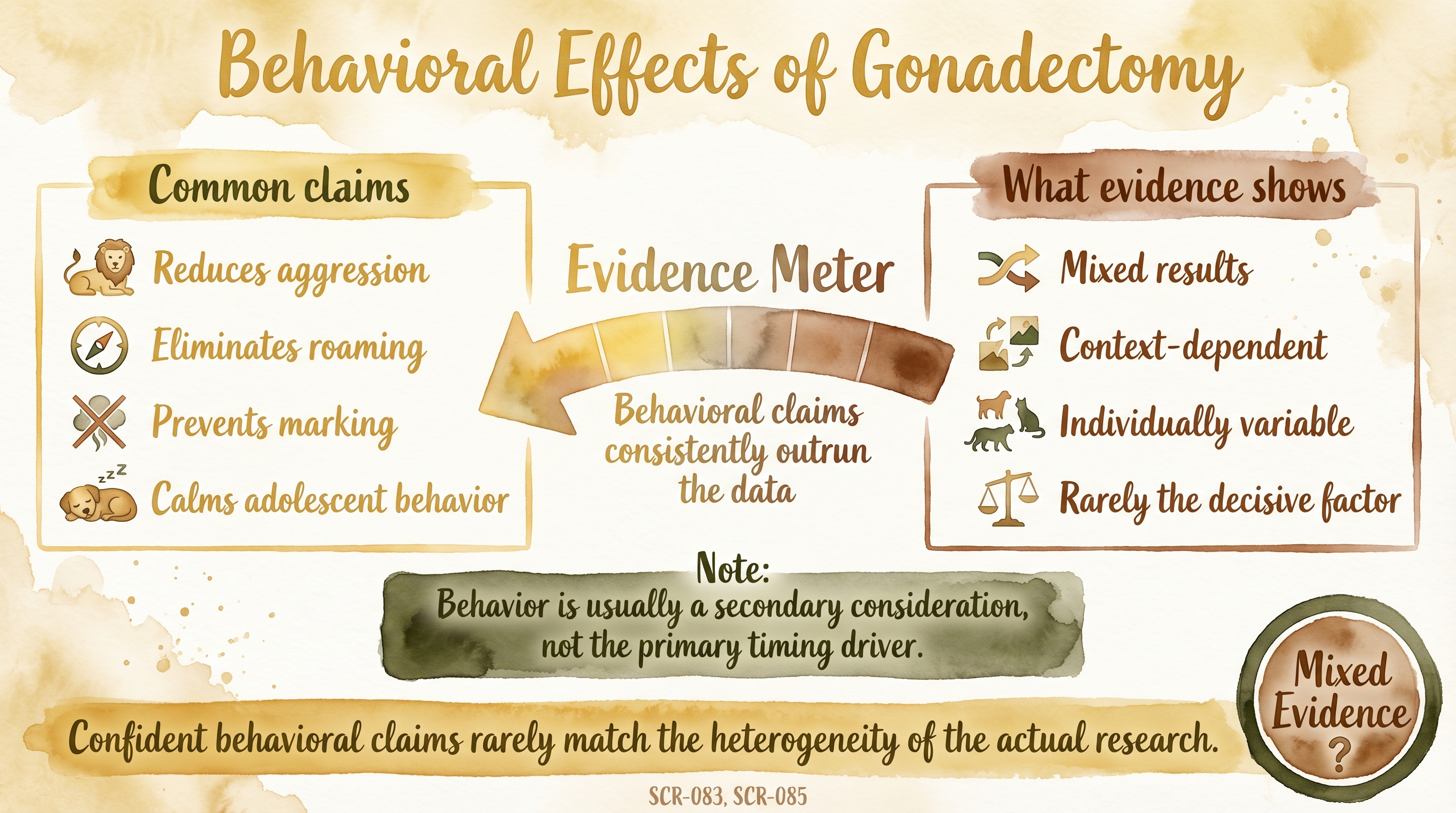
Confident behavioral claims rarely match the heterogeneity of the actual research.
Key Takeaways
- The evidence does not support gonadectomy as a reliable fix for aggression or a broad behavioral reset.
- Early gonadectomy does carry a meaningful caution signal around fearfulness and noise sensitivity in several datasets.
- Any real benefits are narrower and usually involve sexually dimorphic nuisance behaviors rather than total behavioral maturity.
- For Goldens, behavior should usually be a secondary timing consideration compared with joint and cancer evidence.
The Evidence
This entry uses observed claim-level tags beyond the dedicated EvidenceBlocks below. These tags mark JB program observation or practice-derived claims that need dedicated EvidenceBlock coverage in a later content pass.
This entry uses heuristic claim-level tags beyond the dedicated EvidenceBlocks below. These tags mark JB interpretive application rather than direct study findings.
- SCR-083 supportdogs
Gonadectomy does not reliably reduce aggression across the dog population. - SCR-084 supportdogs
Early gonadectomy is associated in multiple datasets with greater fearfulness and noise-related behavioral problems. - Behavior-review literaturedogs
The narrowest more reliable benefits involve some sexually dimorphic nuisance behaviors rather than broad emotional stability or trainability.
- C-BARQ and owner-report literaturedogs
Large behavior datasets add scale but remain vulnerable to reporting bias, selection bias, and modest effect sizes that do not cleanly settle causality. - SCR-086 supportdogs
Hormone-sparing groups look more intact-like behaviorally in available data, which is interesting but still does not convert behavior into the main timing driver.
- domestic dogs
No published study directly resolves every practical trade-off families face when using behavioral effects of gonadectomy across sex, breed, household, and management contexts.
SCR References
Sources
- Farhoody, P., Mallawaarachchi, I., Tarwater, P. M., Serpell, J. A., Duffy, D. L., & Zink, C. (2018). Aggression toward familiar people, strangers, and conspecifics in gonadectomized and intact dogs. Frontiers in Veterinary Science, 5, 18. https://doi.org/10.3389/fvets.2018.00018
- Zink, M. C., Farhoody, P., Elser, S. E., Ruffini, L. D., Gibbons, T. A., & Rieger, R. H. (2014). Evaluation of the risk and age of onset of cancer and behavioral disorders in gonadectomized Vizslas. Journal of the American Veterinary Medical Association, 244(3), 309-319. https://doi.org/10.2460/javma.244.3.309
- Houlihan, K. E. (2017). A literature review on the welfare implications of gonadectomy of dogs. Journal of the American Veterinary Medical Association, 250(10), 1155-1166. https://doi.org/10.2460/javma.250.10.1155
- Zink, C., Delgado, M. M., & Stella, J. L. (2023). Vasectomy and ovary-sparing spay in dogs: Comparison of health and behavior outcomes with gonadectomized and sexually intact dogs. Journal of the American Veterinary Medical Association, 261(3), 366-374. https://doi.org/10.2460/javma.22.08.0382
- Starling, M., Fawcett, A., Wilson, B., Serpell, J., & McGreevy, P. (2019). Behavioural risks in female dogs with minimal lifetime exposure to gonadal hormones. PLOS ONE, 14(12), e0223709. https://doi.org/10.1371/journal.pone.0223709