The Belyaev Farm Fox Experiment
Few experiments in evolutionary biology have shaped dog-origin conversations as strongly as the farm fox project begun by Dmitri Belyaev in Novosibirsk in 1959. Belyaev and later Lyudmila Trut used silver foxes from commercial fur-stock lines and selected breeders almost entirely on one criterion: how calmly they responded to human approach and handling. Over generations, the tame-selected line did not merely become easier to touch. It also developed piebald coats, curled tails, altered reproductive timing, lower baseline cortisol, and far greater willingness to engage with humans. Hare et al. 2005 then showed that tame foxes followed human gestures more like dog puppies than like wild foxes. Kukekova et al. 2018 added genomic evidence that behavioral divergence under tame versus aggressive selection leaves detectable signatures in the fox genome. Those facts explain why the experiment sits at the center of modern domestication theory. It demonstrates, under controlled selection, that choosing for tameness can drive a surprisingly broad package of behavioral and bodily changes. Documented
At the same time, the experiment is not a direct replay of dog domestication. Lord et al. 2020 argued that some syndrome traits were already present in the fur-farm founders and that the idea of a universal domestication syndrome has been overstated. The farm fox work therefore supports plausibility, not proof, for canine history.
That combination makes the experiment unusually valuable. It is one of the strongest empirical demonstrations in the field, and one of the clearest lessons in why good science still needs careful rhetorical boundaries.
It is also one of the rare places where domestication logic was tested prospectively rather than reconstructed after the fact. That alone gives the experiment unusual interpretive weight in the broader literature.
What It Means
How the Experiment Was Built
Belyaev's core insight was that domestication may turn on a relatively small number of behavioral selection pressures. Starting in 1959, his team tested juvenile foxes for their response to human contact. Animals that showed the least fear and aggression toward handlers were given the highest tameness rankings and used disproportionately for breeding. Aggressive and avoidant foxes were retained as comparison lines. That design matters because it isolates the selective target more cleanly than many historical domestication stories ever can.
This was not a training project in the ordinary sense. The foxes were not made tame by drills. They were sorted by inherited behavioral tendency, then bred. That distinction is why the experiment carries so much weight in arguments about domestication as selection rather than as teaching.
What Changed Across Generations
The headline result is not just that the foxes tolerated humans better. Within roughly ten generations, some tame-line foxes approached people readily, wagged their tails, and sought contact. By later generations, the researchers reported changes in coat coloration, ears, tails, reproductive cycles, hormone profiles, and general social behavior. Trut 1999 and Trut et al. 2009 made these findings widely known, while Hare et al. 2005 showed that experimentally domesticated foxes could use human pointing and gaze cues in ways absent in non-selected foxes.
That combination is what made the experiment seem so powerful. Select on one dimension of behavior, and correlated traits appear elsewhere. For theorists interested in dog domestication, the implication was immediate: perhaps early dogs also emerged when selection repeatedly favored animals that were less fearful and more socially manageable around humans. Documented
The fox work is one of the strongest demonstrations that stable social traits can be selected into a lineage. It supports the idea that behavior belongs near the center of domestication, not at the decorative edge.
Why the Experiment Became Controversial
The criticism is real and scientifically important. Lord et al. 2020 argued that the fox founders were not wild-naive animals but fur-farm foxes already shaped by captivity, and that some supposed domestication-syndrome traits were not novel emergences from tameness selection alone. Documented More broadly, they challenged the idea that there is one universal domestication syndrome appearing in the same form across all domesticates. Sanchez-Villagra et al. 2023 likewise argued that the mechanism behind syndrome traits may not be reducible to the classic neural-crest account.
These critiques do not erase the experiment. They change what the experiment can honestly be used to say. It is strongest as evidence that behavioral selection can produce far-reaching correlated change. It is weaker as evidence that dog domestication must have proceeded through exactly the same mechanism or that one developmental theory explains every domestic species.
That is also why the experiment remains so useful to careful readers. Strong science is not only about what survives criticism untouched. It is also about what still stands after the easy overclaims have been stripped away. When the fox findings are narrowed to demonstrable points about selection on tameness, correlated change, and altered social cognition, they remain unusually impressive.
What the Fox Experiment Actually Proves
The experiment proves that selecting against fear and aggression can reorganize social behavior and physiology much faster than casual intuition would predict. Documented It shows that domestication-like traits can arise as correlated outcomes rather than as individually selected ornaments. It also shows that interspecies social cognition can become easier when reactive fear is reduced. What it does not prove is that dogs self-domesticated in a pure campside scavenger scenario, that foxes and proto-dogs shared identical founder conditions, or that every morphological trait in domestic mammals must trace to one uniform causal pathway.
That narrower but stronger reading is the one the dispatch source file recommends, and it is the most intellectually useful one.
In other words, the foxes are best read as a demonstration of mechanism possibility under selection, not as a historical transcript of what happened in canid prehistory.
Why It Matters for Your Dog
For families, the fox experiment matters because it helps answer a practical question that appears everywhere in dog culture: are calmness, sociability, and human orientation the result of training layered onto a fundamentally untamed animal, or can they be deep traits shaped by selection? The fox work strongly supports the second possibility. A lineage can become easier to live with because its biology shifts, not merely because each individual is taught better tricks.
That matters in the home because it reframes what families should expect from development. A Golden Retriever puppy is not waiting for training to make him capable of social ease with humans. He already comes from a lineage shaped by generations of domestication and later breed selection. Training can refine behavior, but it is working on top of inherited social architecture rather than manufacturing that architecture from nothing. Documented
The fox experiment also clarifies why fear matters so much. When the selected trait is reduced fear toward humans, the downstream effects are not minor. Social attention changes. Approach behavior changes. Physiology changes. The whole developmental environment changes because the animal no longer has to spend as much of life organizing around avoidance and conflict. That helps explain why a chronically high-pressure household can feel so biologically mismatched for many pet dogs. It pushes in the opposite direction from the selection history that likely made close human life possible in the first place.
Families also gain a more disciplined view of breed differences from this model. A cooperative breed is not simply a moral success story or a result of better caregivers. It is partly the outcome of selection on temperament and sociability traits over many generations. Goldens make this tangible. Their softness with humans, readiness for affiliation, and social recoverability are not random gifts. They are the sort of traits that selection can amplify when humans repeatedly favor life beside people rather than life against them.
At the same time, the fox experiment keeps families from overclaiming. Selection matters, but selection is not destiny for every individual. A domesticated lineage can still produce anxious, reactive, or impulsive dogs. Development, environment, illness, pain, and household patterning all remain powerful. The point is not that genes erase raising. The point is that raising works within a species history that already matters.
This becomes especially important when people interpret problem behavior as evidence that pressure is the only serious answer. The fox findings suggest a different story. Lower fear and lower reactive aggression are not soft extras. They may be part of the reason the interspecies bond works at all. A strategy that repeatedly drives fear, confusion, or social conflict upward may secure visible compliance in some moments, but it does so by leaning away from the very dimension the domestication literature highlights most strongly.
Families can also use the experiment to understand why social change often looks bundled. A dog who becomes chronically calmer in a coherent home may not merely stop doing one annoying thing. Recovery, attention, social tolerance, sleep, and flexibility may all improve together because the system is integrated. That is not the same as saying one month of good routine replicates 60 years of fox selection. It is saying the experiment teaches a general lesson about how central emotional regulation is to the whole animal.
The project further matters because it breaks the myth that domestication means humans imposed endless technique on wild animals until they submitted. The foxes changed because breeder choice changed who reproduced. In dogs, the analogous point is that the species-level background is older and deeper than any modern method debate. The dog is already the output of historical selection for living with humans.
Once families understand that, some of the daily work becomes easier to interpret. Calm homes stop looking passive. Thoughtful structure stops looking unnecessary. They begin to look like conditions that are more compatible with the kind of animal domestication helped produce.
The experiment also helps families distinguish between forcing behavior and shaping conditions. If one of the deepest levers in domestication is who can stay composed enough to function socially, then the home should not be organized as a place that repeatedly manufactures panic and then celebrates suppression. Families still need boundaries, but the boundaries work best when they preserve social steadiness instead of repeatedly detonating it.
That is part of why the fox work remains so memorable. It gives families a concrete image of how strongly selection on social behavior can matter, which helps them take social-development variables more seriously in their own homes.
What This Means for a Just Behaving Family
JB families should read the fox experiment as a powerful model for one thing above all: social behavior is not superficial. Selection on fear and tolerance can reorganize the whole animal.
That supports taking Calmness, Mentorship, and Structured Leadership seriously in development. A dog lineage shaped by reduced reactive aggression and increased social manageability is not likely to flourish best in a household built on chronic excitement, instability, or conflict.
JB should still be careful with the analogy. The fox experiment is documented for foxes. Any step from fox results to the exact story of dog domestication is interpretive unless independently confirmed in dogs. The strongest transfer is not "therefore dogs definitely self-domesticated this way." The strongest transfer is "selection on tameness can cause broad correlated change and greater interspecies social ease."
For a JB family, that is already a meaningful lesson. It means the traits most worth protecting in puppyhood are not just outward manners, but the deeper social and emotional conditions that let a domesticated canid remain easy to live with.
That reading also encourages patience. If calmness and human social fluency are central qualities, then building them in the home is not secondary to "real training." It is part of the real developmental work.
The foxes do not tell a JB family every detail of what to do. They do tell the family that fear reduction, social readability, and stable human relationship belong closer to the center of the picture than the training market often admits.
They also remind the family that selection and daily life point in the same direction more often than popular culture suggests. When a puppy is given predictable routines, calm adults, and clear social limits, the family is not dodging reality. It is supporting the sort of regulated social functioning that domestication research repeatedly treats as foundational. Documented
That is a strong enough lesson to carry forward even with all the necessary caveats still in place.
For JB, the most defensible takeaway is simple and strong. Selection on social tolerance can alter far more than momentary manners, which means the family should treat fear, recoverability, and readable relationship as central developmental concerns rather than as optional finishing touches.
It also helps the family read calmness more seriously. If selection on social tolerance can move physiology, cognition, and social ease together, then protecting those qualities in daily life is not a decorative choice. It is a way of supporting traits that domestication research treats as central.
That lesson lands cleanly in the home. Social tolerance is not fluff around the real animal. It is one of the variables most capable of reorganizing the real animal.
That is already a profound lesson for any raising philosophy.
That is why the fox work still matters so much.
That should not be treated lightly.
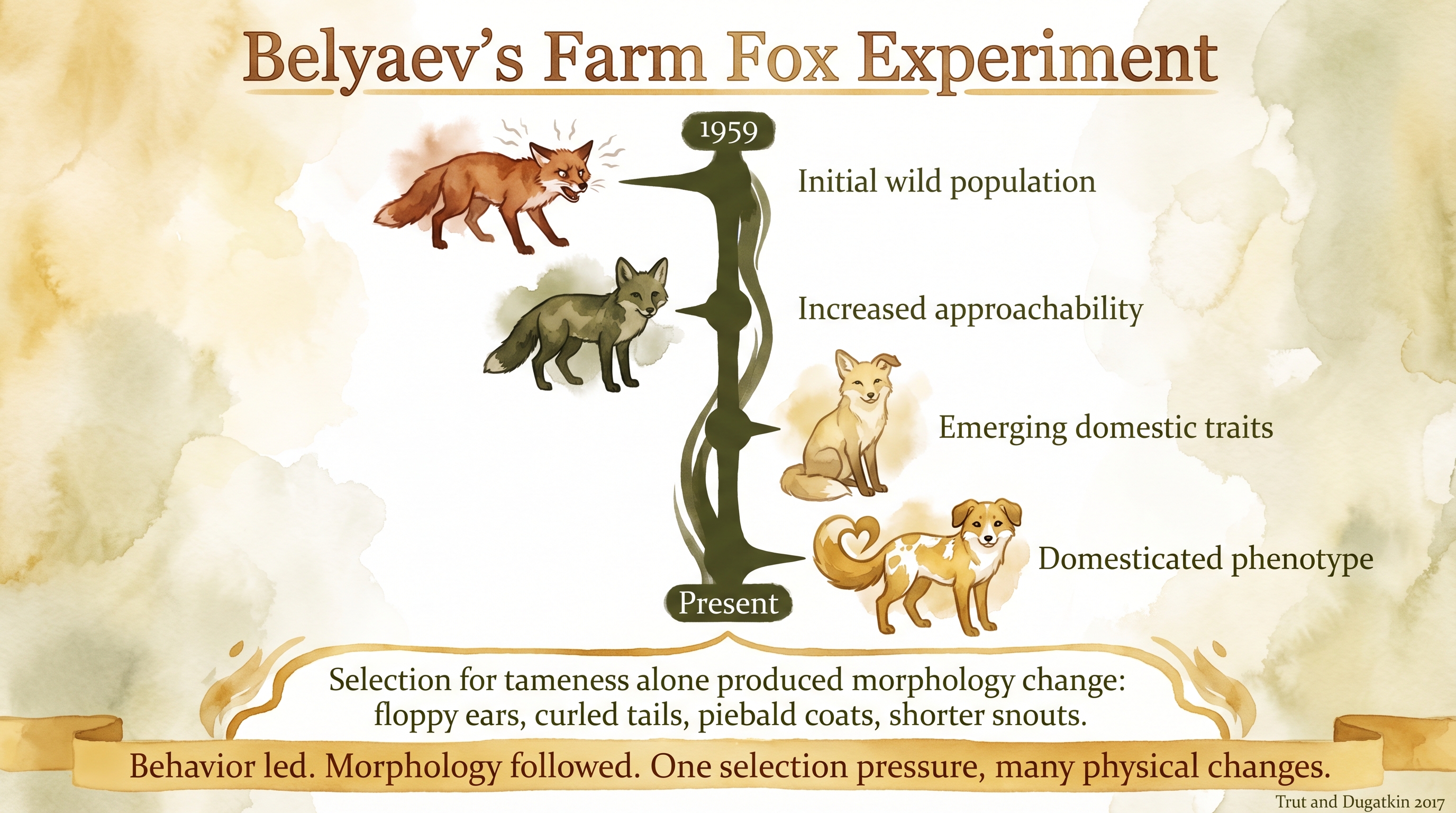
Selection for behavior produced morphology change. One pressure, many effects.
Key Takeaways
- The Belyaev fox project is one of the clearest demonstrations that selection for tameness can produce broad correlated change.
- Its strongest lesson is about plausibility and mechanism, not about proving the exact historical pathway of dog domestication.
- The experiment supports taking fear reduction and social tolerance seriously as deep biological variables rather than cosmetic training outcomes.
- For JB, the fox work is most useful when read as support for the importance of calm social functioning, not as a license to overclaim about canine history.
The Evidence
- Trut (1999) and Trut et al. (2009)silver foxes
Describe the long-running tame-selection experiment and the correlated behavioral, morphological, and physiological changes that emerged. - Hare et al. (2005)tame and non-selected foxes
Found that tame foxes used human social cues in ways absent in the control foxes, strengthening the cognitive significance of tameness selection. - Kukekova et al. (2018)tame and aggressive fox lines
Identified genomic regions associated with the behavioral divergence produced by selection. - Lord et al. (2020)domestication theory
Argued that founder effects and overstatement of a universal syndrome require more caution in how the fox results are generalized.
No published study directly tests the practical implications of the belyaev farm fox experiment for domestic dog raising programs. The application to household dog raising remains an interpretive synthesis rather than a directly tested intervention finding.
SCR References
Sources
- Trut, L. N. (1999). Early canid domestication: the farm-fox experiment. American Scientist.
- Trut, L. N., Oskina, I., and Kharlamova, A. (2009). Animal evolution during domestication: the domesticated fox as a model. BioEssays.
- Hare, B., et al. (2005). Social cognitive evolution in captive foxes is a correlated by-product of experimental domestication. Current Biology.
- Kukekova, A. V., et al. (2018). Red fox genome assembly identifies genomic regions associated with tame and aggressive behaviours. Nature Ecology and Evolution.
- Lord, K. A., et al. (2020). The history of farm foxes undermines the animal domestication syndrome. Trends in Ecology and Evolution.