The Self-Domestication Hypothesis
Compound evidence detail1 SCR / 2 parts
- Documentedself-domestication and commensal-scavenging research as the leading evolutionary-biology account of canine domestication
- HeuristicJB-specific interpretation linking the Five Pillars to selection pressures within that self-domestication framework
The self-domestication hypothesis is the broader theoretical frame around the dog-origin story. Instead of asking only how humans domesticated another species, it asks whether a population can begin moving toward domestication by selecting itself for tameness, reduced reactive aggression, and better fit with a new social ecology. In dogs, that means the initiating pressure may have come less from deliberate human breeding than from repeated success by wolf-like animals that could approach, remain near, and exploit human-associated spaces without escalating conflict. In the wider comparative literature, Brian Hare and Richard Wrangham have used self-domestication to think about bonobos and even aspects of human evolution. Dmitri Belyaev's farm fox work is then treated as an experimental analogue: select on tameness and a cascade of correlated behavioral and morphological traits follows. The dispatch source review is careful here. It treats self-domestication as a strong interpretive framework supported by converging evidence, but not as a simple consensus statement that erases all alternatives. It also marks an important distinction: reduced fear and increased sociability as major selection targets are strongly supported, while the exact initiating pathway remains genuinely contested. Documented
That distinction is why the hypothesis is so valuable. It is broad enough to organize real findings across species, genetics, behavior, and development, yet bounded enough to keep the field from pretending more is settled than actually is.
For JB, this entry is especially important because self-domestication explains why relational traits can sit near the center of species formation without turning that observation into magical proof for every later philosophical claim.
Its value is therefore not only explanatory. It is also disciplinary. It tells researchers which parts of the dog story can be spoken strongly and which parts still need explicit hedging.
What It Means
The Theory Starts With Selection Against Reactive Aggression
The cleanest core of self-domestication is selection against reactive aggression. Hare, Wobber, and Wrangham 2012 argued that bonobo psychology can be understood partly through this lens. In dogs, the equivalent claim is that early dog-like populations gained an advantage when they became less fear-driven and less conflict-prone around humans. repeatedly returns to this point because it is where the dog literature, the fox analogue, and the broader comparative theory overlap.
This matters because the theory is not a sentimental story about love making wolves become dogs. It is a selection story about which individuals could best survive inside a social environment that punished panic and escalatory aggression while rewarding proximity, tolerance, and flexibility.
Why the Framework Reaches Beyond Dogs
Self-domestication became scientifically interesting partly because it seemed to explain repeated patterns across very different lineages. Documented Bonobos are often contrasted with chimpanzees as a lineage that may have undergone selection against reactive aggression. Some human-evolution theorists use similar logic to explain reduced craniofacial robusticity, increased prosocial tolerance, and shifts in coalitionary aggression. Those applications remain more contested than the broad dog discussion, but they matter because they show the framework is not a one-species curiosity.
The value of that broader reach is conceptual. If multiple social species can shift substantially when selection changes who gets to remain inside the group without chronic conflict, then dogs no longer look like an isolated oddity. They look like one especially consequential example of a wider evolutionary pattern.
Self-domestication does not describe animals becoming softer in a vague way. It describes selection favoring organisms that can navigate social environments with lower conflict cost and finer social responsiveness.
The Domestication Syndrome Question
One reason the self-domestication hypothesis became influential is that domesticated animals often share a cluster of recurring traits: reduced fear, altered reproductive timing, piebald coloration, shorter muzzles, smaller teeth, floppy ears, and juvenile-like social behavior. Wilkins, Wrangham, and Fitch 2014 proposed that a mild neural crest cell deficit could help explain why these seemingly separate features travel together. The Belyaev fox experiment then appeared to offer dramatic support, because selecting only for tameness produced many of those traits.
Yet the story is not closed. Lord et al. 2020 challenged the idea that the fox results prove a universal domestication syndrome, and Sanchez-Villagra et al. Documented 2023 argued for a different mechanistic account centered on reproductive disruption rather than neural crest cells alone. So the field has moved from simple triumph to serious mechanism debate. That is healthy. The phenomenon of correlated change remains compelling even while the exact developmental pathway stays unsettled.
Why Dogs Fit the Framework Better Than the Cartoon
Dogs fit the framework because their evolutionary story clearly involves human-associated selection on sociability, fear regulation, and ecological flexibility. Documented They do not fit the cartoon version where a single gene or a single event explains everything. Bergstrom 2022, Axelsson 2013, vonHoldt 2017, and Pendleton 2018 all point to different pieces of the puzzle. Some involve diet. Some involve hypersociability. Some involve developmental pathways. Some involve ancient population structure. The self-domestication hypothesis earns its keep by giving those different findings a shared direction of travel without pretending they collapse into one neat mechanism.
That is why the dispatch source review lands on a carefully hedged position: self-domestication is a strong interpretive frame and a leading explanation, especially for the early filtering of tolerance, but it should not be written as if all specialists now agree on every detail.
That discipline matters because frameworks become most useful when they can absorb disagreement without collapsing. Self-domestication still organizes a great deal of the evidence even after the field stopped pretending there was one neat pathway, one universal syndrome, or one decisive paper that solved the whole history.
That phrasing is not evasive. It is the scientifically mature version of the claim.
Why It Matters for Your Dog
The practical significance of self-domestication is that it changes what families think "dog nature" is. If dogs emerged partly through selection for lower reactive aggression and greater capacity to function inside human social worlds, then the dog in the house is not best understood as a predator whose true self appears only when human constraints fall away. The dog is already the product of selection toward human compatibility. That compatibility can be damaged, distorted, or underdeveloped, but it is not an illusion laid on top of a wolf core.
This matters when families meet common behavior problems. A reactive adolescent, an insecure puppy, or a socially noisy young Golden can tempt adults to say the dog is finally revealing some deeper untamed truth. The self-domestication literature suggests a different interpretation. The species has a preparedness for social tolerance around humans, but that preparedness still depends on developmental conditions. Overstimulation, inconsistency, chronic conflict, and poor early social handling can all derail the expression of an evolved capacity without disproving its existence.
The idea also helps families understand why calm adult conduct is so potent. If reduced fear and better human-directed social functioning were early selection targets, then the dog's nervous system is not indifferent to the emotional climate created by adults. A calm household does not merely feel nicer to humans. It provides conditions under which a domesticated social animal can use the skills its lineage was shaped to use. Predictability, readable expectations, and non-chaotic social life become biologically relevant rather than cosmetically appealing.
The framework also matters because it resists both romanticism and cynicism. Romanticism says dogs are naturally perfect and human influence only corrupts them. Cynicism says dogs are fundamentally troublesome animals who can be made socially acceptable only through relentless imposed control. Self-domestication points in neither direction. It says natural selection built genuine human compatibility into the species, but that compatibility is not self-executing. It has to develop inside a real environment.
Goldens illustrate this well. Breed selection has amplified traits that already sit comfortably within the self-domestication story: human orientation, biddability, social softness, and tolerance of close family life. Yet those same dogs can become dysregulated if adults keep them chronically overaroused, rehearse frustration, or fail to provide stable social structure. The theory therefore gives families a useful mix of optimism and responsibility. The dog is not starting from zero, and the adults are not irrelevant.
The self-domestication framework also helps families interpret why dogs read human intention and mood so strongly. Hare 2002, Topal 1998, Miklosi 2003, and Nagasawa 2015 are often discussed as cognition or attachment findings. Observed-JB They are also downstream consequences of a species history shaped by human-directed social selection. The dog-human bond is not an accidental overlay on a separate ancestral design. It is one of the outcomes the lineage has been repeatedly pushed toward.
This is where the fox experiment, even as an analogue, becomes emotionally clarifying for families. Selecting against fear does not just make an animal easier to approach. It reorganizes social life. That is why harsh, conflict-heavy handling is such a poor fit with the broader domestication picture. It works against the very dimension of social functioning the species seems to have been selected to expand.
None of this means every dog problem should be blamed on modern stress and none on biology. Individual variation remains real. Breed history remains real. Pathology remains real. What the self-domestication hypothesis offers is a better default picture of what sort of animal the family is trying to raise: not a wolf to be conquered, but a domesticated canid whose lineage was shaped by repeated success in human company.
That picture matters because it changes the questions adults ask. Instead of "How do I overpower this animal into compliance?" the better question becomes "What conditions allow the domesticated capacities already present in this species to stabilize and organize?" That question tends to lead households toward steadier, more coherent decisions.
It also encourages adults to treat regressions more intelligently. A dog who becomes noisier, clingier, or more impulsive is not automatically exposing some hidden wild essence. More often the animal is showing what happens when a domesticated social system is pushed past its current ability to regulate. That perspective leads families toward environmental repair before they reach for theatrical force.
It also helps families interpret progress more accurately. Maturing social ease is not a trivial cosmetic gain. It may be one of the deepest ways a domesticated animal is becoming more fully itself. Gradually.
What This Means for a Just Behaving Family
JB families can use self-domestication as a conceptual guardrail. It supports the idea that dogs were shaped by selection for human-oriented social functioning, which means relationship and environment belong near the center of raising rather than at the edges.
At the same time, JB should not oversell the framework. The field has not proven a single uncontested initiating pathway, and the Five Pillars are not directly demonstrated by any one domestication paper. Documented Where JB goes beyond the core literature, it should keep the move explicitly interpretive.
What JB can say with confidence is that a social mammal shaped partly by selection against reactive aggression is unlikely to flourish best in a chronically conflict-heavy home. Calmness, mentorship, and structured leadership fit the documented direction of the evidence better than dominance myth or permanent agitation.
That is a meaningful conclusion even before the rest of the philosophy enters. Families do not need perfect closure on every ancient debate to understand that the dog in front of them is biologically oriented toward human social life in a way wolves are not.
For a JB family, that means raising the dog as a domesticated partner species with real developmental needs, not as a creature who becomes natural only when human guidance disappears. Good structure then stops feeling like control theater and starts feeling like species-appropriate stewardship.
The framework also nudges families toward a calmer kind of patience. If domestication is partly about stable functioning in human company, then development should be judged by how the puppy is learning to inhabit family life, not only by how many overt behaviors can be produced on cue. That keeps attention on regulation and social maturity rather than on performance alone.
The self-domestication hypothesis does not remove humility. It gives it a better shape. Adults can act confidently in the home while still remembering where the evidence is strongest and where synthesis begins.
That is a useful kind of confidence because it combines backbone with accuracy instead of mythology with volume.
It also keeps the family from mistaking social maturity for something accidental. If domestication likely favored lower reactive aggression and better function in human company, then helping those traits stabilize in the home is not cosmetic polishing. It is cooperating with the deepest directional story the literature currently supports.
That is why the hypothesis has such practical force even before every mechanism is closed. It directs attention toward the conditions under which a domesticated social animal is most likely to become more fully organized, less reactive, and easier to live with in human company.
That is enough for the hypothesis to matter in practice. It points adults toward the conditions under which domesticated capacities are most likely to stabilize instead of fray.
That is a strong enough guide even under ongoing debate.
That is enough to keep the framework practically alive.
That is enough to guide serious attention.
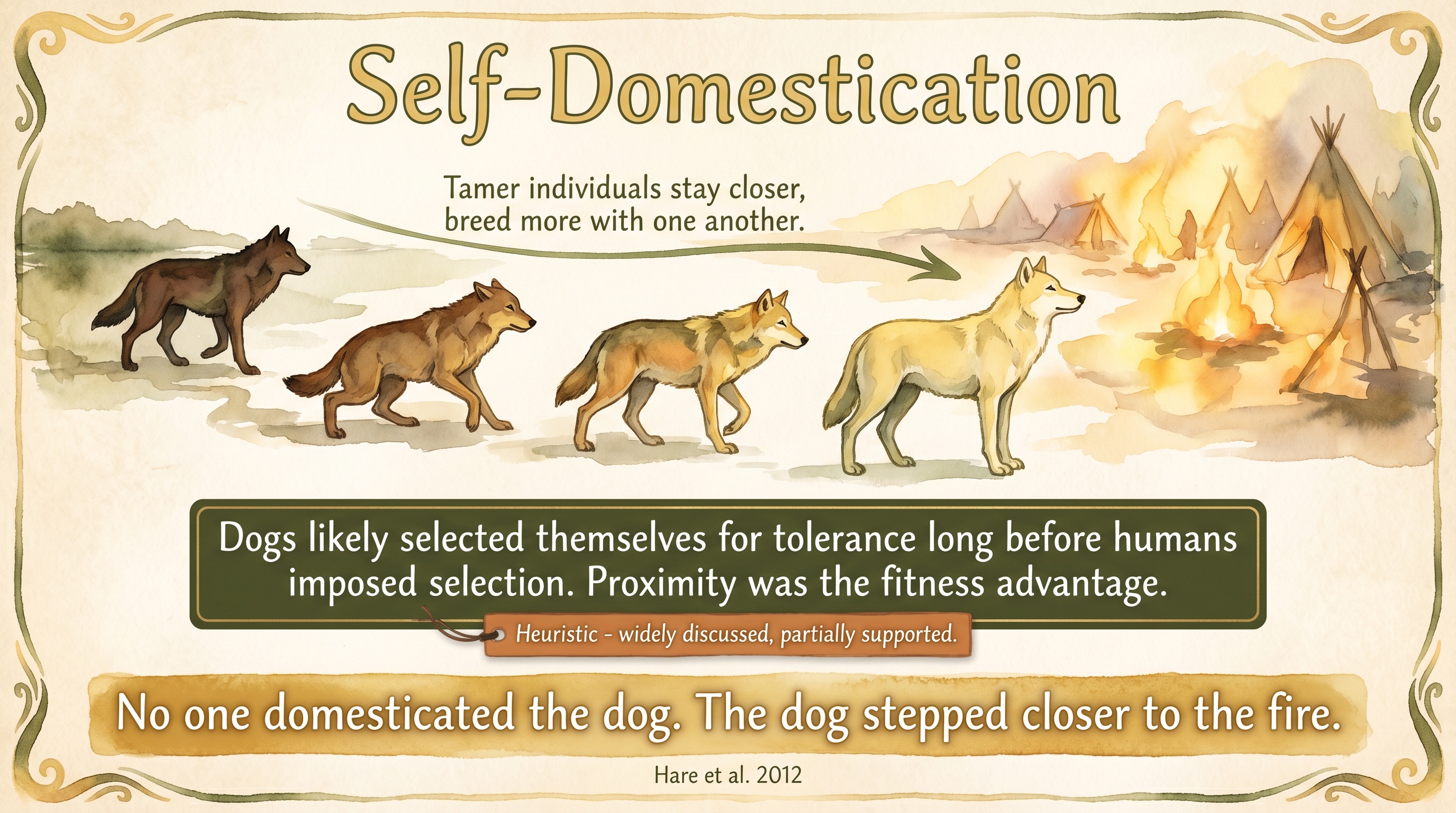
No one domesticated the dog. The dog stepped closer to the fire.
Key Takeaways
- Self-domestication asks whether a population can move toward domestication by selecting itself for tolerance and reduced reactive aggression.
- Dogs fit this framework well, but the field still debates the exact initiating pathway and the mechanism behind domestication syndrome.
- The framework is useful because it links ecology, behavior, and later social cognition without pretending all details are solved.
- For JB, it supports taking relationship and emotional climate seriously while keeping deeper philosophical synthesis explicitly heuristic.
The Evidence
This entry uses observed claim-level tags beyond the dedicated EvidenceBlocks below. These tags mark JB program observation or practice-derived claims that need dedicated EvidenceBlock coverage in a later content pass.
- Hare, Wobber, and Wrangham (2012)bonobos and comparative mammals
Formalized self-domestication as a broader framework centered on selection against reactive aggression. - dog domestication literature
Positions self-domestication as a leading but not settled hypothesis, matching the SCR-001 rhetorical ceiling. - Wilkins, Wrangham, and Fitch (2014)domesticated mammals
Proposed a developmental explanation for correlated domestication-syndrome traits through neural crest biology. - Lord et al. (2020) and Sanchez-Villagra et al. (2023)domestication theory
Show that the mechanism behind domestication syndrome remains actively debated rather than closed.
No published study directly tests the practical implications of the self-domestication hypothesis for domestic dog raising programs. The application to household dog raising remains an interpretive synthesis rather than a directly tested intervention finding.
SCR References
Sources
- Hare, B., Wobber, V., and Wrangham, R. (2012). The self-domestication hypothesis: evolution of bonobo psychology is due to selection against aggression. Animal Behaviour.
- Wilkins, A. S., Wrangham, R. W., and Fitch, W. T. (2014). The domestication syndrome in mammals: a unified explanation based on neural crest cell behavior and genetics. Genetics.
- Lord, K. A., Larson, G., Coppinger, R. P., and Karlsson, E. K. (2020). The history of farm foxes undermines the animal domestication syndrome. Trends in Ecology and Evolution.
- Sanchez-Villagra, M. R., et al. (2023). Shared reproductive disruption, not neural crest or tameness, explains the domestication syndrome. Proceedings of the Royal Society B.
- Hare, B., et al. (2005). Social cognitive evolution in captive foxes is a correlated by-product of experimental domestication. Current Biology.