The Belyaev Fox Experiment: Cross-Species Behavioral Genetics
The Belyaev fox experiment is one of the clearest demonstrations that selection on behavior can pull broad correlated change behind it, and the reason it occupies such a prominent place in the domestication and behavioral-genetics literature is that it provides something few other experiments can: a live, replicable demonstration that selecting animals on a single behavioral dimension can transform not just that dimension but also physiology, development, and morphology over a timescale short enough to be observed within a human research career. Starting in 1959, Dmitri Belyaev and later Lyudmila Trut selected silver foxes primarily for tameness toward humans at the Institute of Cytology and Genetics in Novosibirsk, Siberia. Over generations, the tame line changed not only in approach behavior, but also in physiology, development, and visible morphology in ways that tracked the broader pattern often called the domestication syndrome. That is why the experiment matters so much to breeding discussions. It shows, in another canid species, that temperament is not a decorative side trait but can sit near the center of evolutionary and selective change. Documented-Cross-Species
What It Means
The experimental design
Belyaev began the fox experiment to test a specific hypothesis about domestication, namely that selection on a single behavioral trait (tameness, or specifically the reduction of fear and aggression toward humans) could be the causal driver of the broader package of changes that distinguish domestic animals from their wild ancestors. The hypothesis was bold because it proposed that the many visible differences between domestic and wild populations (changes in coat color, body size, ear shape, skull proportions, reproductive timing, and physiological stress response) might all trace back to the genetic correlates of a single behavioral selection target rather than requiring independent selection on each trait separately.
To test the hypothesis, Belyaev and his team selected silver foxes from a Russian fur farm population and began selecting breeding candidates based on a single criterion: how the fox responded to a human approaching the cage. Foxes that tolerated or approached the human were preferred. Foxes that showed fear or aggression were not selected. Over successive generations, this selection was applied consistently with no other selection criteria being deliberately imposed, and the researchers documented both the behavioral changes and any correlated changes that emerged in other traits.
The experiment also maintained control lines of foxes not selected for tameness, which allowed researchers to distinguish the changes produced by selection from changes that might have occurred for other reasons, and the comparison between selected and control lines is part of what gives the experiment its scientific weight. Documented-Cross-Species
The results
The core lesson is narrow but powerful. If you repeatedly select the least fearful, least aggressive, most socially approachable animals, other traits may move with them even though those other traits were never explicitly selected for.
In the fox experiment, the tame-selected line showed changes in calmer approach to humans, meaning foxes that actively sought human contact rather than simply tolerating it. Greater social engagement appeared, with tame-line foxes showing behaviors like tail wagging, face licking, and vocalizations that resembled the social behaviors of domestic dogs more than the behaviors of wild foxes. Altered stress physiology was documented, with tame-line foxes showing different cortisol patterns and reduced stress reactivity compared to control lines. Changes in coat pattern appeared, including piebald spotting patterns that had not been present in the founding population and that emerged spontaneously in the tame line without any deliberate selection for coat color. Changes in body form accumulated over generations, including shorter snouts, wider skulls, and other cranial changes. Changes in developmental timing appeared, with tame-line foxes showing altered maturation schedules and altered reproductive cycling.
That package is what made the study famous, and the fact that it emerged under selection on behavior alone rather than on any of the morphological traits themselves is what gave the experiment its theoretical impact. Documented It suggested that behavior can sit close to the center of domestication and selective change rather than at the decorative edge, and that the many visible features of domestic animals may be correlated consequences of behavioral selection rather than targets of separate selection pressures applied by breeders.
The mechanism question
The question of why these correlated changes appeared is still an active research topic, and the mechanism is probably more complex than the simplest interpretations of the experiment have sometimes suggested. Documented One influential hypothesis is that behavioral selection on tameness influences neural crest cell development during embryogenesis, and because neural crest cells contribute to many tissues beyond the nervous system (including pigment cells, craniofacial structures, and adrenal tissue), changes in neural crest behavior during development could produce the correlated package of changes observed in the tame line.
Other researchers have raised questions about how completely the neural crest hypothesis explains the observations, and about how much of the fox domestication syndrome actually tracks the pattern seen in other domestic animals versus being specific to the particular circumstances of the Novosibirsk experiment. Documented More recent work has also raised questions about the founder population of the Belyaev foxes and whether some of the correlated changes were already present in the fur farm population before selection began. These methodological questions do not overturn the experiment's central finding about selection on behavior producing correlated change, but they do suggest that the details of the interpretation should be held with appropriate caution rather than treated as fully settled.
The breeding-genetics implication
For dog breeders, the Belyaev work matters because it reinforces a simple population-genetics point that applies regardless of the mechanism details: selection on temperament can accumulate, and the accumulation can produce changes that go beyond what the breeder was explicitly selecting for. A program does not need every trait to be single-gene simple for long-run change to be real, and the fox experiment demonstrates this in a context that would be impossible to replicate within dogs because of the timescales involved.
The broader lesson is that temperament is a legitimate and consequential breeding target, and that selection applied consistently across generations can shift population averages in ways that matter. This does not mean that dog breeders are running miniature Belyaev experiments in their kennels, and the timescales and selection intensities involved in most modern breeding programs are dramatically different from those of the Novosibirsk work. But the principle that behavioral selection produces real population change is established by the fox experiment in a way that gives breeders scientific grounding for treating temperament selection as serious work rather than as cosmetic attention to a side trait.
Why It Matters for Your Dog
Families do not need the foxes because they own foxes. They need the foxes because the experiment clarifies what selection can do in general, and that clarification reshapes how families should think about what breeders are doing when they select for temperament.
If temperament is heritable enough that selecting calmer, more socially manageable animals changes an entire population over time, then the question "What is this breeder selecting for?" becomes much more important than surface sales language about puppies being well-socialized or coming from a good home. A breeder who selects consistently for stable temperament across generations is doing something different from a breeder who selects mainly for appearance or for competition wins, and the fox experiment provides scientific grounding for believing that this difference produces real consequences in the dogs the programs produce.
The fox work also helps explain why correlated change is a real idea in breeding, not just a theoretical concern. Selecting for one central trait can move others with it, which is exactly why breeders should be thoughtful about where they place pressure and exactly why appearance-only selection has produced documented health problems in a number of breeds where the correlated traits turned out to include real welfare concerns. The fox experiment shows the correlated-change mechanism operating under the cleanest possible experimental conditions, and the fact that it operates there is reason to expect it operates in less-controlled settings as well.
For Just Behaving, the safe takeaway is not "our program proves the fox experiment in dogs," which would overstate what any small-scale breeding program can claim. The safe takeaway is smaller and stronger: the fox experiment supports the general idea that persistent selection on social tolerance can reshape a population across generations, and it gives programs that take temperament selection seriously a scientific foundation for continuing that work even when the results of any single generation may not be visibly dramatic. The fox experiment is an argument for patience with behavioral selection rather than a promise of rapid results, and it is an argument for treating temperament as central rather than peripheral. Both of those framings support the kind of breeding approach the Five Pillars philosophy is built on. Observed-JB
Why It Matters for Your Dog
What It Does Not Prove
The fox experiment is not a direct transcript of dog domestication, and the slide from fox evidence to claims about dog history or modern breeding programs has to be policed carefully to keep the argument honest.
It does not prove that early dogs emerged through the exact same pathway, because the circumstances of the Novosibirsk experiment (deliberate human selection on a captive fur-farm population) differ in important ways from the most-supported models of dog domestication (the commensal pathway, in which proto-dogs self-selected toward human camps through their own behavioral initiative rather than being selected by human handlers). The fox experiment shows that one kind of selection can produce domestication-like changes. It does not show that this was the kind of selection that operated during actual dog domestication.
It does not prove that every so-called domestication syndrome trait has one universal mechanism, because different domestic species show different combinations of the syndrome traits and because the genetic and developmental pathways involved may differ across species even when the surface patterns look similar. Treating the fox experiment as proof of a universal domestication mechanism overreads the evidence.
And it does not prove that a small modern breeding program is literally recreating Novosibirsk in miniature, because the selection intensities, population sizes, and timescales involved are dramatically different from those of the Belyaev work. A modern Golden Retriever breeder selecting carefully for temperament over a few generations is doing real and valuable work, but it is not the same work Belyaev and Trut did across sixty years and dozens of generations with explicit experimental control.
That is the firewall this page needs. The documented layer is fox evidence, and the fox evidence is strong enough to carry real weight in discussions about what selection on behavior can accomplish. The step from foxes to the exact canine historical story, or to a precise analogy with Just Behaving temperament selection, is interpretive and should stay heuristic rather than being presented as if the fox experiment directly validates the dog-specific claim.
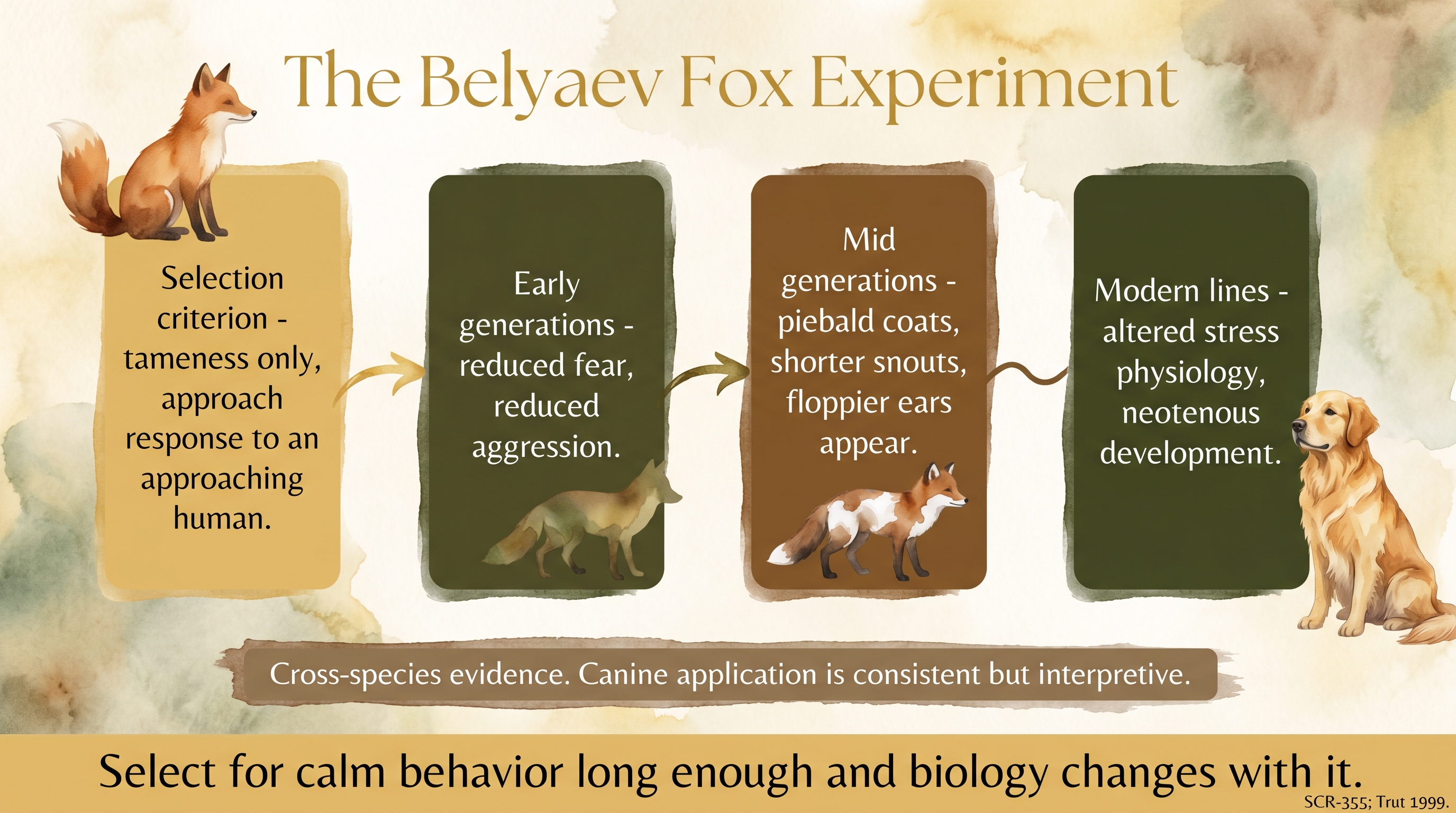
Select for calm behavior long enough and biology changes with it.
Key Takeaways
- The Belyaev fox experiment is strong cross-species evidence that selection on tameness can produce broad correlated change in behavior, physiology, development, and morphology.
- Its clearest lesson for breeders is that temperament can be a central selection target rather than a decorative extra.
- The experiment should not be collapsed into a direct proof of dog domestication history or a one-to-one model of any modern breeding program.
- The correlated-change observation is a general warning that selection on one trait can move others with it, which is why breeders should be thoughtful about where they place pressure.
- The most defensible use of the fox work is as an analogy about the power of selection, not as a shortcut around canine-specific evidence.
The Evidence
This entry uses documented claim-level tags beyond the dedicated EvidenceBlocks below. These claims should remain tied to the entry Sources and SCR references during the next evidence-chain authoring pass.
This entry uses observed claim-level tags beyond the dedicated EvidenceBlocks below. These tags mark JB program observation or practice-derived claims that need dedicated EvidenceBlock coverage in a later content pass.
- Trut and related Novosibirsk literaturesilver foxes
Selection for tameness produced marked changes in approach behavior, physiology, development, and morphology across generations. - Hare et al. and later fox-cognition worksilver foxes
The tame-selected foxes also showed altered social-cognitive engagement with humans, reinforcing the centrality of the behavioral trait under selection.
- JB interpretation under SCR firewall disciplinedogs and breeding programs
The fox experiment makes it scientifically reasonable to view temperament as a trait that can respond meaningfully to selection, but it does not directly prove any exact canine historical pathway or any specific breeder-level outcome.
No published study has directly replicated the Belyaev selection-for-tameness protocol in domestic dogs to test whether comparable correlated morphological and physiological changes appear under the same selection regime.
SCR References
Sources
- Trut L.N. (1999). Early canid domestication: the farm-fox experiment. American Scientist, 87(2), 160-169.
- Trut L.N., Oskina I., & Kharlamova A. (2009). Animal evolution during domestication: the domesticated fox as a model. BioEssays, 31(3), 349-360.
- Wright D. & Trut L.N. (2020). Defining the domestication syndrome: comment on Lord et al. 2020. Trends in Ecology & Evolution.
- Kukekova A.V., Johnson J.L., Xiang X., Feng S., Liu S., Rando H.M., et al. (2018). Red fox genome assembly identifies genomic regions associated with tame and aggressive behaviours. Nature Ecology & Evolution, 2, 1479-1491.
- Lord K.A., Larson G., Coppinger R.P., & Karlsson E.K. (2020). The history of farm foxes undermines the animal domestication syndrome. Trends in Ecology & Evolution, 35(2), 125-136.
- Wilkins A.S., Wrangham R.W., & Fitch W.T. (2014). The "domestication syndrome" in mammals: a unified explanation based on neural crest cell behavior and genetics. Genetics, 197(3), 795-808.
- Hare B., Plyusnina I., Ignacio N., Schepina O., Stepika A., Wrangham R., & Trut L. (2005). Social cognitive evolution in captive foxes is a correlated by-product of experimental domestication. Current Biology, 15(3), 226-230.
- Sánchez-Villagra M.R., et al. (2023). Shared reproductive disruption, not neural crest or tameness, explains the domestication syndrome. Proceedings of the Royal Society B, 290, 20222464.