The Domestication Syndrome
The domestication syndrome is the name given to a recurring package of traits that appear across many domesticated animals. The list usually includes reduced fear and aggression, lower adrenal reactivity, shorter snouts, smaller teeth, depigmented or piebald coats, curled tails, floppy ears, altered reproductive cycles, and more juvenile social behavior. Dogs, foxes, pigs, horses, rabbits, and several other domesticates show some version of this cluster, though not always the same subset in the same strength. The idea became especially influential after Wilkins, Wrangham, and Fitch 2014 proposed that mild changes in neural crest cell development could explain why so many different tissues and traits seemed to move together under selection for tameness. The Belyaev fox experiment then gave the hypothesis a dramatic narrative engine because many syndrome-like traits appeared in foxes selected only for calm response to humans. Documented
Yet the syndrome is not a solved mechanism. Lord et al. 2020 challenged the overgeneralization of the fox evidence. Johnsson 2021 argued that the neural crest hypothesis is not a unified explanation for all domestication data. Sanchez-Villagra et al. 2023 proposed a different reproductive-disruption framework. So the field now treats the syndrome as a real and useful pattern, while arguing much harder about why the pattern appears.
That is exactly the kind of scientific posture JB should welcome: a strong observed pattern, a live mechanism debate, and a need to keep rhetoric below the evidence ceiling.
It is also a useful reminder that evolutionary biology often advances in two steps. First a recurring pattern becomes too visible to ignore. Only later does the field sort out whether one mechanism, several mechanisms, or partly different pathways best explain the pattern. Domestication syndrome is living in that second stage now.
What It Means
The Pattern Is Real Even if the Mechanism Is Debated
The first thing to understand is that "domestication syndrome" names a phenotype pattern before it names a cause. Across multiple domesticated species, researchers really do see recurring combinations of tameness-related behavior and changes in morphology, pigmentation, endocrinology, and development. Documented The pattern does not have to be perfectly universal to be scientifically meaningful. Many biological syndromes are families of correlated traits rather than exact copies of one master template.
That is why the syndrome concept survived even after the mechanism became contested. The observed package remains too suggestive to ignore. Selecting animals for social tolerance repeatedly seems to move more than one dial at a time.
The Neural Crest Hypothesis
Wilkins, Wrangham, and Fitch 2014 offered the most famous explanation. Neural crest cells contribute to many tissues involved in pigmentation, craniofacial structure, adrenal function, and peripheral nervous development. If selection for tameness somehow perturbs neural crest migration or proliferation, then a surprisingly broad set of correlated traits could appear together. This made the hypothesis attractive because it linked one developmental system to many visible domestication markers. Documented
The hypothesis also fit the fox results beautifully on paper. Reduced fear, altered stress physiology, depigmentation, floppy ears, and changed skull proportions looked like exactly the sort of distributed outcome a developmental bottleneck could generate.
The domestication syndrome matters less because it proves one perfect mechanism and more because it shows how selection on social behavior can echo across the whole organism.
Why Critics Pushed Back
The pushback came from two directions. One was empirical: not all domestic species show the full syndrome, and the traits do not always covary cleanly. Johnsson 2021 argued that the evidence is not strong enough for one unified neural crest explanation across domesticates. The second direction was conceptual: Lord et al. 2020 argued that the fox story itself had been simplified, especially regarding founder effects and claims that syndrome traits emerged de novo from tameness selection alone.
Sanchez-Villagra et al. 2023 then argued that shared reproductive disruption may explain more of the syndrome pattern than neural crest changes do. Documented Whether or not that model becomes dominant, it reinforced the point that the syndrome remains a field of mechanism competition rather than a completed textbook chapter.
What the Syndrome Means in Dogs
Dogs fit the syndrome conversation well, but not magically. They show many classic domestication features: reduced fear of humans, changed stress biology, paedomorphic social behavior, coat diversity, craniofacial modification, and reproductive differences from wolves. But dogs also carry later breed selection layered on top of the original domestication process. That means some dog traits reflect deep domestication, some reflect much later breed refinement, and some reflect both.
This is why the syndrome is most useful as a framework rather than a checklist. It helps explain why tameness could reshape the whole dog, while reminding researchers not to force every later trait into one origin story.
That flexibility is not a retreat from rigor. It is the right response to a phenomenon that is broad, repeated, and biologically messy. Dogs clearly belong inside the syndrome conversation even if no one developmental account has won the argument yet. Documented
In practice, that means the syndrome is most valuable when treated as a pattern of coupled change rather than as a magic checklist. Researchers do not need every domesticated species to show every trait in order to learn the larger lesson that social selection can echo far beyond behavior alone. The power of the concept lies in that repeated echo.
The syndrome concept also protects families from treating temperament as detachable from everything else. A dog is not a pile of independent traits assembled without interaction. The more families understand that behavior, physiology, and development travel together, the more seriously they tend to take regulation, sleep, stress load, and emotional climate as whole-dog concerns.
Why It Matters for Your Dog
The domestication syndrome matters because it helps families understand that behavior, body, and physiology are not separate silos. Selection that changes how an animal responds to social stress can ripple outward into coat, reproduction, skull shape, and developmental timing. That is a profound lesson for anyone raising a dog. It says the organism is integrated. Social traits are not glued onto an otherwise untouched body.
That matters in practical family life because people often assume temperament can be altered without touching the deeper animal, or that morphology can be bred without consequence for behavior. The syndrome literature suggests those separations are often too tidy. Dogs are packages of linked traits. When humans breed, raise, or stress them, they are working with an integrated system.
Owners can also use the syndrome concept to resist one of the oldest modern myths: that calmness and sociability are decorative softness added by people, while the "real" animal underneath is the hard, wild one. The domestication record points the other way. Reduced fear and altered stress responsiveness are among the most central domestication signals. In that sense, social softness toward humans is not fake dogness. It is part of dogness.
This helps explain why breed selection can carry both gifts and liabilities. Goldens, for example, inherit a lineage with strong human-directed sociability and relatively soft social presentation. Those are not trivial features. They are exactly the kind of traits domestication theory says can become central. But high sociability does not erase vulnerability to overarousal, frustration, fear, or immaturity. Integrated organisms can have beautifully domesticated social signals and still need careful developmental management.
The syndrome also matters because it shows why fear-heavy handling is such a blunt tool. Documented If domestication involved repeated selection away from reactive aggression and toward lower conflict cost with humans, then pushing fear and social conflict back into the relationship is not just philosophically unpleasant. It can be biologically mismatched. The species story makes that mismatch easier to see.
Families further benefit from understanding that domestication did not only produce surface obedience. It changed developmental style. Many pet dogs remain remarkably juvenile in social dependence and human orientation compared with wolves. That neotenous pattern can be lovely, but it also means adult dogs can remain socially young in ways households need to guide carefully. The syndrome concept helps make sense of that blend of sweetness and immaturity.
Another practical value is that the syndrome teaches caution about simplistic breeding goals. Selecting hard on one desired trait can bring unexpected companions along for the ride. People who breed for looks alone, drive alone, or novelty alone may be moving more than the visible target. The domestication literature is a standing reminder that organisms are built from coupled systems.
That same lesson applies below the breeding level too. Families are not changing their dog's genome in the living room, but they are constantly interacting with an integrated organism whose behavior, physiology, and attention influence one another. A dog living under chronic stress rarely changes in one dimension only. Sleep, digestion, frustration tolerance, recovery time, and social readability often move together.
This again reaches the home directly. A family does not need to master developmental genetics to feel the everyday truth of it. Change the emotional climate of the dog, and many other things change too: attention, recovery, appetite, sleep, social tolerance, and flexibility. The syndrome is an evolutionary-scale version of the same lesson about whole-animal integration.
Seen that way, the syndrome becomes a check on reductionism. Owners naturally want one explanation for one problem and one fix for one symptom. The domestication literature keeps warning that biology is less tidy than that. Traits that were linked together during species history often stay linked enough in daily life to punish oversimplified thinking.
That warning is practical, not merely theoretical. When a dog is chronically overaroused, the fallout may include worse sleep, noisier social behavior, slower recovery, and less flexible learning all at once. Families often treat those as separate annoyances. The syndrome literature encourages them to look for the deeper state variables connecting the whole pattern.
Read carefully, the domestication syndrome does not tell families one precise rule. It tells them what kind of animal they are living with: one whose social and biological architecture have been reshaped together through life with humans.
This is one reason calm and stable raising can look more effective than its surface drama level suggests. When adults lower conflict and improve regulation, they may be helping several linked systems at once. A whole-animal problem often responds best to a whole-animal improvement rather than to a narrow correction aimed at one visible symptom.
What This Means for a Just Behaving Family
JB families should use the domestication syndrome as a reminder that behavior belongs at the biological center, not at the decorative edge. Social tolerance, fear regulation, and human readability are not superficial features of the dog.
That supports the general JB instinct to treat calmness and relational structure as developmental variables with whole-animal consequences. A dog whose social system is repeatedly pushed into chronic conflict is not being challenged only behaviorally. The whole organism is involved.
JB should also stay restrained. The syndrome is documented as a broad pattern, but the exact mechanism remains debated. Ambiguous Neural crest language should therefore be presented as one influential explanation, not as finished law.
For the home, the useful lesson is simpler. The dog is an integrated domestic species. How the dog feels socially and how the dog develops physically are not cleanly unrelated stories.
That has practical implications for pace and tone. A family that protects regulation, sleep, predictable boundaries, and low-conflict human contact is not only making behavior easier to manage in the moment. It is helping the whole organism stay in the kind of state that domestication appears to have favored.
It also encourages humility about breeding and raising decisions. Once people accept that traits travel in clusters, they become less tempted to chase one visible outcome while ignoring the rest of the dog. That is a healthier frame whether the choice concerns genetics, puppyhood management, or later behavior intervention.
For JB, the home-level lesson is to protect the whole animal rather than chasing isolated surface wins. Calmness, predictability, and low-conflict relationship matter partly because they support integrated function, not just better manners. That is exactly the sort of whole-organism thinking domestication syndrome keeps pushing the field toward.
That makes thoughtful raising look more serious, not less. When a family protects calmness, predictability, and low-conflict social life, it is respecting the kind of animal domestication helped produce.
The syndrome remains a debate worth following. It is already useful enough to reshape how families think about dog biology.
It also supports patience with broad developmental change. A dog whose sleep, recovery, attention, and social tolerance all start improving together is not necessarily changing in mysterious ways. The organism may simply be stabilizing across linked systems, which is exactly the kind of coupled response domestication syndrome makes easier to imagine.
That whole-animal view is one of the syndrome literature's most useful gifts to families. It encourages better questions about state, integration, and regulation before people chase isolated symptom control.
That is a more mature way to read both behavior and biology.
That perspective makes thoughtful raising look biologically serious rather than merely stylistic.
That is a better frame for real development.
Families need that lens.
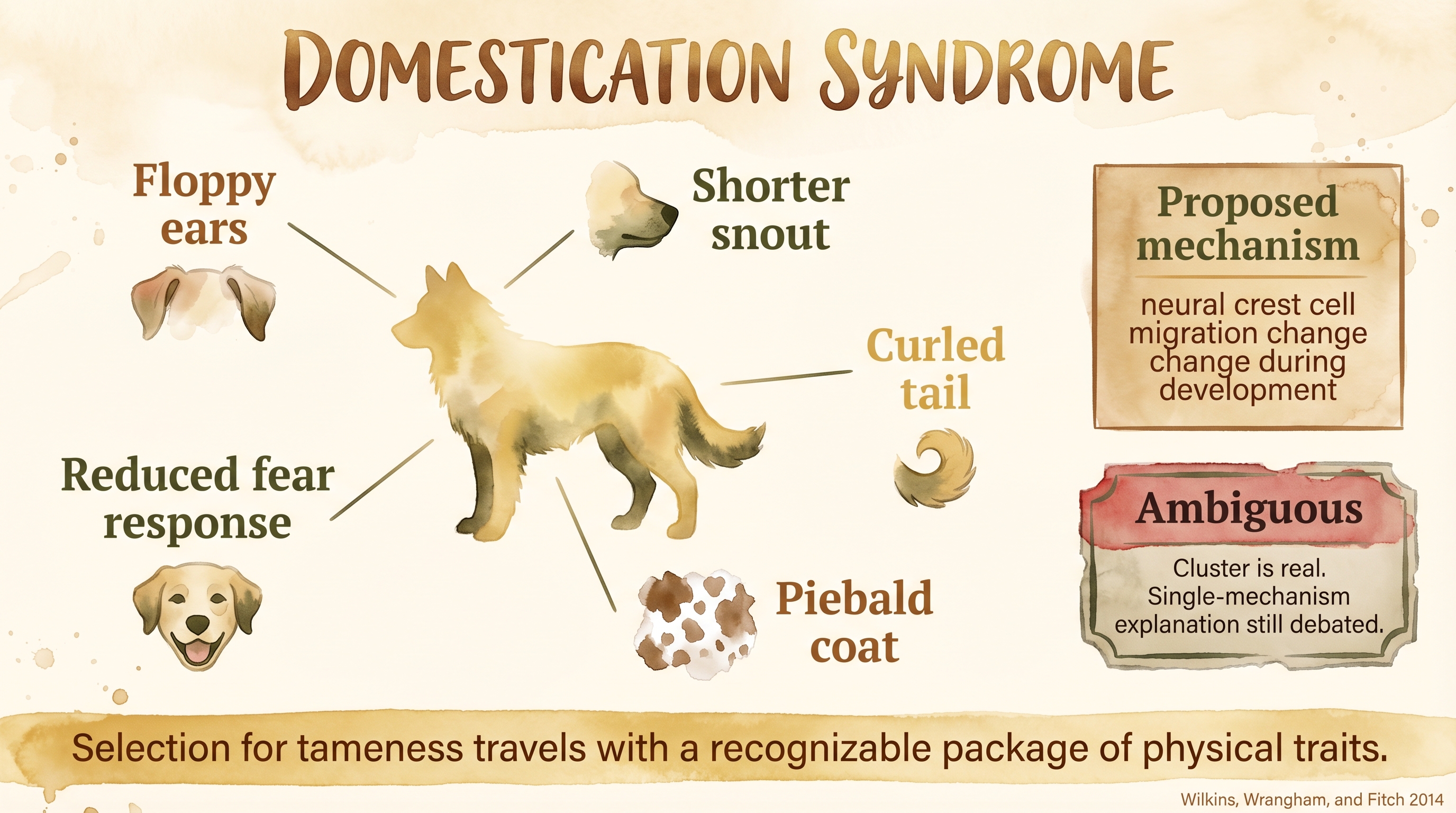
Selection for tameness travels with a recognizable package of physical traits.
Key Takeaways
- The domestication syndrome refers to a recurring package of social, morphological, and physiological changes seen across many domesticates.
- Its existence as a pattern is easier to defend than any single mechanism explaining every case.
- The neural crest hypothesis remains influential, but not definitive.
- For JB, the main lesson is that social behavior and whole-animal biology are linked deeply enough that calmness and social structure cannot be treated as cosmetic variables.
The Evidence
This entry uses ambiguous claim-level tags beyond the dedicated EvidenceBlocks below. These tags mark claims where the literature remains unsettled or multiple interpretations coexist.
- Wilkins, Wrangham, and Fitch (2014)domesticated mammals
Proposed the influential neural crest explanation for the correlated trait package seen across many domesticates. - Belyaev and Trut fox worksilver foxes
Provided a dramatic experimental model in which selecting for tameness was accompanied by multiple syndrome-like changes. - Johnsson (2021)domestication theory
Argued that the neural crest hypothesis does not yet provide one unified explanation for domestication across species. - Lord et al. (2020) and Sanchez-Villagra et al. (2023)domestication theory
Show that both the fox analogy and the syndrome mechanism remain under active critical review.
No published study directly tests the practical implications of the domestication syndrome for domestic dog raising programs. The application to household dog raising remains an interpretive synthesis rather than a directly tested intervention finding.
SCR References
Sources
- Wilkins, A. S., Wrangham, R. W., and Fitch, W. T. (2014). The domestication syndrome in mammals: a unified explanation based on neural crest cell behavior and genetics. Genetics.
- Johnsson, M. (2021). The neural crest cell hypothesis: no unified explanation for domestication. Genetics.
- Lord, K. A., et al. (2020). The history of farm foxes undermines the animal domestication syndrome. Trends in Ecology and Evolution.
- Sanchez-Villagra, M. R., et al. (2023). Shared reproductive disruption, not neural crest or tameness, explains the domestication syndrome. Proceedings of the Royal Society B.