Dog Domestication and the Five Pillars
Compound evidence detail1 SCR / 2 parts
- Documentedpeer-reviewed evolutionary-biology framework for canine domestication via commensal scavenging at human settlements
- HeuristicJB-specific interpretation that the Five Pillars describe selection pressures consistent with the commensal phase of domestication
This entry is an interpretive synthesis, not a primary claim of settled science. The documented pieces underneath it are substantial. The commensal pathway remains a leading model for dog origins, even if SCR-001 correctly prevents it from being described as full consensus. Belyaev's fox work shows that selection on tameness can generate broad correlated change. Axelsson et al. 2013 shows metabolic adaptation to human food ecologies. vonHoldt et al. 2017 links dog hypersociability to a specific domestication-relevant genomic region. Hare et al. 2002, Miklosi et al. 2003, and Topal et al. 1998 and 2005 show dogs are unusually prepared for human social cues, human attachment, and human-guided problem solving. Range and Viranyi 2022 sharpen the behavioral side by arguing that conflict avoidance and human-oriented rule-following are cleaner descriptors than simple low aggression. All of that is documented. The JB claim that the Five Pillars name the kind of social conditions favored across this domestication process is a further reading layered on top of those findings. Heuristic
That distinction has to remain visible from the first paragraph or this entry becomes sloppy. The goal is not to pretend the literature has already validated JB's full philosophical architecture. The goal is to ask whether the architecture fits the direction of the evidence well enough to be taken seriously.
JB's answer is yes, but yes in a careful way. The fit is interpretive, cumulative, and constrained by the documented record rather than directly proven by it.
That carefulness is part of the value. A domestication synthesis that cannot survive explicit humility is not sturdy enough to guide anyone. The point of this entry is to show that the pillars can remain philosophically strong while still being described with evidence discipline.
What It Means
What the Literature Directly Shows
The domestication literature directly shows several things relevant to JB. Documented First, dogs emerged through prolonged evolutionary life with humans rather than through modern training systems. Second, the process involved selection on fear, sociability, stress biology, and human-adjacent ecological success. Third, domestication changed real systems in the animal, not just outward manners. Axelsson 2013 on starch adaptation, vonHoldt 2017 on hypersociability, Pendleton 2018 on developmental pathways, and Bergstrom 2022 on ancestry structure all point that way.
The comparative cognition literature adds another documented layer. Dogs spontaneously use human gestures more readily than wolves or chimpanzees in Hare 2002. Dogs look back to humans during unsolvable tasks in Miklosi 2003. Dogs show attachment-style secure-base effects in Topal 1998 and later follow-ups. These are not pillar claims. They are empirical findings about what kind of species dogs are.
Where JB Reads Mentorship and Calmness
JB reads Mentorship into this literature because dogs appear biologically prepared to learn upward into human social partners. That step is not fantasy. It is a synthesis built from documented human-oriented cue use, attachment, and social learning. Puppies learn from conspecifics and humans in Fugazza et al. 2018, and dogs show durable social-learning capacities in the broader observational literature. The heuristic move is saying that this suite of findings fits a raising model centered on calm adult guidance rather than on constant engineered prompting.
JB reads Calmness into the domestication record because the species appears to have been shaped away from chronic reactive fear and toward more stable human coexistence. Heuristic The fox work, dog-wolf divergence studies, and stress-related genomic findings all point in that direction. Again, the exact sentence "dogs were selected for the JB Calmness pillar" is not directly demonstrated. The justified sentence is that the pillar is consistent with the documented direction of selection.
The Five Pillars are not presented here as a set of lab-proven domestication variables. They are presented as JB's name for a pattern of relational conditions that appears consistent with what domestication seems to have favored.
Where JB Reads Structured Leadership, Prevention, and Indirect Correction
Structured Leadership is the easiest of the remaining pillars to connect because attachment research gives direct evidence that dogs use humans as secure bases and safe havens. Documented If domestication increased readiness for human attachment and guidance, then the JB parent-not-playmate framing fits the documented architecture more naturally than a dominance-rival framing does. The move from attachment findings to the whole pillar is still interpretive, but it is not a wild leap.
Prevention is inferred from a different cluster. If dogs were selected for successful low-conflict functioning around humans, then environments that avoid unnecessary escalation, avoid rehearsing unstable patterns, and keep the organism below chronic reactivity thresholds look evolutionarily coherent. The literature does not contain a paper saying "proto-dogs evolved because humans prevented rehearsal of unwanted behavior." It does contain multiple lines pointing toward the importance of low-conflict compatibility and stress regulation.
Indirect Correction is the most delicate of the five in this domain. Wolves and other canids do use spatial pressure, ritualized social boundaries, and non-injurious signaling. Dogs also remain acutely sensitive to subtle social cues. What is not documented is that the exact JB framing of Indirect Correction was an explicit selection target during domestication. The honest synthesis is narrower: a species selected for reading nuanced social information is a species in which low-drama signaling may carry unusual weight.
The Confidence Boundary That Must Not Be Crossed
The line JB must not cross is the line from "consistent with" to "empirically proven as." Domestication papers do not test the Five Pillars directly. They test wolf-dog divergence, genetics, archaeological sequence, attachment, social cognition, and related systems. JB is building a philosophy by integrating those streams. That is legitimate if the rhetoric stays at the correct level. It becomes slippage the moment heuristic synthesis is voiced as documented conclusion.
This entry exists partly to make that ceiling impossible to miss. The evidence underneath is real. The philosophical map drawn over it is still a map.
And maps can be useful without being the territory. Families do not need a laboratory variable called "Five Pillars" in order to benefit from a framework that organizes domestication findings coherently. They do need the framework to keep admitting where it is reading across the evidence rather than quoting it directly.
Why It Matters for Your Dog
For families, this synthesis matters because it reframes the whole raising project. If the Five Pillars are at least directionally consistent with the conditions under which dogs became dogs, then JB is not proposing a clever modern workaround for canine nature. It is proposing a raising environment that may fit canine nature unusually well. That is not the same as proof, but it is far more meaningful than mere personal preference.
This changes how adults interpret ordinary choices. Calmness stops looking like an aesthetic mood and starts looking like a plausible species-fit variable. Mentorship stops sounding sentimental and starts sounding consistent with comparative social-cognition findings. Structured Leadership stops looking like jargon and starts looking like a practical rendering of the secure-base literature.
The same synthesis also protects against overreach in the other direction. A family should not believe that using JB language guarantees evolutionary perfection in the home. Dogs are still individual organisms with variation, pathology, breed histories, injuries, and environmental pressures. A heuristic fit to domestication evidence does not cancel ordinary biological complexity. Heuristic
That is precisely why the entry is useful. It offers a strong reason to take the pillars seriously without turning them into magic. Families often need that middle. They do not want a philosophy built only on slogans, and they do not need a false promise that the lab has already certified every JB sentence. What they need is a credible reason to believe the pillars are not arbitrary. Domestication provides that.
This matters especially for Goldens because the breed can seduce families into thinking its social gifts require little adult shape. In reality, a human-oriented dog may need good adults even more, because the dog's attention and attachment systems are so tuned to the household. If the household is calm, legible, and structured, those systems can organize beautifully. If the household is frantic or socially vague, the same orientation can become instability, dependence, or chronic overarousal.
The synthesis also helps families sort method claims in the broader marketplace. If domestication selected dogs toward human compatibility, conflict avoidance, social referencing, and attachment, then techniques that lean on constant arousal, coercive pressure, or mechanical cue dependency can reasonably be questioned, even before one claims they are universally wrong. The challenge is to phrase that as reasoned inference rather than as overcertified science.
Another practical value is emotional confidence. Families can often feel that a calm, relational way of raising a dog is too soft or too intuitive to be intellectually defensible. This synthesis gives them firmer ground. They can understand that many JB instincts are not floating free from biology. They are at least plausibly aligned with the species history.
It also deepens responsibility. If the pillars fit the species well, then households that ignore calmness, mentorship, structure, prevention, and signal quality may be fighting the grain of domestication rather than merely choosing a different style. That is not a moral condemnation. It is a developmental risk.
This becomes especially useful when families are choosing among methods that all claim to be natural. The domestication record does not hand down one branded protocol, but it does point toward a species shaped for human attachment, low-conflict coexistence, and social readability. Any approach that repeatedly works against those traits should at least have to justify itself against that larger evolutionary background.
At its best, this synthesis turns evolutionary history into a practical lens. It helps families ask not "What technique wins?" but "What sort of social world is this species most likely to flourish inside?" That is one of JB's core questions.
That question becomes especially valuable when a dog is struggling. Instead of assuming every problem demands more intensity, families can ask whether the home is making good use of domesticated capacities for attachment, social reference, and low-conflict coexistence. A synthesis file cannot turn that into a guaranteed formula, but it can make it the first serious place to look.
That is also why this synthesis is best tested at the level of lived environment. If the pillars are directionally right, then a home that becomes calmer, more legible, and less conflict-heavy should start making the dog easier to organize, not harder. That is a practical benchmark families can understand without pretending the philosophy is already laboratory-certified.
That is a demanding but useful standard. The more the pillars help create an easier, calmer, more socially workable dog, the more credible the synthesis becomes in lived practice.
That makes the synthesis more than a slogan. It becomes a practical question about what kind of home best fits the domesticated dog.
What This Means for a Just Behaving Family
JB families should use this entry as orientation, not as a weaponized proof text. It is meant to show why the Five Pillars plausibly fit the dog's domestication story, not to claim that every part of the philosophy has already been experimentally validated. Heuristic
That means the household can act with conviction while keeping its rhetoric clean. Mentorship, Calmness, Structured Leadership, Prevention, and Indirect Correction can all be defended as biologically coherent in light of domestication evidence. The stronger claim that domestication studies directly prove the pillars should be avoided.
In practice, this still changes a lot. Adults can value calmness more seriously, take their own social readability more seriously, and recognize that the dog's orientation to them is part of the species design rather than a training side effect.
The entry also reminds JB to stay governed. Where evidence is documented, say so. Where the philosophy is synthesizing, say that too. The integrity of the framework depends on holding that boundary.
It also suggests a practical bias for the home. If the pillars are broadly coherent with domestication evidence, then adults should test them by becoming calmer, clearer, and more socially organized before assuming the dog needs more conflict. That is not proof by convenience. It is acting on the side of the evolutionary picture that currently has the stronger support.
It also means the pillars should be evaluated as a whole environment, not as isolated slogans. Domestication did not carve dogs into separate compartments for attachment, social learning, and stress regulation. The point of the JB reading is that those systems seem to support one another, which is why a coherent household can matter so much more than one clever technique.
For families, that honesty is a strength. It lets them trust the philosophy more because they can see where interpretation begins instead of being asked to accept an inflated certainty.
That is the right posture for the Evolutionary Foundation: confident enough to guide action, disciplined enough to remain truthful.
For JB, this means the philosophy should keep earning trust through disciplined application. The stronger claim is not that every pillar has been directly proven. It is that the whole package points families toward a social world that fits the domestication evidence unusually well.
That is a meaningful place for a philosophy to stand.
That is enough to work from.
That makes the framework demanding, but also unusually useful in practice.
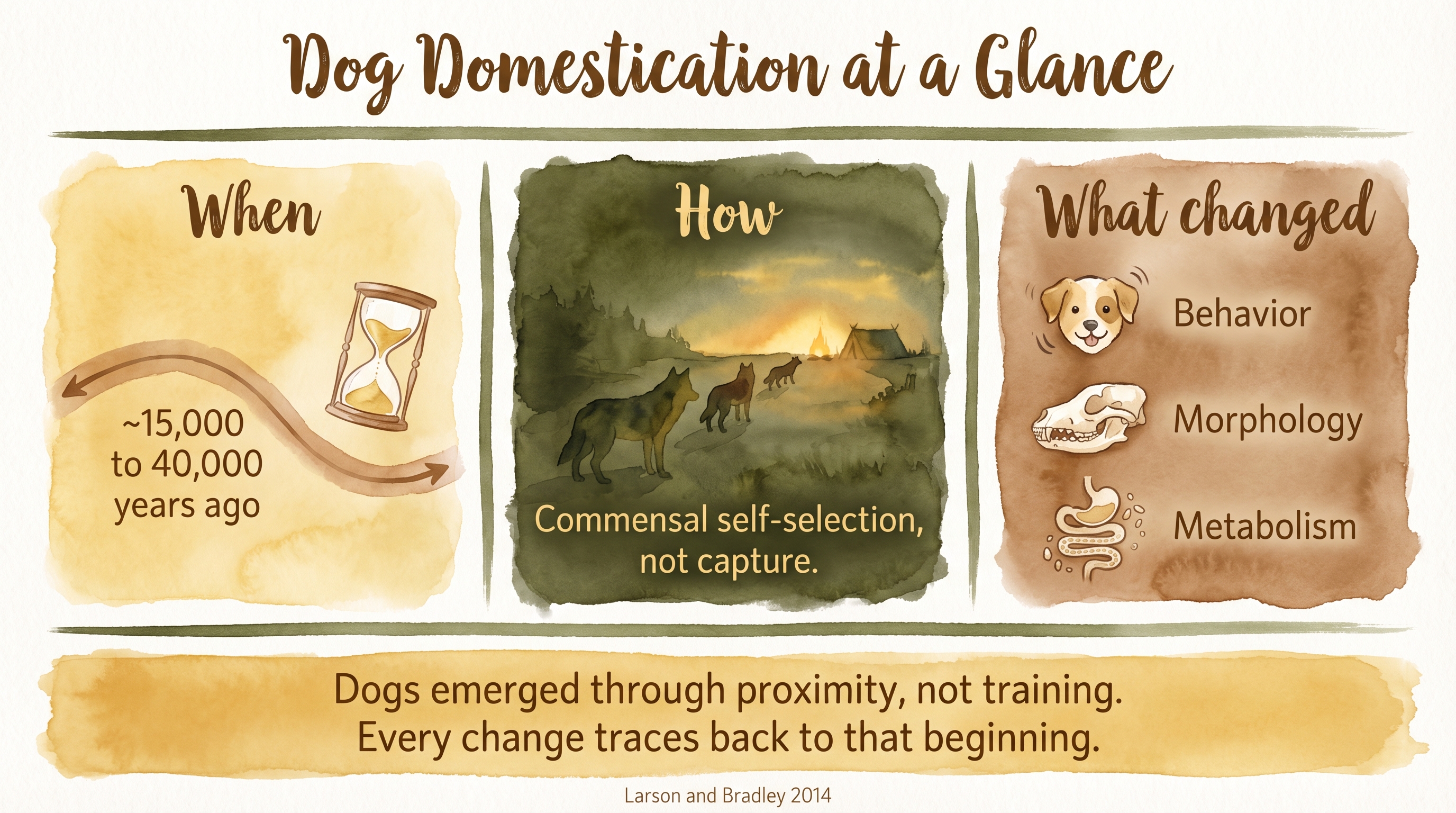
Dogs evolved for calm human proximity. The pillars honor that inheritance.
Key Takeaways
- The evidence streams under this entry are documented, but the move from those streams to the Five Pillars is interpretive and should stay labeled that way.
- JB's reading is strongest when framed as consistency with domestication evidence rather than as direct laboratory validation.
- The synthesis is still practically meaningful because it suggests the pillars fit the kind of social world dogs may have been selected to function inside.
- For families, the result is useful conviction without false scientific closure.
The Evidence
This entry uses documented claim-level tags beyond the dedicated EvidenceBlocks below. These claims should remain tied to the entry Sources and SCR references during the next evidence-chain authoring pass.
- Commensal pathway, fox model, and domestication genomicsdogs and foxes
Support selection on tolerance, altered stress biology, and human-associated functioning without directly naming JB's pillars. - Hare et al. (2002), Miklosi et al. (2003), and Topal et al. (1998, 2005)dogs and wolves
Document dogs' unusual readiness for human cue use, attachment, and human-guided problem solving. - Range and Viranyi (2022)dogs and wolves
Frame conflict avoidance and human-oriented rule-following as key dog-wolf differences relevant to JB's reading. - Source_JB domestication synthesisintegrated literature
Explicitly treats the step from documented domestication evidence to the Five Pillars as an interpretive JB synthesis rather than a direct proof.
No published study directly tests the practical implications of dog domestication and the five pillars for domestic dog raising programs. The application to household dog raising remains an interpretive synthesis rather than a directly tested intervention finding.
SCR References
Sources
- Hare, B., et al. (2002). The domestication of social cognition in dogs. Science.
- Miklosi, A., et al. (2003). A simple reason for a big difference: wolves do not look back at humans, but dogs do. Current Biology.
- Topal, J., et al. (1998). Attachment behavior in dogs: a new application of Ainsworth's Strange Situation Test. Journal of Comparative Psychology.
- Topal, J., et al. (2005). Attachment to humans: a comparative study on hand-reared wolves and differently socialized dog puppies. Animal Behaviour.
- Range, F., and Viranyi, Z. (2022). Comparing wolves and dogs: current status and implications for human self-domestication. Trends in Cognitive Sciences.