Behavioral Divergence Between Dogs and Wolves
Dogs and wolves share deep canid continuity, but they do not solve the same social problems in the same way. Across a long line of comparative work, dogs show lower fear of humans, greater willingness to treat humans as social partners, stronger readiness to follow human communicative cues, and a greater tendency to look back to humans when a task becomes difficult. Wolves, even when hand-raised, can equal or exceed dogs in some non-social problem solving, persistence, imitation of conspecifics, and independent environmental engagement. Hare et al. 2002 showed that pet dogs used human pointing gestures better than wolves and chimpanzees in object-choice tasks. Miklosi et al. 2003 showed that dogs facing an unsolvable problem looked back at humans for help while wolves kept working more independently. Topal et al. 2005 found that hand-reared wolves did not express the same attachment profile toward humans that dog puppies did. Range and Viranyi's later reviews sharpened the pattern by warning against simplistic claims that dogs are just "less aggressive"; conflict avoidance and human-oriented rule-following are often cleaner descriptors. Documented
That package of differences is exactly what domestication should have produced if early success depended on functioning in human social worlds rather than on living apart from them.
What makes this literature especially valuable is that it moves the discussion away from romance and insult at the same time. Dogs do not have to be idealized as pure-hearted companions, and wolves do not have to be demonized as antisocial failures. The research instead asks a cleaner question: what happens to a lineage when selection repeatedly favors animals that can recruit humans into ordinary life?
For JB, this entry matters because several pillars assume dogs are biologically prepared to use humans as real social anchors. The comparative literature is one of the strongest places where that assumption meets direct evidence.
What It Means
Dogs Use Humans Differently Than Wolves Do
The clearest dog-wolf difference is not raw intelligence. It is social orientation. Dogs are quicker to treat humans as relevant partners in problem solving, communication, and uncertainty. Hare 2002 made this visible in pointing tasks. Miklosi 2003 made it visible in unsolvable-task behavior. Topal 2005 made it visible in attachment expression. Those are not three versions of the same experiment. They are three different windows into the same underlying shift.
Wolves can certainly learn about humans, especially when intensively socialized. What they do not show to the same degree is the spontaneous bias to treat humans as default social resources.
Independence Versus Social Referencing
Miklosi's famous 2003 finding that wolves did not look back at humans the way dogs did is often treated as a minor curiosity. Observed-JB It is more important than that. Looking back is a clue about what kind of problem-solving system the animal is using. Dogs are more likely to recruit the human into the task. Wolves are more likely to continue acting on the environment directly.
This is one reason dogs can appear both easier and harder than wolves in practical life. They are easier in human social environments because they use the human as a resource. They can also become harder when the human is inconsistent, chaotic, or unreadable, because they are organizing around that human more deeply.
The comparative dog-wolf literature strongly supports the idea that dogs are prepared to look upward into a social partner for information. That does not prove the entire JB Mentorship pillar, but it gives the pillar real biological footing.
Fear Development and Conflict Style
The domestication sources used in this dispatch also emphasize that dog-wolf difference is not well described by saying dogs are simply milder wolves. Documented Dogs often show broader readiness to tolerate human handling and a lower default barrier to human social access. Range and Viranyi 2022 argued that "conflict avoidance" and "rule-following" fit better than simplistic low-aggression language. This matters because many companion dogs are highly arousable and can certainly show serious aggression. The difference lies more in how the species was shaped to navigate human social systems.
That is why the behavioral divergence literature fits so well with the genomics and attachment literature. The species-level shift points toward altered fear processing, altered social expectancy, and altered use of humans as reference points.
The Quantitative Caveat
None of these differences are absolute. Hand-raised wolves can learn remarkable human-directed skills. Dogs vary by breed, developmental history, and individual temperament. Some comparative studies have been criticized for rearing asymmetries or experimenter effects. Documented The best modern reviews therefore describe the dog-wolf divide as quantitative and probabilistic rather than magical. Dogs are biased toward humans in ways wolves are not. That bias is powerful without being mystical.
This caveat makes the conclusion stronger, not weaker. A realistic difference is more scientifically useful than a cartoon one.
It also protects the field from a lazy binary. The point is not that wolves never orient to humans and dogs always do. The point is that dogs were shifted in that direction so reliably that the bias now shows up across attachment, communication, conflict style, and help-seeking. When several partially independent literatures all lean the same way, the broader species story becomes difficult to dismiss.
That reliability is what gives the comparison practical weight. A family does not need every dog to act identically in order to benefit from a species-level bias. It only needs the bias to be strong enough that clearer, steadier human behavior predictably helps more than a wolf template would lead people to expect.
Another important implication is that human relevance is part of the dog's normal cognitive equipment, not an embarrassing dependency to eliminate. Families can therefore work on maturity without trying to train out the dog's orientation toward people. The healthier goal is to make that orientation calmer, clearer, and less conflict-driven over time.
Why It Matters for Your Dog
The everyday relevance of dog-wolf behavioral divergence is enormous because it tells families what kind of learning system and social system they are dealing with. A dog who checks your face, waits on your movement, loses confidence when your behavior becomes erratic, or settles more effectively when you are clear and calm is not being weirdly dependent by accident. Those patterns fit the species-level direction of domestication.
That has practical consequences in the home. Families often think the answer to an uncertain or unruly dog is to become more forceful. The comparative literature suggests another major lever: become more legible. If dogs are built to use humans as social information sources, then adult coherence is not optional background. It is part of the developmental environment.
This matters especially in adolescence, when some dogs feel temporarily less cooperative and more intense. A wolf frame can make adults think the dog is becoming oppositional in some ancestral dominance sense. A dog-domestication frame suggests a different interpretation. The dog's social referencing system is still there, but the animal may be aroused, conflicted, or developmentally disorganized. That changes the intervention. Instead of rank theater, the household may need better structure, clearer guidance, lower arousal, and more patient repetition.
Goldens are a strong example because they often display the dog side of this contrast so vividly. Many will orient heavily to people, recover through proximity, and read emotional tone quickly. That does not make them perfect. It does mean the breed often gives families an unusually visible demonstration of what a human-oriented domesticated canid looks like.
The divergence literature also helps families understand why rough methods can be so destabilizing. If dogs have been selected to treat humans as social anchors, then force from a human does not land on the same biological surface as an impersonal environmental challenge. It can disrupt the reference point itself. That does not mean dogs cannot tolerate frustration or correction. It means relationship and signal quality matter more than many method debates acknowledge.
Another practical lesson is that independence is not always the gold standard people think it is. Wolves may outperform dogs in some independent problem-solving contexts, but that does not make wolves better pets or dogs deficient wolves. Dogs were shaped for a different niche. A family dog who recruits the human into uncertainty is often showing species-appropriate strategy, not weakness. Observed-JB
This is helpful because many frustrated families accidentally punish dogs for being dogs. They dislike clinginess, constant checking, sensitivity to tone, or visible dependence on household structure, as if those were moral failings. In reality, those traits often sit inside the same domestication package that makes human partnership possible.
There is a developmental lesson in this too. A dog that depends on human readability will not mature best in a social vacuum and may not stabilize well in a household where adults swing wildly between indulgence, irritation, and hype. Families often interpret that instability as evidence that the dog needs harder pressure. The comparative literature suggests the opposite question first: how usable is the human social environment the dog is being asked to organize around?
The comparison also sharpens what good raising should aim to do. The goal is not to turn a dog into a wolf-like independent solver. The goal is to help a domesticated animal use its human-oriented capacities well: calm social referencing, secure attachment, flexible recovery, and mature behavior inside a human household.
It also changes how success should be measured. A technically trained dog who remains chronically suspicious, brittle, or socially unmoored has not necessarily become more compatible with family life. By contrast, a dog who increasingly regulates through clear human structure may be expressing one of the deepest domestication gains even if the process does not look dramatic on social media.
This is where many homes get misled by spectacle. A dog that performs intense independence under pressure can look impressive while still being badly matched to the emotional and social realities of household life. The divergence literature suggests that a calmer dog who uses people well may represent a more mature success, even if it appears less flashy.
Once families see the divergence clearly, many arguments in dog culture lose their spell. The dog is not a failed wolf. It is a successful dog, which is a different thing.
That distinction can save families a great deal of frustration. Once they stop equating maturity with distance from humans, they can aim for a dog who checks in calmly, uses guidance efficiently, and recovers without drama. Those are deeply domestic achievements, and the comparative literature gives them more dignity than dog culture often does.
What This Means for a Just Behaving Family
JB families should read dog-wolf divergence as support for the biological seriousness of Mentorship and Structured Leadership. Dogs are prepared to use humans as guides, reference points, and secure bases in ways wolves are not.
That does not mean dogs are fragile or mindless. It means the adult human role matters more deeply than a reward-dispenser model suggests.
Practically, this argues for clear, calm, socially readable adulthood in the home. If the dog is wired to recruit the human into uncertainty, then adult incoherence becomes especially expensive.
JB should still avoid caricature. Wolves are not stupid, and dogs are not infinitely human-like. The field supports a strong bias difference, not an absolute metaphysical gap.
That strong bias difference is enough to matter. It explains why so many dogs thrive when adults become stable social anchors instead of trying to dominate, entertain, or out-excite them.
It also gives JB a cleaner way to talk about authority. Structured adult leadership works here not because dogs are secretly rank-obsessed wolves, but because domesticated dogs are prepared to organize around readable social adults. That distinction preserves backbone while removing a lot of unnecessary mythology.
For day-to-day life, that means the adult's first job is to become useable. When the human is calm, predictable, and proportionate, the dog's human-oriented biology has something coherent to attach to. When the human is theatrical, volatile, or chronically loud, the same biology can become a liability instead of an advantage.
That gives JB a strong practical test for its own language. If a principle does not make the adult more readable and more helpful to a human-oriented dog, it is moving in the wrong direction. Comparative dog-wolf work keeps pointing back to that standard because the core species shift was never toward more drama. It was toward more workable social partnership.
For JB, that is one of the most useful lessons in the whole comparative literature.
It also encourages adults to measure firmness by outcomes rather than by tone. If the dog's behavior becomes steadier, less conflicted, and easier to guide, the adult is probably using the species relationship well. That is a stronger sign of competent leadership than loud correction or visible struggle.
That is a better benchmark for everyday success than spectacle. A dog who can use human partnership well is often showing a deeper maturity than a dog who merely looks tough.
That is the kind of maturity companion dogs are actually built to use.
That is a species difference worth respecting.
That matters every day in the home.
Households should respect it.
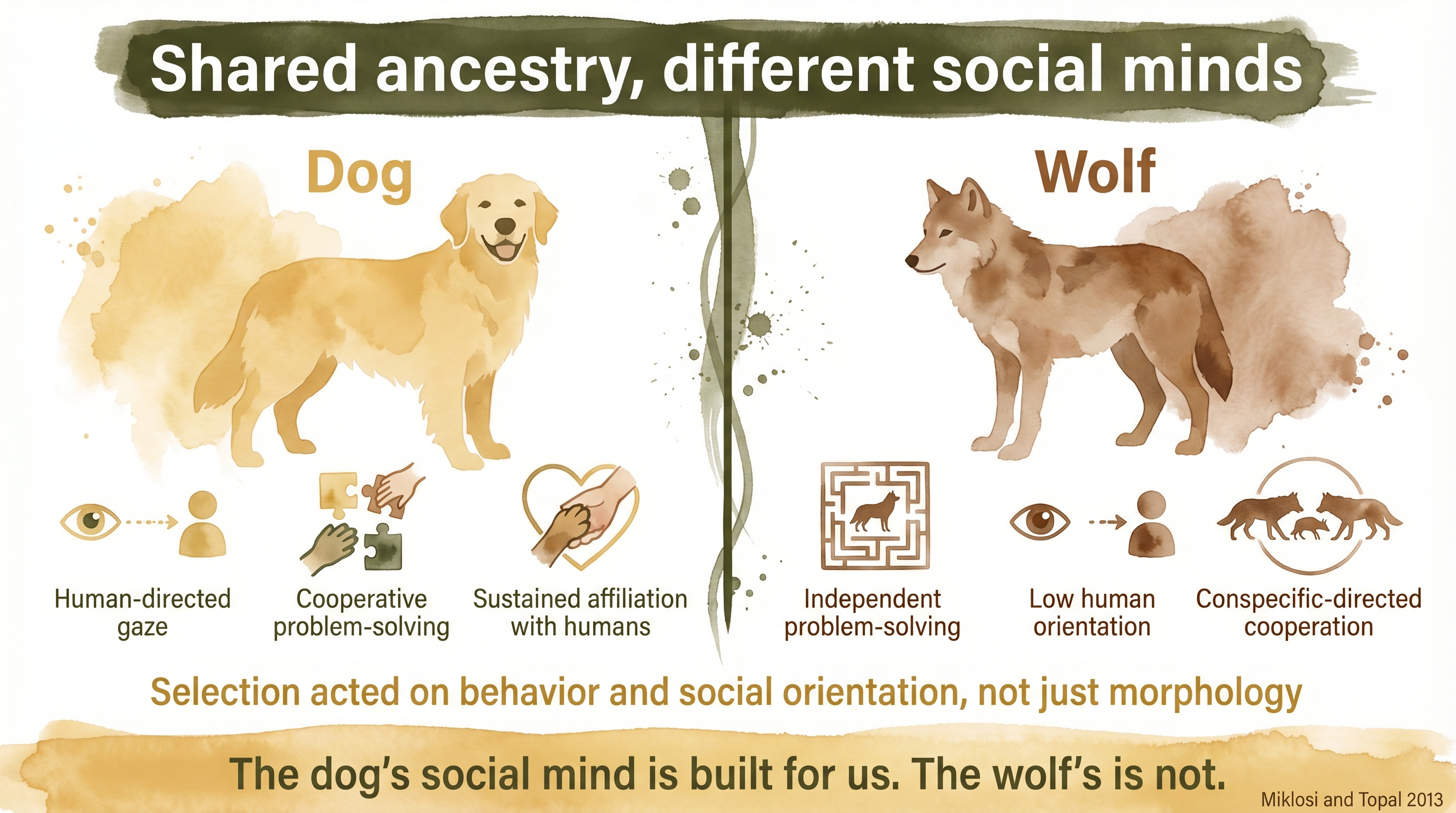
Shared ancestry, different social minds. The dog's is built for us.
Key Takeaways
- The major dog-wolf difference is social orientation toward humans, not a simple all-purpose intelligence hierarchy.
- Dogs more readily treat humans as communicative partners and problem-solving resources.
- Wolves can exceed dogs in some independent tasks, which reflects niche difference rather than pet-quality superiority.
- For JB, the comparative evidence supports treating human guidance as biologically relevant to dogs rather than as an artificial overlay.
The Evidence
This entry uses observed claim-level tags beyond the dedicated EvidenceBlocks below. These tags mark JB program observation or practice-derived claims that need dedicated EvidenceBlock coverage in a later content pass.
- Hare et al. (2002)dogs, wolves, and chimpanzees
Found that dogs used human communicative gestures more successfully than the comparison groups on object-choice tasks. - Miklosi et al. (2003)dogs and wolves
Showed that dogs looked back to humans for help during an unsolvable task while wolves persisted more independently. - Topal et al. (2005)dog puppies and hand-reared wolves
Found stronger human-attachment expression in dogs than in similarly socialized wolves. - Range and Viranyi (2022)dogs and wolves
Argued that conflict avoidance and rule-following better capture key dog-wolf divergence than simplistic claims of lower aggression.
No published study directly tests the practical implications of behavioral divergence between dogs and wolves for domestic dog raising programs. The application to household dog raising remains an interpretive synthesis rather than a directly tested intervention finding.
SCR References
Sources
- Hare, B., Brown, M., Williamson, C., and Tomasello, M. (2002). The domestication of social cognition in dogs. Science.
- Miklosi, A., et al. (2003). A simple reason for a big difference: wolves do not look back at humans, but dogs do. Current Biology.
- Topal, J., et al. (2005). Attachment to humans: a comparative study on hand-reared wolves and differently socialized dog puppies. Animal Behaviour.
- Range, F., and Viranyi, Z. (2022). Comparing wolves and dogs: current status and implications for human self-domestication. Trends in Cognitive Sciences.