The Juvenile Period (3 to 6 Months)
The juvenile period is the stage after the socialization window and before adolescence. It is often treated as the calm middle of puppyhood, but that description is misleading. The better summary is consolidation and refinement. Experiences from the earlier period do not disappear here. They begin settling into more stable habits, expectations, and response patterns while the nervous system is still maturing. Documented
What It Means
By the juvenile period, the puppy looks much more capable. Coordination is better. Endurance is better. Sleep is still high, but activity is wider. Curiosity is more sustained. Daily routines begin to take on recognizable shape.
That visible competence creates the illusion that development is mostly finished. It is not.
Historical framing
Compared with the neonatal stage, the socialization period, or adolescence, the juvenile period is less dramatically discussed in the literature. That often leads people to flatten it into a gap between more famous phases.
That flattening is a mistake.
Developmentally, this period is where early templates start hardening into daily patterns. The puppy is no longer in the most plastic early social window, but it is also far from adult regulation.
What is changing during this phase
The juvenile puppy is building reliability out of repetition.
Motor patterns become more efficient. Environmental expectations become more stable. Sleep-wake rhythm, play style, greeting habits, frustration responses, and recovery patterns become easier to recognize because they are now being repeated in a more mature body across a wider range of daily situations.
This is why the juvenile period can feel deceptively revealing. The puppy begins to show a more recognizable style, but that style is still developmental rather than final. Documented
The brain is still maturing
The strongest neuroscience point here is simple: the dog brain is not finished when the socialization period closes.
SCR-040 documents continued postnatal maturation beyond the earliest puppy phase, with a mostly adult-like MRI appearance by about sixteen weeks but ongoing development beyond that point. That matters because the juvenile period overlaps the stage where the puppy can look increasingly coordinated while still building the communication infrastructure for later integration and control. Documented
At the same time, SCR-041 protects against false precision. Documented We should not pretend the juvenile brain can be summarized by one exact completion percentage or one exact calendar milestone. The safer phrasing is that substantial development has happened, and substantial development is still happening.
Consolidation is not the same as stability
If the socialization period is where the puppy absorbs first templates, the juvenile period is where those templates get rehearsed in everyday life.
That can be good or bad.
A puppy who has learned that novelty is manageable, rest is ordinary, and humans are predictable now rehearses those expectations across more contexts.
A puppy who has learned frantic greeting, high arousal around thresholds, or poor frustration tolerance rehearses those patterns too.
This is why the phase matters so much to the Prevention framework. The dog is not only learning new things here. It is automating old ones.
Play, teething, and rehearsal
The juvenile period is also the age when adults often underestimate the developmental importance of ordinary repetitive behavior because the dog still looks playful and immature.
Teething, object carrying, rougher play, environmental grabbing, threshold excitement, jumping for access, and difficulty settling can all be misread as "just puppy stuff" in a way that removes them from serious developmental attention. Sometimes that interpretation is fair. Many juvenile behaviors are normal and transient.
But normal does not mean irrelevant.
What makes the juvenile period so consequential is that normal immaturity is happening inside a system that learns from repetition. If the dog repeatedly practices high arousal at doors, frantic greeting, poor recovery after play, or self-rewarding environmental behaviors, those patterns can become easier to trigger precisely because they are ordinary and frequent.
This is why the phase is tricky. Adults do not need to respond to every juvenile behavior as if it were pathology. They do need to understand that repeated juvenile behavior can become adult default if it is rehearsed often enough.
Pruning, selection, and the limits of mechanism talk
The pruning discussion needs discipline. SCR-043 confirms that pruning machinery is real and functionally necessary in the developing dog brain. It does not give us a normal behavioral pruning calendar for the juvenile period.
That means we can responsibly say developmental selection and refinement are real biological processes; experience is still shaping which patterns are stabilized; and exact canine week-by-week pruning claims remain unmapped.
We should not say the puppy prunes one exact behavior at one exact age; and one juvenile habit maps to one known cortical elimination event.
Why young dogs still struggle with consistency
This is also the phase where families start asking adult questions of a non-adult brain.
The juvenile dog can often do more than it could at ten weeks stay engaged longer; generalize a little better; recover a little faster; and tolerate routine more reliably.
But "a little better" is not the same as adult-level self-management.
The behavioral-science pages on prefrontal control matter here. Documented Executive stability, restraint, and flexible inhibition depend on systems still maturing through juvenile development and beyond. The dog is learning rules while still building some of the hardware that will make following those rules easier later.
Why It Matters for Your Dog
The juvenile period is where many families accidentally stop reading development and start reading character.
That can cause two different mistakes.
The first mistake is complacency. The puppy seems fine, so structure loosens. Rest gets replaced by more stimulation. Minor habits are waved off because the dog is "still young." That can give repeated behavior many more chances to settle in.
The second mistake is overinterpretation. The puppy seems inconsistent, impulsive, or distractible, and the adult reads those patterns as deliberate stubbornness or permanent temperament.
Both errors miss the nature of the phase.
The juvenile period is best understood as the place where earlier foundations are tested in ordinary life but are not yet finished products.
This period supports the prevention logic in a narrower biological sense: repeated behavior is becoming easier to perform, more familiar, and more likely to recur while development is still actively underway. Everyday rehearsal matters.
Expectations should rise, but not all the way
A good developmental stance during this period is to raise expectations gradually without pretending maturity has already arrived.
That means routines should become clearer, not looser, recovery should be supported, not assumed, habits should be noticed early, not after months of repetition, and stimulation should stay paced to what the dog can process, not to what the family wants to see.
A useful way to think about this phase is that the dog is old enough to start carrying more of daily life and still young enough to need the environment designed around immature control. That combination is exactly why juvenile dogs benefit from clear routines, limited unnecessary friction, and low-drama repetition of the same adult expectations.
Limits and open questions
The juvenile period is scientifically real but not finely mapped. Compared with human developmental psychology, dog science has less detailed direct work on the exact upper and lower boundaries of juvenile refinement, especially in ordinary pet dogs.
The evidence is stronger on ongoing brain maturation; the importance of earlier sensitive periods; and the immature status of later control systems.
It is weaker on breed-specific juvenile milestones; exact normal variation in habit consolidation across home environments; and direct causal mapping between juvenile management patterns and later adult traits.
How this connects to the rest of the wiki
This page sits between socialization-period and adolescence.
If the earlier period explains why experience has outsized leverage, this page explains how repeated daily life begins converting that leverage into stable patterns.
If you want the neuroscience beneath it, canine-brain-development-timeline and prefrontal-cortex-and-inhibitory-control explain why later self-control is still a developmental achievement rather than a starting condition. Documented
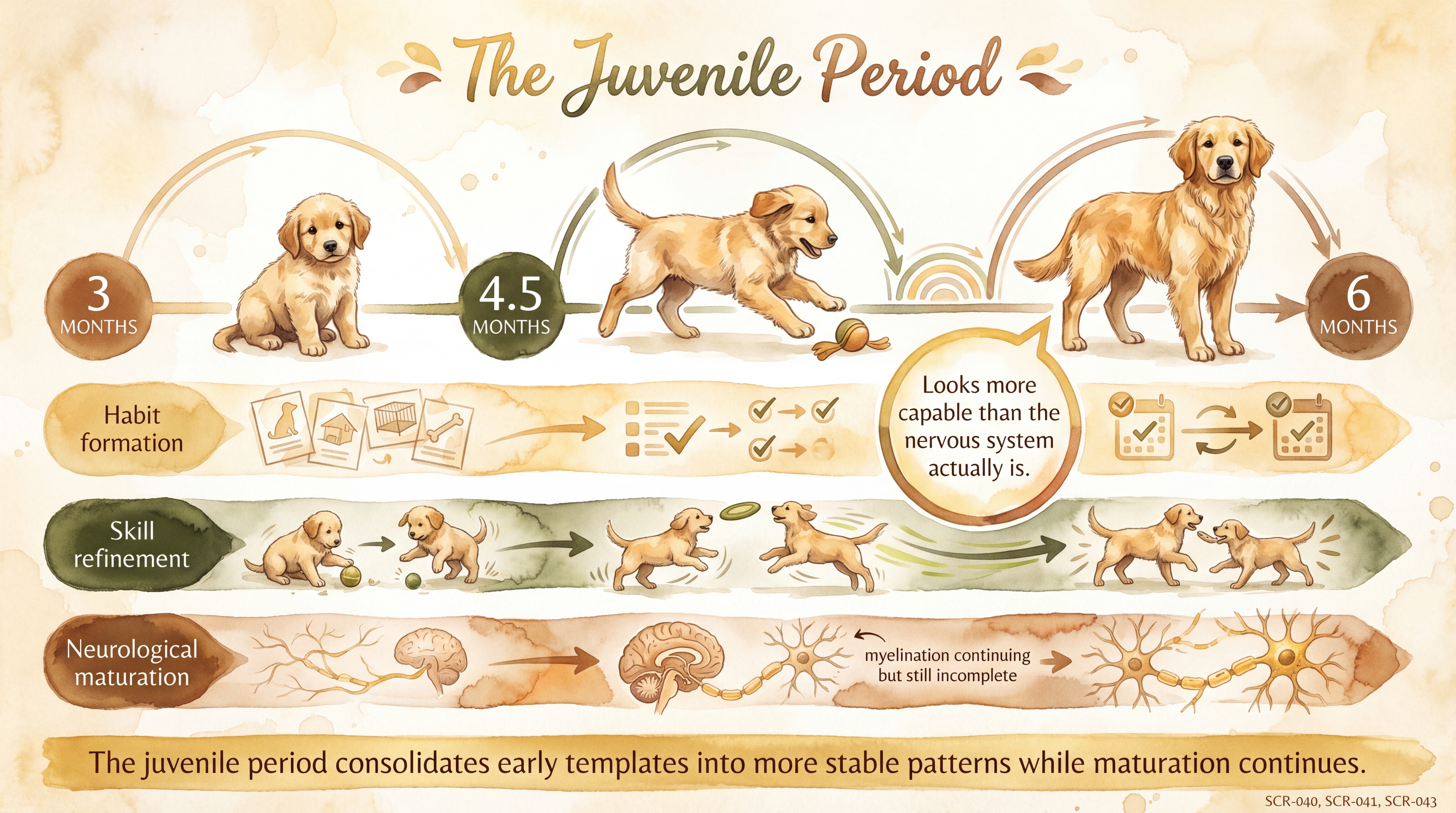
The juvenile period consolidates early templates into stable patterns while neurological maturation continues.
Key Takeaways
- The juvenile period is a consolidation phase, not a developmental pause.
- Earlier socialization experiences start settling into more stable daily habits during these months.
- The dog looks more capable than before, but later control systems are still maturing.
- This is the phase where everyday repetition matters most because patterns are becoming easier to perform and harder to ignore.
The Evidence
- Gross, B. et al. (2010)domestic dogs
Showed that canine brain maturation continues beyond the earliest socialization weeks, with a mostly adult-like MRI appearance by about sixteen weeks but continued maturation after that. - Wu, Y. C. et al. (2011)domestic dogs
Diffusion imaging supported continuing white-matter maturation through later juvenile development. - Seppala, E. H. et al. (2011)domestic dogs
Confirmed that pruning-related machinery is present and functionally necessary in the developing canine brain, while not mapping a normal age-specific behavioral pruning schedule.
- Cook, P. F. et al. (2016)domestic dogs
Stronger frontal cortical activation predicted better inhibitory control in dogs, supporting the importance of still-maturing control systems for later behavior. - Developmental neurobiology synthesismultiple mammals
Juvenile development is typically a period of consolidation, increased integration, and continued maturation rather than final adult control.
- SCR-041 boundarydomestic dogs
Exact percentage claims about juvenile brain maturity remain unverified and should not replace the broader, better-supported story of ongoing maturation. - SCR-043 boundarydomestic dogs
Pruning machinery is confirmed in dogs, but a normal pruning calendar tied to specific juvenile behaviors is not currently established.
No direct canine research located for this specific topic. Current understanding relies on related research, clinical observation, and cross-species inference.
SCR References
Sources
- Cook, P. F., Spivak, M., & Berns, G. S. (2016). Neurobehavioral evidence for individual differences in canine cognitive control: An awake fMRI study. Animal Cognition, 19(5), 867-878.
- Gross, B., Garcia-Tapia, D., Riedesel, E., Ellinwood, N. M., & Jens, J. K. (2010). Normal canine brain maturation at magnetic resonance imaging. Veterinary Radiology & Ultrasound, 51(4), 361-373.
- Seppala, E. H., et al. (2011). LGI2 truncation causes a remitting focal epilepsy in dogs. PLoS Genetics, 7(7), e1002194.
- Wu, Y.-C., Field, A. S., Duncan, I. D., & Samsonov, A. A. (2011). High b-value and diffusion tensor imaging in a canine model of dysmyelination and brain maturation. NeuroImage, 58(3), 829-837. DOI: 10.1016/j.neuroimage.2011.06.067.