The First Fear Period (8 to 11 Weeks)
The first fear period is the short developmental span, usually placed around eight to eleven weeks, when frightening experiences can leave a larger-than-usual imprint. It is best understood as a late-socialization vulnerability rather than as a separate world outside the socialization window. The puppy is still learning quickly, but the balance between curiosity and caution is changing. Mixed Evidence
What It Means
The phrase "first fear period" is common in dog-development writing, but it is only useful if it is handled carefully. Documented
Historical framing
Classic canine developmental literature recognized that the later part of the socialization window is not psychologically identical to the earlier part. Documented Fox's work, later breed-variation studies, and modern syntheses all converge on the same broad point: as puppies move deeper into the window, wariness of novelty starts to rise.
That does not mean a single switch flips on one universal day for every dog. Mixed Evidence It means the emotional cost of poorly managed novelty is increasing.
What changes during this period
Earlier in the socialization window, puppies are more likely to approach the world with broad exploratory bias. Mixed Evidence During the first fear period, that balance becomes more delicate. The puppy can still explore, still bond, and still learn new things. But negative experience now has more opportunity to become caution, avoidance, or durable alarm.
This is the heart of the period learning remains active; novelty is not neutral; strong fright is more memorable; and recovery quality matters more.
Why this period overlaps with go-home age
For many puppies, the first fear period overlaps with transport, placement, new people, new rooms, new sounds, and a radically different daily rhythm.
That overlap is one of the most important practical facts in the whole dispatch. The puppy is not only changing homes. The puppy is often changing homes while entering a developmental subphase in which overwhelming novelty can teach the wrong lesson fast.
That does not mean puppies should never go home during this range. It means the quality of the handoff matters.
The neural context
The current canine neuroscience is strong enough to support careful network language and weak enough to punish exaggeration.
The strongest direct dog imaging on fear circuitry shows that anxious dogs have measurable amygdala-centered salience-network abnormalities associated with fearfulness, excitability, and impaired trainability. That does not prove a puppy in a first fear period is showing the same full clinical pattern. What it does provide is a dog-direct reminder that canine fear and salience systems are biologically real, measurable, and behaviorally consequential.
The developmental synthesis then adds a plausible bridge: late socialization involves rising caution inside a still-high-plasticity system. That makes a frightening experience more likely to be encoded as "this is dangerous" rather than as a small bump in a broadly exploratory world.
Why one bad event can matter more here
The first fear period does not mean one scary noise ruins a puppy forever. It means the same event can carry more developmental weight than it would at another age.
That is a probability statement, not a destiny statement.
The puppy's age changes what kind of lesson is most available from the event "interesting but manageable"; and or "this should be avoided".
The more intense, abrupt, or inescapable the experience, the more likely the second lesson becomes.
Why transition stress can stack here
The first fear period is especially important in pet homes because it often stacks multiple stressors that would be easier to absorb if they arrived separately.
The puppy may be processing loss of litter routine; transport to a new place; new sleeping arrangement; new people; new flooring, sounds, and odors; and different handling style.
None of those variables is automatically damaging. But together they can create a developmental load much bigger than any single novelty item on its own. That is why the question "should puppies go home during the first fear period?" is less useful than the question "what kind of landing do they experience when they do?"
The role of recovery
The key variable is not only whether the puppy startles. Startle is normal. The more useful question is what happens next.
Can the puppy recover?
Can the puppy use the adult as a reference point?
Can the environment become ordinary again quickly?
This is why calm adult behavior matters so much during the first fear period. The adult cannot erase a frightening event, but the adult can change the puppy's larger interpretation of what the event means.
Why It Matters for Your Dog
The first fear period is where developmental timing and family behavior interact most visibly.
The family often imagines the puppy needs a dramatic introduction to life: lots of visitors, high excitement, rapid outings, constant novelty. The fear-period literature pushes the other direction. Novelty should continue, but it should be measured, paced, and recoverable.
The soft-landing idea fits this period because the puppy often enters a new home while its fear system is becoming more developmentally significant. Calm continuity protects learning better than intensity for intensity's sake.
What good handling looks like
During the first fear period, good developmental handling usually means avoiding forced interaction, keeping introductions calm and short, not overwhelming the puppy with spectators, allowing observation before participation, and taking sudden fear reactions seriously without turning them into drama.
This is not about coddling. It is about not adding needless emotional load to a period where the puppy is already more impressionable to negative experience.
It also means resisting the temptation to "prove" the puppy is fine by pushing the puppy through the thing that caused the fear. Adults often do this because they are afraid of reinforcing fear. In reality, developmental forcing often teaches a different lesson: not only is the thing frightening, but the adult becomes unpredictable at the moment fear appears.
That is why the calm adult role matters so much. The adult does not need to reward alarm. The adult does need to keep the environment readable while the puppy regains footing.
Limits and open questions
This page is marked mixed for a reason.
The broad developmental reality of a late-socialization rise in fear sensitivity is well supported in canine literature. But the exact boundaries, intensity, and universality of a neat "first fear period" vary across sources and likely across breeds and litters.
The current SCR support is also indirect SCR-025 documents the broader socialization window; SCR-035 is an observed JB signal that fearfulness around three months predicts later anxiety; and SCR-049 documents canine fear-network abnormality in anxious dogs. Estimated
That combination supports a careful developmental page. It does not justify claiming that every eight-week-old puppy is inside one identical hard-coded fear phase.
How this connects to the rest of the wiki
This page sits inside the broader socialization-period and socialization-window pages.
For the fear-circuit mechanism, amygdala-and-fear-circuits and sensitization extend the biology beyond this age-specific subphase.
The later analogue, treated much more cautiously, is second-fear-period.
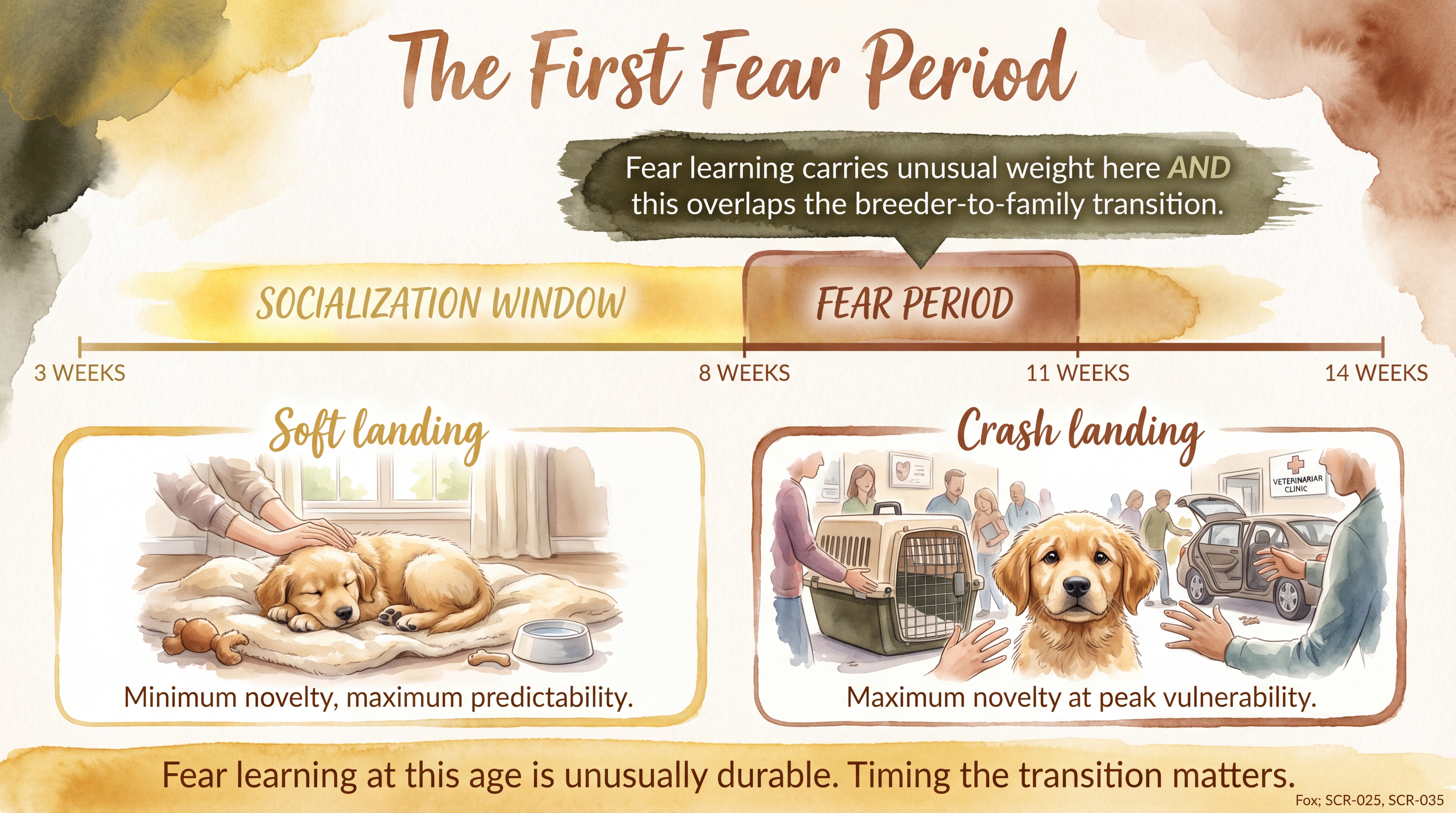
Fear learning at this age is unusually durable - the first fear period overlaps the critical breeder-to-family transition.
Key Takeaways
- The first fear period is best treated as a late-socialization vulnerability, not as a separate developmental universe.
- Negative experiences can carry more weight here because the balance between curiosity and caution is shifting.
- This often overlaps with the breeder-to-family handoff, which makes calm transition especially important.
- The phase is real enough to matter, but its exact boundaries and universality still require careful wording.
The Evidence
This entry uses estimated claim-level tags beyond the dedicated EvidenceBlocks below. These tags mark approximate ranges or timing claims that should remain bounded by the cited sources.
This entry uses mixed-evidence claim-level tags beyond the dedicated EvidenceBlocks below. These tags mark claims that combine documented findings with observed practice, heuristic application, or unresolved gaps.
- Fox, M. W. (1971)domestic dogs
Classic developmental work described a late-socialization rise in caution and heightened impact of aversive experience during early puppy development. - Morrow, M. et al. (2015)domestic dogs
Breed-dependent fear-related avoidance onset supports the idea that the latter part of the socialization window carries increasing vulnerability to fear learning. - Xu, J. et al. (2023)domestic dogs
Anxious dogs show measurable amygdala-centered salience-network abnormalities, confirming the biological relevance of canine fear circuitry.
- SCR-035 internal dataGolden Retrievers in the JB program
Fearfulness at around three months correlated with later anxiety in JB observations, reinforcing the practical importance of this late-socialization stage while remaining an observed internal finding.
- Canine fear-period boundarydomestic dogs
The broad developmental phenomenon is well described, but exact age boundaries and intensity vary across sources and are not locked to one universal breed-wide timetable.
SCR References
Sources
- Fox, M. W. (1971). Integrative development of brain and behavior in the dog. University of Chicago Press.
- Morrow, M., Ottobre, J. S., Ottobre, A. C., Neville, P., St-Pierre, N., Dreschel, N. A., & Pate, J. L. (2015). Breed-dependent differences in the onset of fear-related avoidance behavior in puppies. Journal of Veterinary Behavior, 10(4), 286-294. DOI: 10.1016/j.jveb.2015.03.002.
- Canine fear-period boundary. Retain as boundary note: useful clinical and breeder concept, but not a tightly standardized experimental canine period.
- Xu, Y., Christiaen, E., De Witte, S., Chen, Q., Peremans, K., Saunders, J. H., Vanhove, C., & Baeken, C. (2023). Network analysis reveals abnormal functional brain circuitry in anxious dogs. PLOS ONE, 18(3), e0282087. DOI: 10.1371/journal.pone.0282087.