Scott and Fuller: Foundational Canine Behavioral Genetics
Scott and Fuller matter because they turned several old breeder intuitions into a disciplined scientific field, and the work they did at the Jackson Laboratory between roughly 1946 and 1965 remains one of the most ambitious and carefully designed studies of dog behavior ever conducted. Over years of work, they raised dogs from multiple breeds under standardized conditions and showed that breed-typical behavioral differences were real, heritable, and developmentally structured in ways that neither pure environmentalism nor pure genetic determinism could adequately explain. They also helped anchor the early socialization window that later puppy-development work kept refining, and the framework they established continues to inform how modern breeders, trainers, and researchers think about the interaction between inherited tendencies and early experience. Their book, Genetics and the Social Behavior of the Dog, remains a foundational citation more than half a century after its publication, and its core findings have held up remarkably well under the scrutiny of later research. Documented
What It Means
The experimental design that made the study possible
The Scott and Fuller study is still foundational because of its design, not just because of the conclusions it reached, and understanding the design is part of appreciating why the conclusions carried the weight they did. Documented Scott and Fuller did not simply compare adult dogs living in wildly different homes and try to tease apart heredity from environment after the fact, which is the methodological problem that plagues most casual observation of dog behavior. They attempted to reduce environmental noise by raising five breeds under highly standardized conditions at the Jackson Laboratory, with the specific goal of making heritable contributions to behavior visible against a controlled background rather than lost in the noise of varying rearing environments.
The five breeds they chose were Basenjis, Beagles, American Cocker Spaniels, Shetland Sheepdogs, and Wire Fox Terriers, and the selection was deliberate because the breeds represented different functional histories and different reputations for behavior. Basenjis came from an African hunting background and had a reputation for independence. Beagles came from a pack-hunting background and had a reputation for social sociability and vocal communication. American Cocker Spaniels came from a bird-dog background with heavy selection for affiliative orientation toward humans. Shetland Sheepdogs came from a herding background with selection for responsiveness and working cooperation. Wire Fox Terriers came from a varmint-hunting background with selection for boldness and persistence. Each breed represented a different point in the space of functional selection, and comparing them under identical conditions was a way of asking what behavioral differences survived when the environment was held constant.
The standardized rearing conditions included carefully controlled socialization protocols, similar housing, similar handling schedules, and systematic behavioral testing that let researchers measure individual dogs on comparable behavioral dimensions rather than relying on subjective impression. This level of experimental control is rare in dog research even today, and at the time it was unprecedented, and it is part of why the study's conclusions carried more weight than earlier observational work on breed behavior.
The core findings
The work established several durable points that have held up under subsequent research and that continue to shape how canine behavior is understood. Documented Breed differences in behavior are real, meaning that the behavioral variation across breeds was not an artifact of different rearing environments but persisted when environmental conditions were equalized. The Basenjis behaved differently from the Beagles, the Cockers differed from the Terriers, and these differences were measurable and reproducible in ways that could not be attributed to how the dogs had been raised.
Those differences are not erased by giving dogs the same general environment, which is a subtle but important point because it distinguished the Scott and Fuller conclusions from the environmental-determinist view that was popular in some behavioral circles at the time. If breed differences had been purely a function of how different breeds were typically raised by their owners, then equalizing the rearing environment should have erased them, and the fact that this did not happen was direct evidence against that hypothesis.
Individual variation still exists within each breed, meaning that the breed-typical patterns were statistical averages around which individual dogs varied in meaningful ways. Not every Basenji was identically independent, not every Beagle was identically vocal, and the within-breed variation was substantial enough to make individual behavioral assessment meaningful even when the breed average gave a useful starting point. This finding would later become important for pushing back against the oversimplified view that breed label alone could predict individual behavior with high confidence.
Early developmental timing matters, especially for social behavior, and this was perhaps the most influential finding of the entire project in terms of its downstream impact on puppy-raising practice. Scott and Fuller documented the existence of a sensitive period in early puppy development during which social attachments and basic social behaviors were most readily formed, and they described the consequences of socialization experiences occurring inside versus outside that window. The framework they established is the direct ancestor of the socialization period framework that modern puppy-development work still uses.
Why the findings rejected both simplifications at once
This combination of findings is what made the project so important, because it rejected two opposite simplifications simultaneously in a way that few studies before or since have managed to do with comparable rigor. Documented
It rejected the idea that behavior is only training and environment, which was the dominant view in some academic psychology circles at the time and which would have implied that any dog could become any kind of dog given the right rearing approach. The persistence of breed differences under standardized rearing conditions directly contradicted this view and showed that inherited tendencies contribute meaningfully to behavioral outcomes in ways that cannot be overridden simply by manipulating the rearing environment.
It also rejected the idea that breed averages make individual development irrelevant, which was the opposite simplification popular in some dog-fancy circles and which would have implied that once you knew a dog's breed you knew most of what mattered about it. The within-breed individual variation and the importance of developmental timing showed that what happens to a particular puppy still shapes the adult dog that puppy becomes, even when the breed baseline is fixed.
Both heredity and development mattered, and they interacted with each other in ways that required attention to both, not just one or the other. This middle ground is where modern behavioral genetics has settled, and Scott and Fuller were among the first to document it rigorously enough that the position became scientifically defensible rather than merely intuitive.
The lasting influence on canine developmental science
The influence of Scott and Fuller on modern canine developmental science is difficult to overstate, even though later studies have added substantial detail, refined the timing of sensitive periods, and used molecular tools that were unavailable in the original work. Documented Almost every modern discussion of puppy socialization traces its intellectual lineage back to the Jackson Laboratory work, and the basic concept of a sensitive period for social development is now so thoroughly embedded in practical puppy-raising guidance that many people who use the concept have no awareness of where it originated.
Modern research has refined the timing estimates, identified multiple overlapping sensitive periods for different aspects of development, documented the neurobiological mechanisms underlying the phenomena Scott and Fuller observed, and extended the framework to questions about adult behavioral outcomes that the original study could not fully address. Documented But the basic architecture remains the one Scott and Fuller helped build, and the field has refined their conclusions rather than overturning them.
Why It Matters for Your Dog
What It Did Not Settle
Scott and Fuller are foundational, not final, and treating their work as the last word on canine behavioral genetics would misrepresent what the study actually accomplished and what remains for later research to address.
The study did not provide a modern genome-wide map of canine behavior, because the genetic tools needed for that kind of work did not exist in the 1960s and because the study was designed to document behavioral heritability at the phenotypic level rather than to identify specific loci contributing to behavioral variation. Documented Later genome-wide association studies have begun this molecular work, but the connections between specific genetic variants and specific behavioral outcomes remain incomplete even with modern tools.
It did not show that early puppy tests can predict every adult outcome with precision, and some of the individual-dog predictive claims that later behavioral assessment programs tried to build on the Scott and Fuller foundation have not held up well under scrutiny. The heritable structure of canine behavior is real at the population level, but predicting individual adult outcomes from puppy-age testing remains significantly harder than some assessment programs have claimed, and Scott and Fuller should not be blamed for overclaims made by later workers who built on their foundation.
And it did not mean that one breed label can stand in for direct phenotyping of actual breeding dogs, because the within-breed individual variation the study itself documented means that breed-level averages can only take evaluation so far. A breeder who selects breeding candidates based on breed reputation alone, without actually assessing the individual dogs in front of them, is not applying the Scott and Fuller lessons correctly.
What the study did give the field was a durable architecture: inherited behavioral tendencies are real, they express through development rather than bypassing it, and both heredity and early experience contribute to the adult dog in ways that require attention to both rather than forcing a choice between them. Documented
For families, Scott and Fuller matter because the study explains why early life and breeding both count, and the explanation is neither trivial nor obvious until you have thought about it carefully.
If behavior had turned out to be almost entirely postnatal shaping, breeder selection would matter much less than most serious breeders believe it does, because any puppy could become any kind of dog with the right training. Families could choose puppies based on cosmetic preference alone and expect to train their way to whatever temperament they wanted, and breeders would function mostly as producers of interchangeable puppies whose differences did not matter much after adoption.
If behavior had turned out to be fixed regardless of development, puppy raising would matter much less than most serious raisers believe it does, because the adult dog would already be encoded in the puppy at birth and nothing the family did during development could meaningfully change the trajectory. Families could bring home any puppy and expect it to turn out according to its genetic blueprint regardless of their own investment in the early weeks and months.
Instead, the work points to the middle ground that serious breeders and serious families actually live in. Inherited tendencies matter because they shape the starting conditions from which development proceeds. Developmental timing matters because certain kinds of experiences have outsized influence when they occur during specific windows. The early environment matters because the developmental windows during which experience has the largest effect occur early in life. And later experience still matters, but not at the same cost as earlier experience, because the windows do eventually close or become less plastic even if behavior never becomes fully fixed.
That picture fits closely with the Just Behaving transition framework, and the alignment is not coincidental because the Five Pillars approach was built on the same understanding of canine development that Scott and Fuller helped establish. A puppy does not arrive as blank material, and it does not arrive as finished destiny either. The puppy arrives with inherited architecture that still needs to be carried through a narrow developmental window with competent adult guidance, and the job of good raising is to meet the inherited potential of the puppy with developmentally appropriate experience rather than either assuming the puppy will raise itself or believing that training can rewrite the inherited starting point.
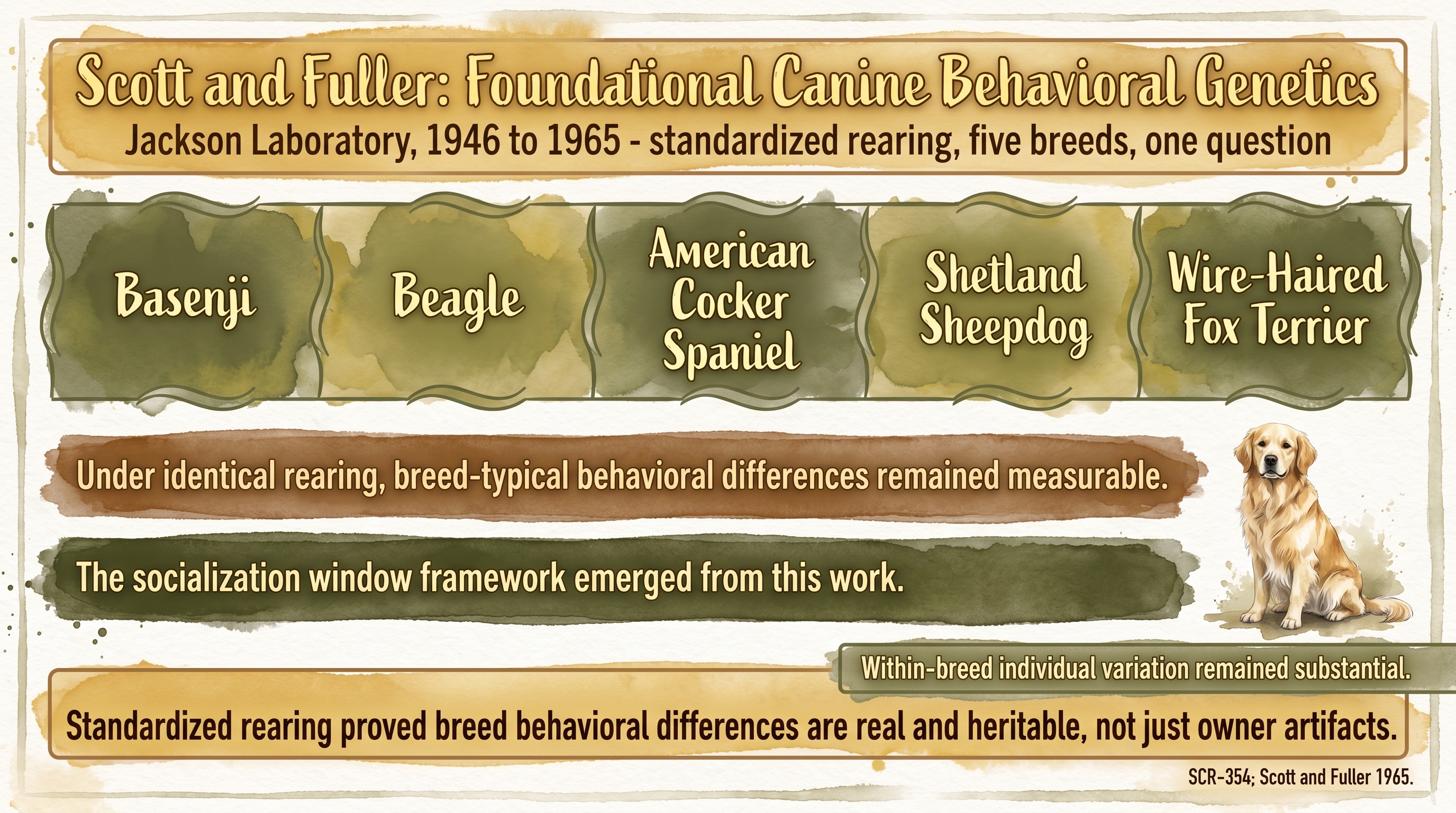
Standardized rearing proved breed behavioral differences are real and heritable, not just owner artifacts.
Key Takeaways
- Scott and Fuller helped establish canine behavioral genetics by comparing five breeds under standardized rearing conditions at the Jackson Laboratory.
- Their work showed that breed-typical behavior is real, heritable, and still expressed through development rather than outside it.
- The study also helped anchor the early socialization framework that remains central to modern puppy-development science.
- The findings rejected both pure environmentalism and pure genetic determinism by documenting that heredity and development interact rather than competing.
- For modern breeding and raising, the enduring lesson is that heredity and early environment are partners rather than rivals, and both deserve attention in any serious program.
The Evidence
- Scott and Fuller (1965)domestic dogs
The Jackson Laboratory work established that many canine behavioral traits show heritable structure and that breed differences remain visible under standardized rearing conditions. - Temperament heritability source synthesisdogs
Scott and Fuller remain a foundational reference for canine behavioral genetics because they linked heredity, breed differences, and early developmental timing in one integrated program.
- Canine developmental literaturedomestic dogs
The early socialization-period framework later refined by other studies sits directly downstream of the developmental timing findings Scott and Fuller helped establish.
No modern study has replicated the Scott and Fuller multi-breed comparison design with current breeds, standardized rearing, and contemporary behavioral measurement tools to test whether the original conclusions hold under updated methodology.
SCR References
Sources
- Scott J.P. & Fuller J.L. (1965). Genetics and the social behavior of the dog. University of Chicago Press.
- Jones A.C. & Gosling S.D. (2005). Temperament and personality in dogs (Canis familiaris): A review and evaluation of past research. Applied Animal Behaviour Science, 95(1-2), 1-53. doi:10.1016/j.applanim.2005.04.008
- Svartberg K., Tapper I., Temrin H., Radesäter T., & Thorman S. (2005). Consistency of personality traits in dogs. Animal Behaviour, 69(2), 283-291. doi:10.1016/j.anbehav.2004.04.011
- Saetre P., Strandberg E., Sundgren P.-E., Pettersson U., Jazin E., & Bergström T.F. (2006). The genetic contribution to canine personality. Genes, Brain and Behavior, 5(3), 240-248. doi:10.1111/j.1601-183X.2005.00155.x
- Goddard M.E. & Beilharz R.G. (1983). Genetics of traits which determine the suitability of dogs as guide-dogs for the blind. Applied Animal Ethology, 9(4), 299-315. doi:10.1016/0304-3762(83)90010-X