Prefrontal Cortex and Inhibitory Control
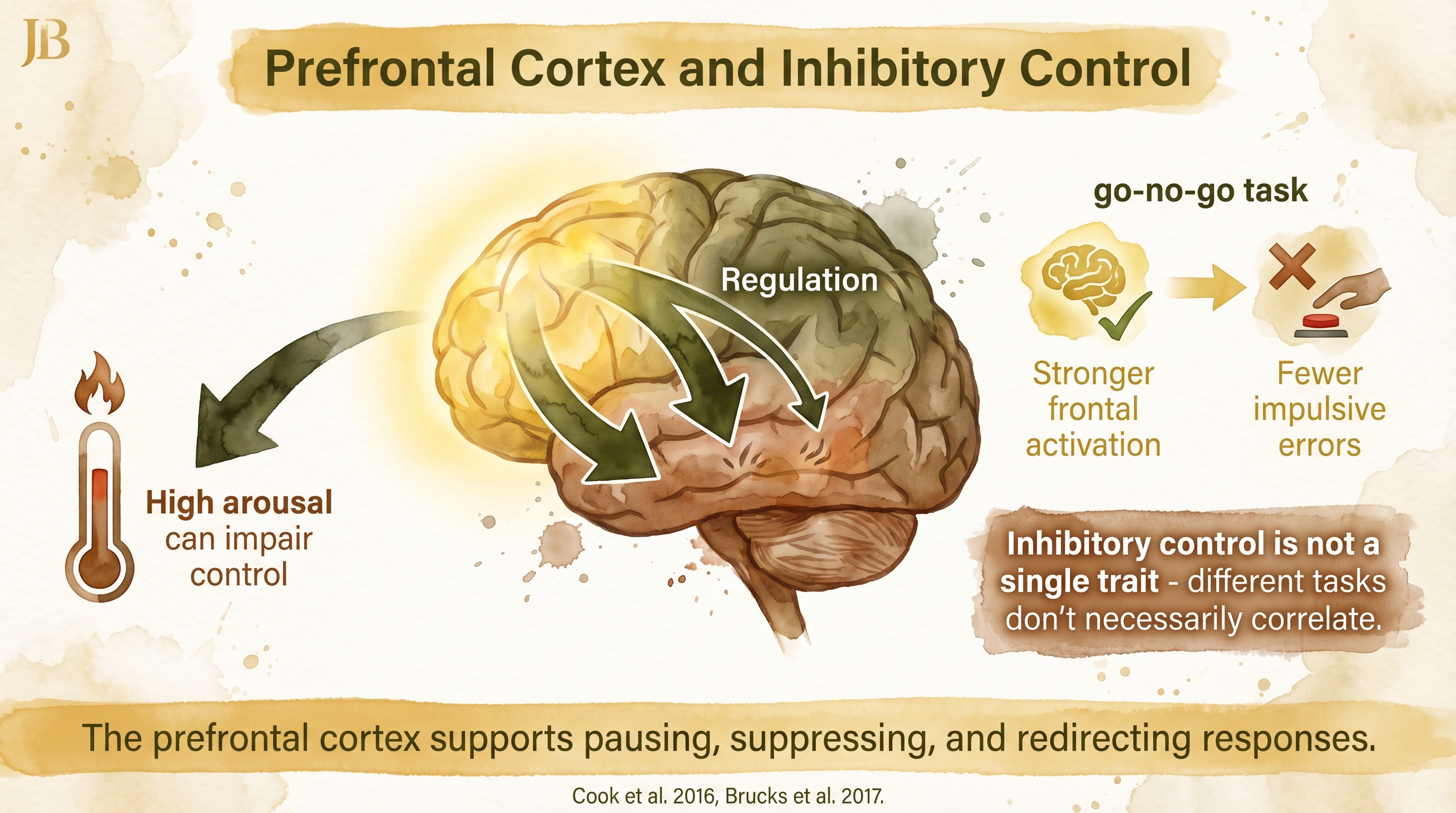
The prefrontal cortex is the broad cortical system most closely associated with executive control: holding back a response, maintaining task rules, shifting flexibly, and acting in a more deliberate rather than purely reactive way. Dogs show measurable frontal engagement during inhibitory tasks, and stronger frontal activation predicts fewer impulsive errors. Documented
What It Means
Inhibitory control is not simply "good behavior." It is the ability to pause, suppress, or redirect an immediately available response. In dogs, this can show up as detouring instead of charging directly, withholding a learned response when a no-go signal is present, tolerating delay before reward access, and shifting away from a highly salient cue toward a rule. Documented These behaviors depend on more than temperament. They depend on brain systems that support top-down regulation.
Direct Canine Evidence
SCR-048 is the anchor here. In an awake fMRI go-no-go paradigm, Cook, Spivak, and Berns found that dogs showing stronger frontal cortical activation during inhibition trials made fewer commission errors. That does not solve every question about canine executive function, but it does establish a direct link between frontal engagement and successful behavioral inhibition in dogs. Documented This matters because it moves the conversation beyond metaphor. The dog does not only "seem thoughtful" or "seem impulsive." There is measurable frontal-cortical involvement in whether inhibitory control succeeds.
Dogs Do Not Have a Single Inhibition Score
One important boundary from the literature is that inhibitory control is not a single unitary trait captured perfectly by one task. Documented Brucks and colleagues found that different dog inhibition tasks do not necessarily correlate strongly with one another. More recent work also shows that training history and discipline can affect performance, suggesting that executive function in dogs is both measurable and context-sensitive. That means one failed behavior does not automatically prove a globally weak prefrontal system. It may reflect task demands, emotional load, prior experience, or the specific component of control being tested.
Developmental Timing
The developmental side of this page is more cautious than the broad mammalian literature sometimes sounds. Dogs clearly mature behaviorally and neurally after the earliest puppy stage, but the exact late-frontal developmental schedule is not mapped in dogs with human-like precision. SCR-041 helps by protecting against false precision. If even the "70 percent by six weeks" claim is unverified, downstream pages should avoid pretending we have a fully settled month-by-month frontal timeline. The safer conclusion is: frontal control is functionally real in dogs, it develops over juvenile life, and young dogs should not be treated as if they already have adult inhibitory hardware. That conclusion is strongly consistent with the structural-development, white-matter, sleep, and behavior literatures taken together.
Stress, Salience, and Control
Frontal control does not operate alone. It exists in a larger system that includes motivational and limbic networks. This is why high arousal can impair performance in some dogs and contexts. The strong dog evidence is behavioral and physiological: inhibitory performance worsens when already excitable dogs are pushed higher in arousal. The stronger mammalian neuroscience claim is that stress can weaken prefrontal network efficiency. The specific real-time phrase "the prefrontal cortex goes offline" remains more inferential in dogs and should be treated that way. Documented-Cross-Species
Why It Matters for Your Dog
When adults expect consistent self-restraint from a very young dog, they are often asking for a level of control the nervous system is still assembling. Observed-JB That does not mean structure is pointless. It means structure has to work with development instead of pretending development is already finished. Frontal control improves through use, maturation, and experience. But it is never wise to interpret immature control as simple moral failure or deliberate opposition. Build calm baselines early. That foundation gives the prefrontal system the stability it needs to develop reliable control. A dog operating from high baseline arousal will struggle with inhibition even as the brain matures because the system is fighting against its own activation state. A dog with a calm baseline has room for the prefrontal system to do its work.
The calmness layer often argues that regulated environments protect thinking capacity. The direct dog evidence supports a narrower version: frontal engagement predicts inhibitory success, and higher arousal can reduce control in dogs who are already starting high.
The prefrontal cortex matures last - expecting adult impulse control from a puppy is asking hardware that does not yet exist.
Key Takeaways
- Dogs show direct frontal-cortical involvement in inhibitory control.
- Inhibitory control is measurable but not reducible to a single universal task score.
- Young dogs should not be treated as if adult self-restraint is already fully available.
- High arousal can undermine control, while stronger mechanistic claims about real-time prefrontal shutdown remain more inferential in dogs.
The Evidence
This entry uses observed claim-level tags beyond the dedicated EvidenceBlocks below. These tags mark JB program observation or practice-derived claims that need dedicated EvidenceBlock coverage in a later content pass.
- Cook, P. F. et al. (2016)domestic dogs
Awake fMRI showed that stronger frontal activation during a go-no-go task predicted fewer impulsive errors. - Brucks, D. et al. (2017)domestic dogs
Found that inhibitory-control measures do not necessarily correlate across tasks, indicating multiple subcomponents rather than one universal score. - Foraita, M. et al. (2023) and Mellor, N. et al. (2024)domestic dogs
Support executive function as a measurable canine domain shaped by age, training history, and task structure.
- Arnsten, A. F. T. (2015)multiple mammals
Reviewed how stress chemistry can weaken prefrontal network function and reduce higher-order control. - Canine arousal-performance literaturedomestic dogs
Dog studies show that control performance is sensitive to arousal state and baseline excitability, even when the exact neural mechanism is not directly imaged in real time.
No longitudinal fMRI study has tracked the same dogs from puppyhood through adulthood to measure developmental changes in prefrontal activation during inhibitory tasks.
No study has measured whether specific early-life experiences or caregiving styles correlate with later prefrontal engagement or inhibitory-control capacity in dogs.
SCR References
Sources
- Arnsten, A. F. T. (2015). Stress weakens prefrontal networks: Molecular insults to higher cognition.
- Brucks, D., et al. (2017). Measures of dogs' inhibitory control abilities do not correlate across tasks. Frontiers in Psychology.
- Cook, P. F., Spivak, M., & Berns, G. (2016). Neurobehavioral evidence for individual differences in canine cognitive control: An awake fMRI study. Animal Cognition, 19(5), 867-878.
- Foraita, M., et al. (2023). Executive functions as measured by the Dog Executive Function Scale over the lifespan of dogs.
- Mellor, N., McBride, S., Stoker, E., Dalesman, S., & Casey, R. (2024). Impact of training discipline and experience on inhibitory control and cognitive performance in pet dogs. Animals, 14(3), 428. DOI: 10.3390/ani14030428.