The Second Fear Period (6 to 14 Months)
The second fear period is one of the more useful and more overconfidently stated ideas in dog-development writing. The useful part is real: some adolescent dogs do show a temporary return of stronger caution, novelty sensitivity, or apparently sudden concern about things that previously seemed neutral. The overconfident part is pretending this is already mapped with the same certainty as the early socialization window. It is not. Observed-JB
What It Means
The phrase usually refers to a stage somewhere in early to mid-adolescence, often placed broadly between six and fourteen months, in which the dog appears more reactive, more suspicious, or more alarm-prone than it did only weeks earlier.
Why the concept persists
The concept persists because many families, breeders, and behavior professionals have seen something like it. Observed-JB
A dog who was previously unbothered by a statue, a trash barrel, a dark hallway, or a stranger's posture suddenly reacts as if the thing is new and potentially threatening. Observed-JB The pattern often feels transient. It often overlaps with adolescence. It often calms back down with time and steady handling.
Those observations are real enough to deserve serious treatment. The problem is not that the concept is fabricated. The problem is that the direct experimental canine base is thinner than the confidence with which the phrase is often used.
The current best-supported frame
The strongest frame is that adolescence is a documented canine developmental phase; that some dogs show a temporary rise in caution or fearfulness during that phase; and that the exact boundaries, mechanism, and universality of a discrete second fear period remain less firmly pinned down.
That is why this page is marked observed rather than documented.
What the direct canine evidence does support
SCR-038 documents adolescence as a real sensitive period in dogs, including caregiver-directed conflict and a developmental shift around puberty timing. Observed-JB SCR-049 documents that canine fear and salience circuitry is measurable and behaviorally relevant in anxious dogs. SCR-035 adds an internal JB caution signal that fearfulness around three months predicts later anxiety, which supports taking developmental fear seriously even when the exact later-phase phenomenon is not fully standardized.
Together, those entries do not prove a universal second fear period. They do support a sober developmental picture in which adolescent dogs are biologically plausible candidates for temporary emotional volatility, novelty reactivity, and unstable recovery.
Why adolescence makes this plausible
Adolescence is already a stage of uneven regulation. Motivation, salience, social pressure, and conflict can all become more intense while inhibitory control is still maturing.
That makes a temporary bump in fear responsiveness plausible even before we get to the question of whether every dog shows the same neat "period."
The dog is that bigger and more powerful; that more hormonally active; that less evenly regulated; that sometimes more caregiver-conflicted; and that often more environmentally engaged.
That is a recipe for apparent reversals in confidence even without a perfectly discrete universal fear clock.
Why some things suddenly look new again
One reason adolescent fear looks so strange is that the dog is not literally new to the stimulus. The dog is new to the stimulus from a changed developmental state.
The dog at nine months is not processing the world with the same regulatory balance it had at five months. So a familiar object can acquire new emotional significance because the dog reading it has changed.
That does not require mystical language. It requires only developmental language.
The differential diagnosis problem
One reason this concept remains hard to standardize is that the same surface presentation can have several causes.
A suddenly wary adolescent dog might be showing a genuine transient developmental shift; accumulated chronic stress; fallout from one or more recent frightening events; pain or physical discomfort; social tension with other dogs; poorer sleep and recovery; and a changed handling style from the humans. Observed-JB
This means the phrase "second fear period" should function as a developmental possibility, not as a shortcut that stops further thinking. If the dog is worsening broadly, not recovering, or showing new signs that do not fit a transient developmental wobble, the label is too small for the problem.
Why It Matters for Your Dog
The main value of the second-fear-period concept is practical. It encourages adults not to dismiss sudden adolescent fear as pure defiance, and not to respond to it with force, ridicule, or reckless flooding.
The wrong lesson adults often take
Because the dog is physically larger during adolescence, adults often assume the dog should be psychologically steadier too. So when the dog startles, balks, or worries, the adult concludes the dog is that being dramatic; that manipulating; that regressing for no reason; and that in need of stronger confrontation.
That interpretation is exactly where developmental understanding helps.
The dog may be showing a temporary vulnerability rather than a stable adult identity.
What steady handling looks like
Good handling during this phase usually means taking new fear responses seriously without catastrophizing them, giving the dog time to observe before insisting, avoiding conflict escalation, preserving ordinary routine and predictability, and noticing whether the pattern is transient or broadening.
The useful takeaway from the second fear period is not that every adolescent dog has a fixed hidden timetable. It is that adolescent volatility deserves calm interpretation, because a developmental explanation is often more accurate than a moral one.
When the label stops helping
The phrase becomes unhelpful when it explains everything.
Not every new fear in adolescence is a "second fear period." Pain, chronic stress, poor sleep, repeated frightening events, social conflict, and changing adult behavior can all produce similar presentations. The label should stay descriptive, not diagnostic.
That descriptive value is still worth keeping. A concept can be useful without being universal. In this case the phrase earns its keep when it prompts adults to slow down, stop moralizing, and look at the adolescent dog as a moving developmental target rather than as a stable adult who has suddenly become unreasonable for no reason.
Limits and open questions
This is one of the clearest examples in the category of a concept that is probably directionally right while still being under-verified in exact form.
We still need better work on how common the phase really is; whether it clusters differently by breed or sex; whether it reflects a distinct window or a looser adolescent reactivity tendency; and how much of the pattern is developmental versus environmental.
How this connects to the rest of the wiki
This page depends heavily on adolescence, because the later fear concept is only meaningful inside an adolescent developmental frame.
It also pairs with first-fear-period, which is earlier, stronger in classic literature, and tied more directly to the end of the primary socialization window. Documented
For circuit background, amygdala-and-fear-circuits explains why fear language in dogs should be framed as network bias rather than cartoon "limbic hijack."
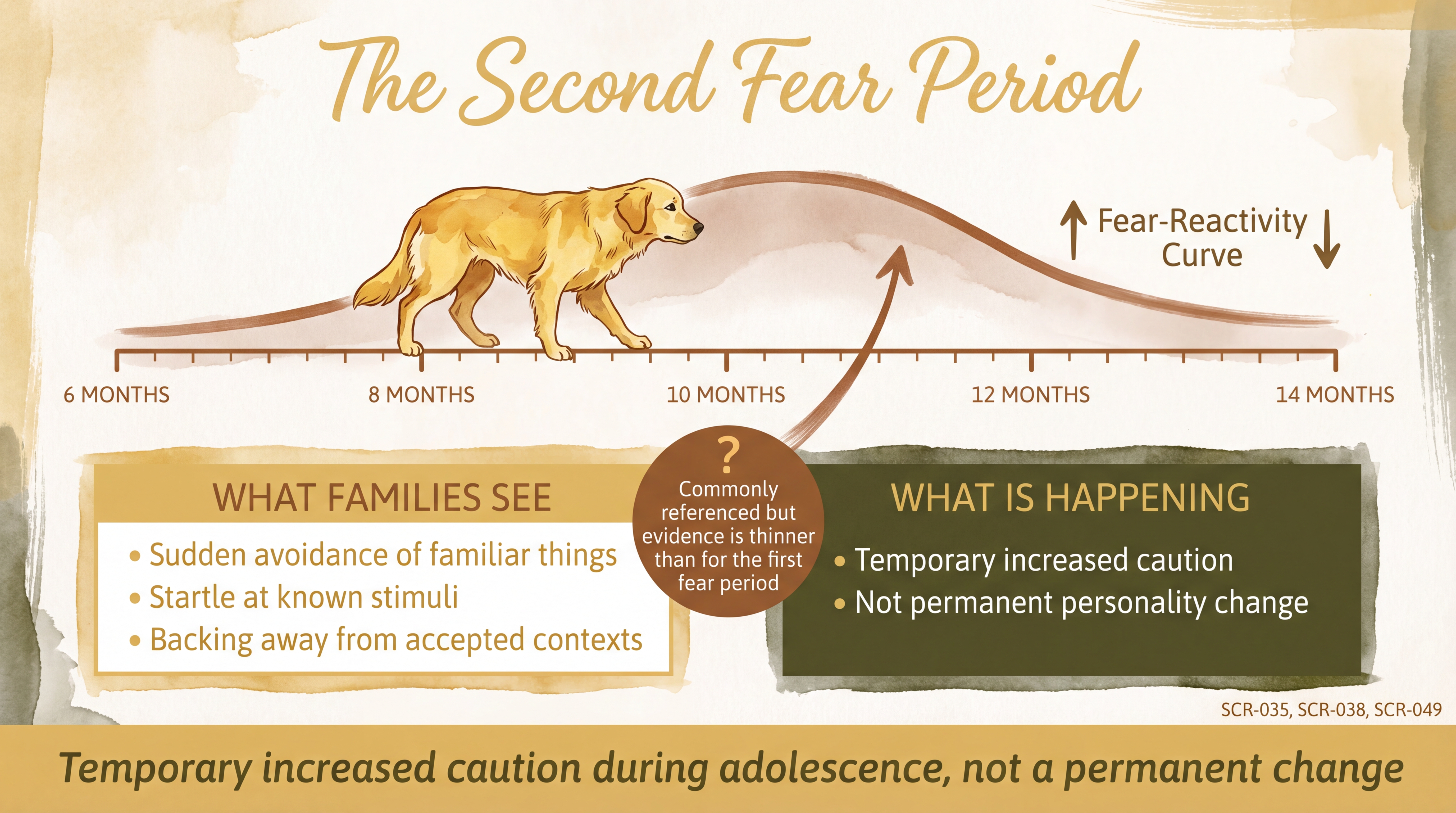
Temporary increased caution during adolescence, not a permanent personality change.
Key Takeaways
- The second fear period is a useful adolescent concept, but the direct canine evidence is thinner than the confidence with which the phrase is often used.
- A temporary return of caution during adolescence is developmentally plausible and commonly observed, especially in unevenly regulated dogs.
- The label is most helpful when it encourages calm interpretation rather than escalation.
- Not every new adolescent fear response should be automatically attributed to a second fear period.
The Evidence
- Canine developmental synthesisdomestic dogs
A subset of adolescent dogs appears to show a transient return of stronger fear responses to previously neutral or manageable stimuli, but the experimental canine base is thinner than for the early socialization window. - Clinical and breeder observation traditiondomestic dogs
The second fear period persists as a useful descriptive concept because it matches recurring adolescent presentations in real dogs.
- Asher, L. et al. (2020)domestic dogs
Documented canine adolescence as a real developmental phase with caregiver-directed conflict and attachment-sensitive instability. - Xu, J. et al. (2023)domestic dogs
Showed that fear and salience circuitry in dogs is biologically measurable and behaviorally consequential.
- Evidence boundarydomestic dogs
Current evidence does not justify claiming that every dog passes through one tightly timed, experimentally standardized second fear period.
SCR References
Sources
- Asher, L., England, G. C. W., Sommerville, R., & Harvey, N. D. (2020). Teenage dogs? Evidence for adolescent-phase conflict behaviour and an association between attachment to humans and pubertal timing in the domestic dog. Biology Letters, 16(5), 20200097. DOI: 10.1098/rsbl.2020.0097.
- Canine developmental synthesis. Supports adolescent fear-period plausibility and observed clinical pattern; does not establish a universal or tightly timed second fear period in all dogs.
- Xu, Y., Christiaen, E., De Witte, S., Chen, Q., Peremans, K., Saunders, J. H., Vanhove, C., & Baeken, C. (2023). Network analysis reveals abnormal functional brain circuitry in anxious dogs. PLOS ONE, 18(3), e0282087. DOI: 10.1371/journal.pone.0282087.