Amygdala and Fear Circuits in Dogs
The amygdala is a central part of mammalian threat detection and salience processing. It helps assign urgency to stimuli, prioritize rapid defensive response, and bias attention toward possible danger. In dogs, direct neuroimaging evidence shows that anxious dogs have measurable amygdala-centered network abnormalities associated with fearfulness, excitability, and impaired trainability. Documented
What It Means
The amygdala is often described loosely as the brain's fear center. That shorthand is useful, but incomplete. Its role is broader than raw fear. The amygdala helps detect relevance, especially threat-related relevance, and coordinates rapid behavioral and physiological response. It works with cortical, hippocampal, hypothalamic, and autonomic systems rather than acting alone. This is why fear circuits are better understood as networks rather than a single isolated switch.
Fast and Slow Threat Processing
The classic LeDoux framework distinguishes a faster, less elaborated route for threat detection from a slower, more interpretive cortical route. Even though the exact mapping details come mainly from non-canine work, the broad mammalian architecture is still useful: some threat processing is built for speed, while fuller appraisal takes longer and relies on broader circuitry. Documented-Cross-Species That distinction helps explain why dogs can react before they appear to have fully "thought" about a situation. Rapid defensive bias is part of the system, not a sign that cognition never mattered.
What Dog Imaging Shows
SCR-049 is the core canine entry here. Xu and colleagues found that clinically anxious dogs showed heightened amygdala-centered salience-network connectivity, with higher global and local efficiency correlated with stranger-directed fear, excitability, and reduced trainability. Documented That result is important for two reasons. First, it provides direct dog neuroscience, not only cross-species inference. Second, it links the network finding to recognizable behavioral outcomes. The altered circuitry is not abstract. It tracks with the kinds of patterns clinicians actually observe.
Amygdala and Development
The developmental story is where caution matters most. The direct dog evidence does not yet let us say that ordinary puppy events produce one known amygdala-development trajectory. What it does allow is a tighter statement: repeated high-cost, threat-heavy, or poorly scaffolded experience can plausibly bias later fear responding, and clinically anxious dogs do show abnormal amygdala-centered network organization. JB's internal observation that fearfulness at around three months correlates with later anxiety is worth taking seriously inside the program, but it remains observed project data rather than a published dog-neuroimaging result. Observed-JB The safest bridges are these: mammalian fear systems can sensitize, anxious dogs show altered amygdala-centered connectivity, early fearfulness deserves attention, and exact developmental causality in normal pet populations is still being mapped.
Amygdala and Prefrontal Competition
Fear circuits are most informative when viewed alongside prefrontal control. The question is not whether dogs have amygdala activity or frontal activity. They have both. The question is how those systems interact under different states. The direct canine evidence currently supports frontal activation as a predictor of better inhibition and anxious dogs as showing altered amygdala-centered network topology. Documented The more popular phrase "limbic hijack" goes beyond what dog imaging has shown. It is better to say that threat and salience systems can dominate behavior under high arousal, while stronger real-time claims about one system fully shutting down another remain more inferential in dogs.
Why It Matters for Your Dog
Fearfulness in puppies deserves serious attention, not dismissal. When a young dog shows persistent fear responses to ordinary stimuli, that is not simply a personality quirk. Documented The amygdala-centered network research shows that anxious dogs have measurable brain differences associated with their fearfulness. Early intervention and careful scaffolding of threatening experiences matter because they can help shape how fear circuits organize as the brain develops. The goal is not to eliminate all fear - appropriate caution is adaptive. The goal is to prevent fear circuits from becoming hypersensitive, which then makes every minor novelty feel like a major threat. This is why prevention (avoiding unnecessary triggering of fear) and calm, structured exposure (when necessary) are both important parts of raising a well-adjusted dog. A dog with a sensitized amygdala is harder to help later than one whose threat system was protected during development.
The calmness layer often argues that threat-heavy developmental environments make later regulation harder. The science supports that general direction most strongly when stated as network bias and sensitization risk, not as a simplistic one-line story about an amygdala taking over everything.
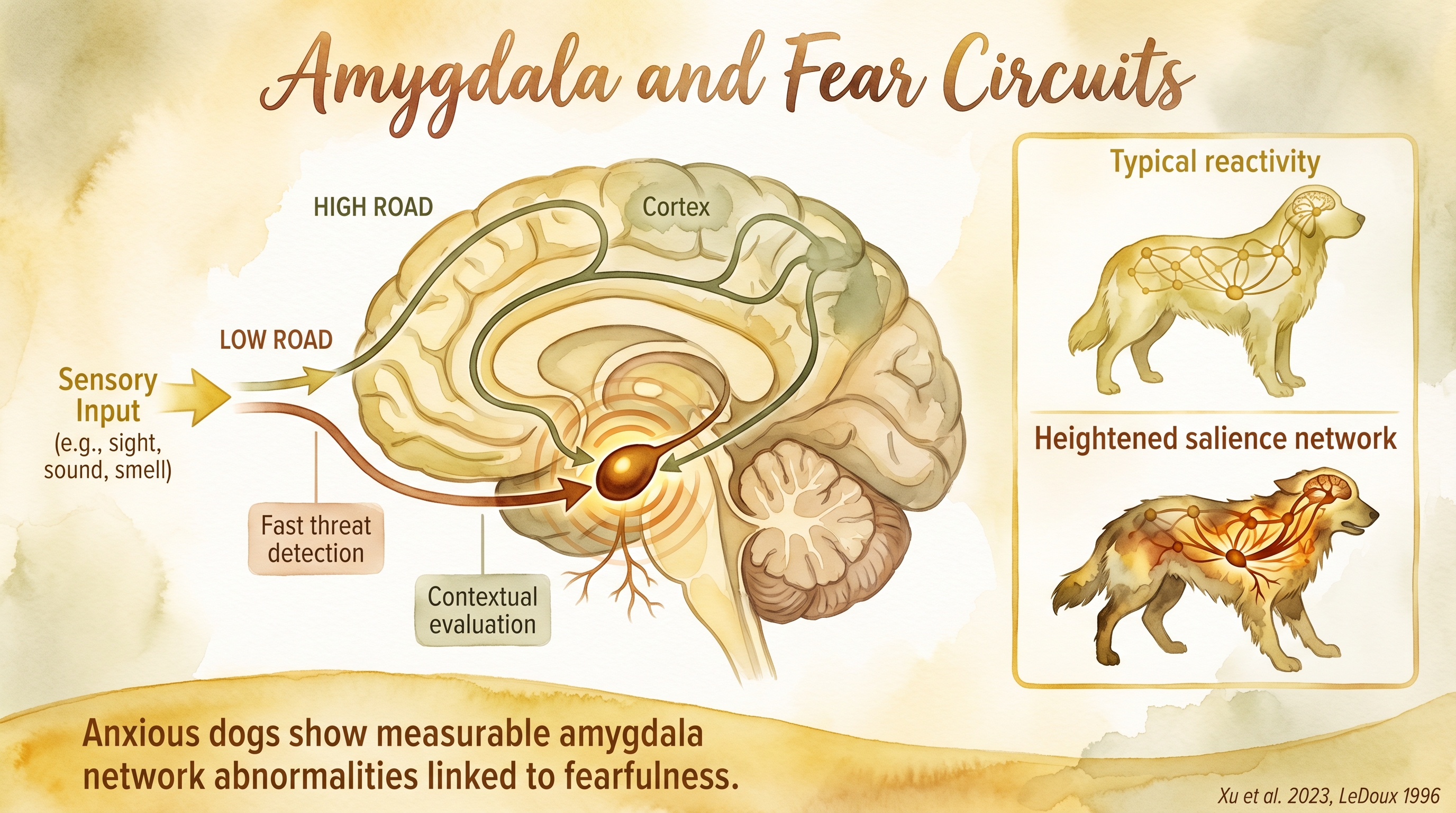
The amygdala processes threats through fast subcortical and slower cortical evaluation pathways.
Key Takeaways
- The amygdala is part of a broader threat and salience network, not just a simple fear switch.
- Anxious dogs show direct amygdala-centered network abnormalities linked to fearfulness and excitability.
- Early fearfulness deserves attention, but the JB three-month predictor remains observed internal data.
- Dog neuroscience supports cautious network language more strongly than popular 'limbic hijack' rhetoric.
The Evidence
- Xu, J. et al. (2023)domestic dogs
Clinically anxious dogs showed heightened amygdala-centered salience-network connectivity associated with fear, excitability, and impaired trainability. - Canine source synthesisdomestic dogs
Dog fMRI and network work supports that fear-related circuitry can be measured and linked to meaningful behavioral phenotype.
- LeDoux, J. E. (1996 and later work)multiple mammals
Developed the classic fast and slow pathway model for threat processing and fear circuitry. - Broader mammalian fear-learning literaturemultiple mammals
Supports amygdala-centered coordination of rapid defensive responding and salience allocation.
- SCR-035 internal dataGolden Retrievers in the JB program
Fearfulness at roughly three months correlated with later anxiety in JB observations, but this remains observed project data rather than published canine consensus.
No published longitudinal study has tracked whether puppies showing fearfulness at three months of age go on to develop clinical anxiety diagnoses in adulthood, limiting the predictive power of early signals to an internal JB observation.
No study has measured whether early environmental interventions specifically targeting amygdala-centered threat bias actually prevent later anxiety-related behavioral problems in dogs.
SCR References
Sources
-
LeDoux, J. E. (1996). The emotional brain. Simon & Schuster.
-
Xu, J., et al. (2023). Functional brain network alterations in clinically anxious dogs. PLOS ONE, 18(2), e0282087.
-
JB internal SCR-035 observation: fearfulness at roughly three months correlated with later anxiety in JB observations; not a published longitudinal canine anxiety study.