The Second Fear Period
Many families meet the second fear period before they know the phrase. The dog that walked past the same porch light ten times without concern suddenly startles at it on the eleventh. A teenager in a hood, a recycling bin near the curb, a man carrying a ladder, a delivery truck with an open side door, a neighbor wearing a hat the dog has never seen before. Observed-JB The reaction can look disproportionate because that is exactly what it feels like. The dog knew this world yesterday. Today it seems less sure.
The phrase second fear period is widely used in dog culture, but the evidence ceiling matters here. The phenomenon is real enough in lived canine observation to deserve a page. The exact modern scientific mapping of a single, precisely bounded adolescent fear window is less settled. That means JB should talk about it honestly: observed, plausible, consistent with developmental science, but not cleanly overclaimed as a perfectly measured universal stage.
What It Means
What Families Usually Mean
When people talk about a second fear period, they usually mean an adolescent stretch, often somewhere between six and fourteen months, in which a previously confident dog becomes more easily startled, more wary of novelty, or more reactive to things that did not matter before.
The change is often selective rather than global. A dog may remain socially confident with known people yet become suspicious of odd objects. Another may tolerate ordinary street life while suddenly reacting to strangers who move differently. Another may become more vocal at dusk, more reluctant in poorly lit spaces, or more likely to freeze before proceeding.
The key family experience is discontinuity. The dog seems to have lost the confidence it had already built.
What the Evidence Supports
The older developmental tradition in dogs, especially the Scott and Fuller lineage, clearly documents fear windows and changing novelty responses during early development. Observed-JB The adolescent extension is less perfectly measured in the modern literature than the early puppy socialization window. Still, both practical canine observation and broader adolescent neurodevelopment science support a cautious conclusion: adolescence can temporarily alter threat sensitivity.
That conclusion does not require a magical fear switch. It only requires a developing animal whose brain and body are recalibrating how much salience to assign to uncertainty.
In mammals more generally, adolescence is associated with changes in emotional processing, risk evaluation, and social sensitivity. In dogs, the best evidence for adolescence as a genuine developmental phase comes from the trainability and attachment-related work. The second fear period sits downstream of that larger reality. If adolescence is real, temporary changes in caution and alarm are unsurprising.
What It Looks Like at Home
The most common signs are ordinary: a sharper startle to familiar neighborhood stimuli, a pause where there used to be easy movement, more visual scanning on walks, barking or backing away from specific novelty, more dependence on the handlers state around uncertain things, and sensitivity that is stronger at certain times of day or under low-rest conditions. Observed-JB
Rest and arousal matter here. A tired adolescent is easier to frighten. An already elevated adolescent is less able to process novelty neutrally. That is one reason the same stimulus can look fine on Tuesday morning and intolerable on Thursday evening.
The JB Response
JB treats the second fear period as a calm-handling problem, not a courage-building project. Observed-JB
The first rule is not to flood the dog. If a dog is suddenly uneasy about a truck, the answer is not to march it directly to the truck until it submits to proximity. That can turn temporary caution into a durable negative memory.
The second rule is not to dramatize the fear. Families can accidentally reward the whole moment with intense soothing, urgent talking, or frantic management that confirms something major is happening.
The middle path is the useful one: notice the fear, increase distance if needed, keep your own state neutral, do not require performance, let the dog observe from safety, and re-approach gradually on later exposures if the dog is ready.
The second fear period does not call for bravery theater. It calls for a calm adult who can stand near uncertainty without amplifying it.
The dog learns two things in that moment: the stimulus was not forced on it, and the handler stayed regulated. Both matter.
What Families Often Get Wrong
The first mistake is overexposure. A family wants the dog to get over it quickly, so it keeps pushing toward the trigger. Sometimes that works in the narrow sense that the dog stops visibly objecting. Sometimes it produces a dog that has simply learned the situation is unavoidable and more frightening than before.
The second mistake is full retreat from ordinary life. If the dog startles at a stranger in a hat, the family decides the dog now needs total protection from hats, people, traffic, dusk, visitors, and outings. That can make the world smaller than the dog needed.
The third mistake is emotional contagion. The handler stiffens, changes voice, tightens the leash, or rushes. The dog then has both the original stimulus and the humans physiological change to read. Observed-JB
JB aims to avoid all three. Stay calm. Stay honest. Manage distance. Keep the world open without turning it into a test.
When It Is More Than a Fear Period
Not every adolescent fear response is a simple temporary developmental blip.
If fear is broadening rapidly, intensifying, generalizing across many contexts, or pairing with aggressive behavior, the family should not keep calling it just a phase. Some dogs have real genetic vulnerability, real prior sensitization, or real behavioral escalation that deserves support beyond ordinary patience.
That is another reason the fear-period frame should stay modest. It is meant to reduce panic, not prevent discernment.
Why It Matters for Your Dog
A second fear period is often remembered not only for what the dog feared, but for how the family behaved while it was happening.
If the handlers became frantic, coercive, or inconsistent, the adolescent often became more uncertain. Observed-JB
If the handlers became quieter, more deliberate, and more patient, the dog often moved through the phase with much less residue.
That does not mean JB promises zero lasting fear. It does not. What it promises is the cleanest response: low drama, safe distance, steady exposure, and a family that refuses to turn transient developmental sensitivity into a permanent adversarial experience.
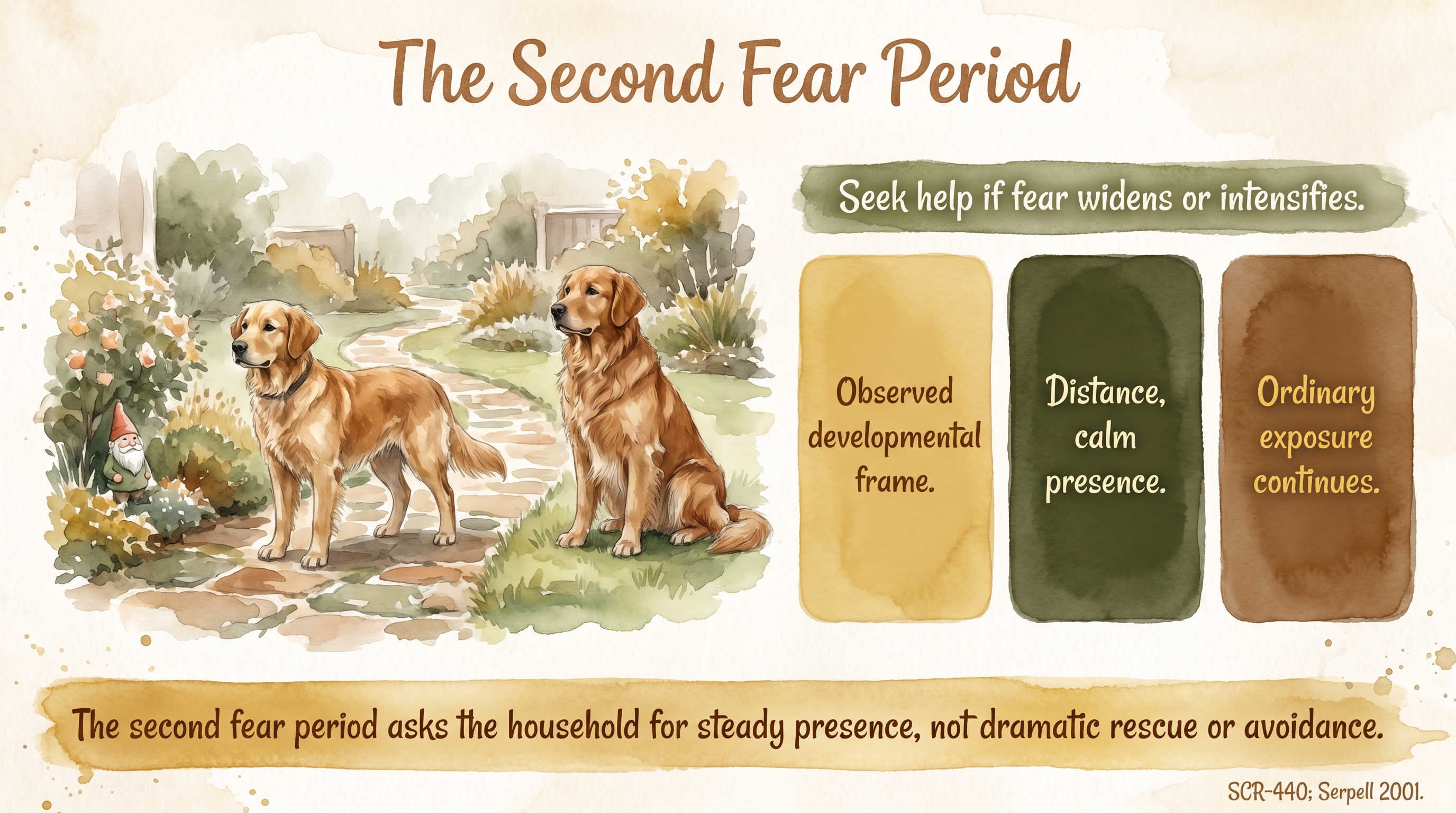
The second fear period asks the household for steady presence, not dramatic rescue or avoidance.
Key Takeaways
- The second fear period is a useful observed frame for adolescent sensitivity, but it should not be overstated as a perfectly measured universal stage.
- Families usually see it as sudden startle, caution, or alarm toward things the dog had previously handled well.
- JB responds with distance, calm presence, and continued ordinary exposure without flooding.
- If fear is widening or intensifying, the family should stop assuming it is only a temporary phase and seek support.
The Evidence
- developmental dog literature and applied observationdomestic dogs
A later adolescent period of increased wariness is widely reported in canine developmental writing and program observation, even though modern direct measurement is less complete than for the early socialization window. - JB breeder observationGolden Retrievers
Dogs in adolescence may show temporary startle, caution, or object-specific alarm toward stimuli they previously ignored.
- general adolescent neurodevelopment literaturemammals
Adolescence can include temporary shifts in threat detection, emotional salience, and caution around novelty while regulation systems are still maturing. - stress and arousal literaturemammals
Higher baseline arousal increases the likelihood that novelty will be processed as threat rather than as neutral information.
- JB synthesisfamily-dog households
The cleanest response to adolescent fear is calm exposure at safe distance with no forced performance and no dramatized retreat from ordinary life.
No published study directly tests the practical implications of the second fear period for domestic dog raising programs. The application to household dog raising remains an interpretive synthesis rather than a directly tested intervention finding.
SCR References
Sources
- Scott, J. P., & Fuller, J. L. (1965). Genetics and the social behavior of the dog. University of Chicago Press.
- Asher, L., England, G. C. W., Sommerville, R., & Harvey, N. D. (2020). Teenage dogs? Evidence for adolescent-phase conflict behaviour and an association between attachment to humans and pubertal timing in the domestic dog. Biology Letters, 16(5), 20200097. https://doi.org/10.1098/rsbl.2020.0097
- Reicher, V., Kis, A., Simor, P., Bodizs, R., Gacsi, M., & Topal, J. (2021). Developmental features of sleep electrophysiology in family dogs. Scientific Reports, 11, 22760. https://doi.org/10.1038/s41598-021-02117-1
- Ziv, G. (2017). The effects of using aversive training methods in dogs: A review. Journal of Veterinary Behavior, 19, 50-60. https://doi.org/10.1016/j.jveb.2017.02.004
- Re-sharpened by Queue1-DecisionTree: Serpell, J. A., & Duffy, D. L. (2016). Aspects of juvenile and adolescent environment predict aggression and fear in 12-month-old guide dogs. Frontiers in Veterinary Science, 3, 49. https://doi.org/10.3389/fvets.2016.00049. This supports adolescent-environment and fear/aggression relevance, but no direct controlled dog study verifying a discrete second-fear-period construct was located. SCR-440 remains an [Observed] applied-practice claim.