Sensitization
Sensitization is the opposite of habituation. Instead of responding less to repetition, the organism responds more. A stimulus that is intense, threatening, badly timed, or repeated against a high-arousal background can become increasingly activating rather than increasingly ordinary. In practical dog terms, sensitization is one of the ways everyday life can start feeling bigger and more expensive to the nervous system over time. Documented
What It Means
Sensitization is another form of non-associative learning. The learner does not need a full cue-reward pairing for the response to grow. Mixed Evidence Sometimes repeated exposure itself, under the wrong conditions, is enough to amplify reactivity.
This is why "just expose the puppy to more" is not automatically safe advice. Exposure only helps when the nervous system can process the event as manageable. Mixed Evidence If the event is too intense, too sudden, or too emotionally costly, repetition may build more alarm instead of less.
Sensitization is especially relevant to fear systems. Repeated activation of threat-related responding can make later reactions stronger, faster, and more difficult to regulate. Clinically anxious dogs show measurable amygdala-centered salience-network abnormalities associated with fearfulness, excitability, and impaired trainability. Documented
That does not mean every excited puppy is on a path toward an anxiety disorder, and it does not authorize sloppy "limbic hijack" rhetoric. It does mean the nervous system can be biased toward greater reactivity under chronic or repeated high-arousal conditions.
The developmental-risk part of this page needs extra care. JB's internal data suggest that fearfulness around 3 months correlates with later anxiety. Observed-JB That is important inside the project, but it is not the same kind of evidence as a published longitudinal canine cohort. The broader scientific point is safer and still useful: early fearful responding deserves respect because threat-heavy learning can snowball.
Why It Matters for Your Dog
Sensitization matters because it is one of the clearest reasons "socialization" can go wrong when it is treated as maximum exposure instead of calm, scaffolded exposure.
Repeated high-arousal experience does not always produce confidence. Sometimes it produces a more reactive nervous system that becomes easier to tip and harder to settle.
For families, that means more stimulation is not always better, repeated overwhelm is not resilience training, and a puppy who is repeatedly pushed past tolerance may learn bigger alarm, not better coping. Heuristic This page therefore sits right next to habituation. The same basic event - repeated exposure - can produce very different outcomes depending on intensity, timing, predictability, and baseline arousal.
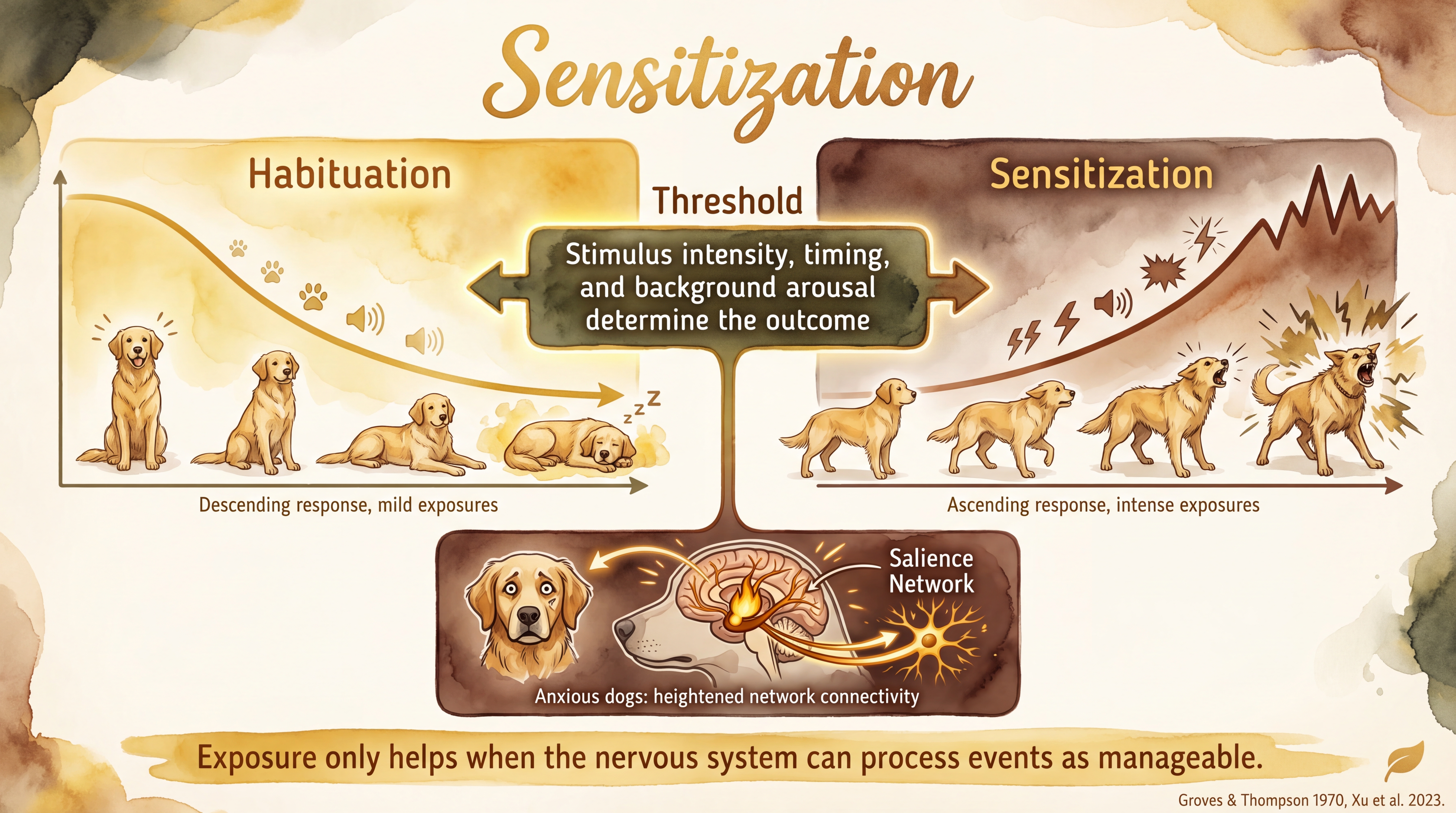
Sensitization is the opposite of habituation - repeated exposure to threatening stimuli amplifies rather than reduces responding.
Key Takeaways
- Sensitization means responding more strongly, not less strongly, after repeated or intense stimulation.
- Exposure does not automatically build confidence. Under the wrong conditions it can build bigger alarm.
- Documented canine neuroscience supports greater amygdala-network abnormality in anxious dogs.
- The JB early-fear predictor remains observed project data and should not be presented as published canine consensus.
The Evidence
This entry uses heuristic claim-level tags beyond the dedicated EvidenceBlocks below. These tags mark JB interpretive application rather than direct study findings.
This entry uses mixed-evidence claim-level tags beyond the dedicated EvidenceBlocks below. These tags mark claims that combine documented findings with observed practice, heuristic application, or unresolved gaps.
- Groves, P. M., & Thompson, R. F. (1970)multiple species
Proposed the dual-process framework in which sensitization and habituation interact to determine observed responding. - Pinsker, H. et al. (1970)Aplysia
Classic demonstration that repeated stimulation can increase defensive responding, helping establish sensitization as a basic learning process.
- Xu, J. et al. (2023)domestic dogs
Clinically anxious dogs showed heightened amygdala-centered salience-network connectivity associated with fear, excitability, and impaired trainability. - Canine developmental and arousal source synthesisdomestic dogs
The socialization and stress literature consistently supports the idea that overwhelming or threat-heavy early experiences can bias later fear responding, even where the exact mechanistic language differs by study.
- SCR-035 internal dataGolden Retrievers in the JB program
Fearfulness around 3 months correlated with later anxiety in JB internal observations. This is useful internally but remains an observed project finding rather than a published canine longitudinal result.
No published longitudinal study has directly compared sensitization outcomes in puppies exposed to calm, structured early experience versus repeated high-intensity, overwhelming exposure with long-term behavioral and fear-response metrics.
SCR References
Sources
- Groves, P. M., & Thompson, R. F. (1970). Habituation: A dual-process theory. Psychological Review, 77(5), 419-450.
- Pinsker, H., Kupfermann, I., Castellucci, V., & Kandel, E. (1970). Habituation and dishabituation of the gill-withdrawal reflex in Aplysia. Science, 167(3926), 1740-1742.
- Xu, Y., Yam, P. S., & Mills, D. S. (2023). Network analysis reveals abnormal functional brain circuitry in anxious dogs. PLOS ONE, 18(2), e0282087.
- Canine developmental and arousal source synthesis: no single source resolves sensitization plus JB raising application.
- JB internal SCR-035 observation: internal fear-signal data, not public primary source.