Stress Contagion in Dogs
Stress contagion is the transfer or matching of stress-related state from one individual to another. In dogs, the strongest evidence shows that human stress is not only visible behaviorally. It is detectable through odor, reflected in autonomic coupling, and associated with measurable effects on canine learning and HPA-axis flexibility. Documented
What It Means
What Counts as Contagion
Stress contagion is related to, but not identical with, several nearby concepts: social referencing (the dog uses another individual's emotional response as information), physiological coupling (dog and human states co-modulate over time), and olfactory stress detection (the dog detects chemical stress cues directly). Documented This page focuses on the transfer side of the picture: how human stress becomes part of the dog's immediate regulatory environment.
Dogs Detect Human Stress Directly
SCR-058 documents one of the clearest findings in the caregiver-state literature: dogs can discriminate human baseline odor from human stress odor. In other words, human stress has a detectable chemical signature from the dog's point of view. Documented
That matters because it means stress transmission does not depend only on the human sounding tense or moving differently. Documented A dog can receive stress information through olfaction even before any obvious handling change is visible.
SCR-107 deepens this from detection to consequence. Parr-Cortes and colleagues showed that odor from an unfamiliar stressed person impaired canine cognitive flexibility and learning performance. This is a crucial shift: the question is no longer only "can dogs smell stress?" but rather "what does that stress cue do to the dog's functioning?"
Why It Matters for Your Dog
Relationship History Modulates the Effect
Not all transmission is anonymous chemistry. SCR-059 shows that the caregiver's psychological profile, especially Neuroticism and insecure relational variables, predicts lower cortisol flexibility in dogs. That means the dog's stress system is not only responding to isolated events. It is also shaped by the emotional profile of the person it lives with most closely.
Source-layer studies on emotional contagion and controlled caregiver-stress induction push in the same direction. Documented HRV changes and physiological matching are stronger in real dyads than with unfamiliar humans, and some effects strengthen with relationship duration. That suggests contagion is not only about exposure. It is also about relationship.
Why This Is More Than "Dogs Read Our Feelings"
Popular language often says dogs "pick up on our emotions." That is directionally true, but the scientific literature is more specific. The evidence supports at least three routes: olfactory detection of stress chemistry, autonomic and endocrine co-modulation in established dyads, and learned or attachment-mediated sensitivity to caregiver state.
These routes can overlap. A dog may smell the stress cue, observe the altered body, and then respond within a relationship that has already taught the dog how much that person's state matters. Documented
What Contagion Does and Does Not Mean
The strongest documented claim is that human stress can measurably alter canine physiology and cognition. The weaker claim is that any moment of caregiver stress mechanically and uniformly "becomes" the dog's stress to the same magnitude. The literature does not support that simplification.
Magnitude varies by relationship duration, breed and selection history, context, measurement method, and the dog's own baseline regulation. That is why disciplined wording matters: "caregiver state matters" is solid, and "every anxious thought transfers directly into the dog at a fixed dose" is not.
The calmness pillar interprets this research as a reason to treat the caregiver's nervous system as part of the dog's environment. This page keeps the claim tighter: dogs detect human stress cues, and those cues can change canine physiology and learning in documented ways.
No published study has directly tested whether puppies exposed to consistently calm caregivers across their early development show measurably better stress resilience or lower anxiety-related behaviors at follow-up compared to puppies with variable or stressed caregivers.
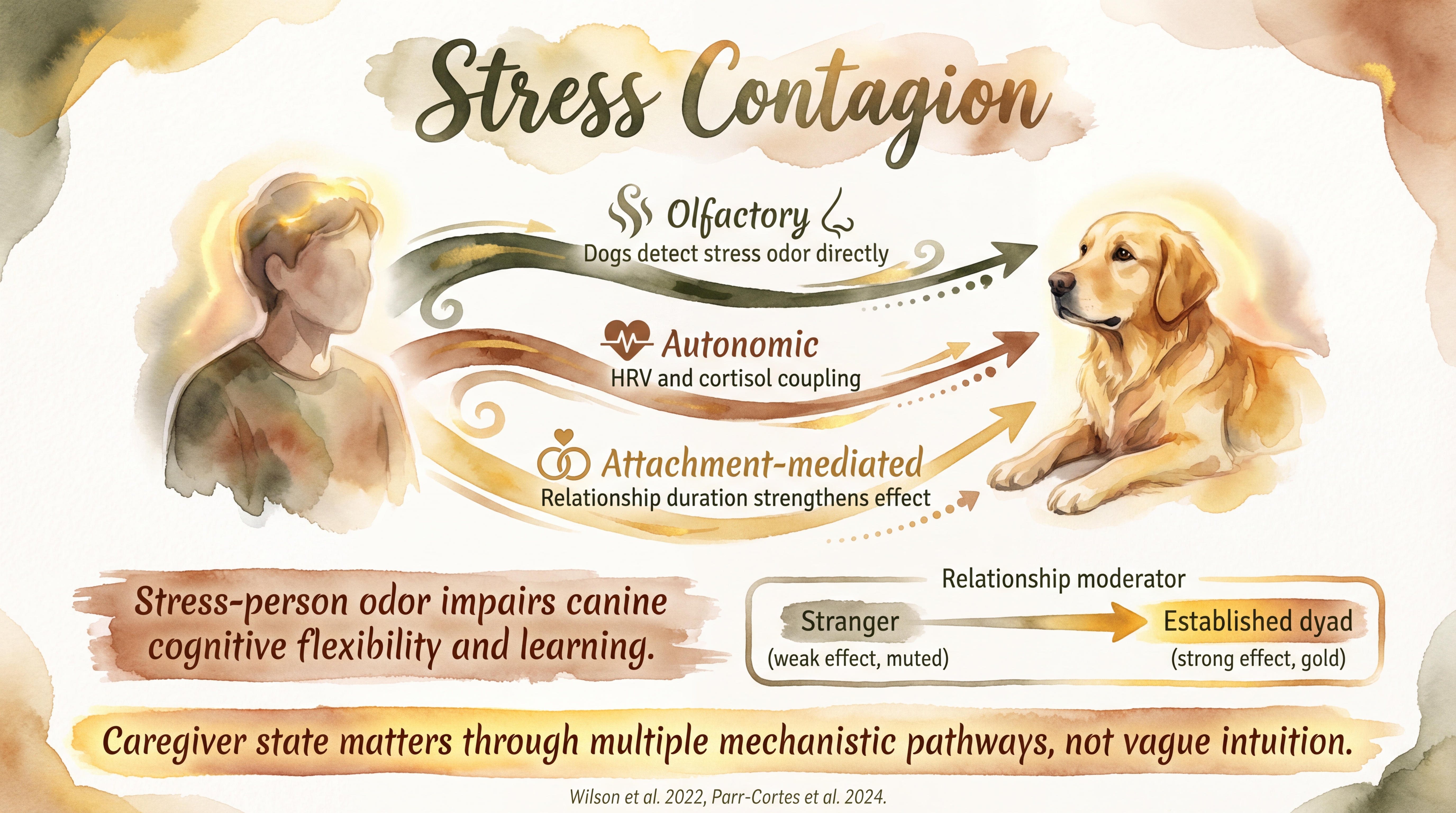
Caregiver stress transmits physiologically to dogs through cortisol synchronization - your state becomes their state.
Key Takeaways
- Dogs can detect human stress directly through olfaction.
- Human stress cues can do more than signal information; they can alter canine learning and flexibility.
- The caregiver's psychological profile is associated with how flexible the dog's stress system remains over time.
- Stress contagion is real, but its magnitude is moderated by relationship and context rather than operating as a uniform constant.
The Evidence
- Wilson, C. et al. (2022)domestic dogs
Dogs discriminated human baseline odor from stress odor in controlled testing. - Parr-Cortes, Z. et al. (2024)domestic dogs
Exposure to stressed human odor impaired canine learning and cognitive flexibility. - Schoberl, I. et al. (2017)domestic dogs and humans
Caregiver psychological profile, especially Neuroticism and insecure attachment variables, predicted lower HPA-axis flexibility in dogs. - Yong, M. H., & Ruffman, T. (2014)domestic dogs
Dogs showed physiological change during exposure to human infant crying, supporting cross-species emotional contagion. - Katayama, M. et al. (2019)domestic dogs
Controlled caregiver-stress paradigms linked caregiver stress context to measurable autonomic changes in dogs, with stronger effects in longer relationships.
- Source synthesis boundarydomestic dogs
Caregiver stress matters, but coupling magnitude varies by relationship, context, and dog. The literature does not support a universal one-size-fits-all contagion claim.
SCR References
Sources
- Katayama, M., et al. (2019). Emotional contagion from humans to dogs is facilitated by duration of ownership. Frontiers in Psychology.
- Parr-Cortes, Z., et al. (2024). The odour of an unfamiliar stressed or relaxed person affects dogs' cognition and learning. Scientific Reports.
- Schoberl, I., et al. (2017). Psychobiological factors affecting cortisol variability in human-dog dyads. PLOS ONE, 12(2), e0170707.
- Wilson, C., et al. (2022). Dogs can discriminate between human baseline and stress odours. PLOS ONE, 17(9), e0274143.
- Yong, M. H., & Ruffman, T. (2014). Emotional contagion: Dogs and humans show a similar physiological response to human infant crying. Behavioural Processes, 108, 155-165. https://doi.org/10.1016/j.beproc.2014.10.006