Social Referencing in Dogs
Social referencing is the use of another individual's emotional reaction as information. When the environment is uncertain, the observer checks a social partner and lets that partner's response shape approach, avoidance, or caution. Ambiguous In dogs, this is a documented phenomenon. Dogs do not only watch what people do. They also watch how people feel about what is happening.
That makes social referencing one of the most important bridges between social learning and emotional regulation.
What It Means
The concept originally became famous in human developmental psychology through the visual-cliff literature. An infant confronted with an ambiguous situation looks to the caregiver and uses the caregiver's expression as a guide for what the situation means. Dogs show a comparable pattern. In the classic studies, a dog encountered an ambiguous object and then checked the caregiver. Positive caregiver responses increased approach, while critical or negative responses promoted hesitation or avoidance. Documented That matters because it shows that the dog is not simply reacting to the object on its own. The caregiver response becomes part of the environment the dog is interpreting.
Why It Matters for Your Dog
What the Dog Literature Shows
Merola, Prato-Previde, and Marshall-Pescini provided the classic demonstration. Dogs facing an unfamiliar and ambiguous object looked to their caregivers and then changed their own behavior in line with the caregiver's affective response. Ambiguous That is social referencing in the strict sense.
The puppy work makes the developmental point even stronger. Fugazza and colleagues found social-referencing effects in puppies as young as eight weeks, and the effect persisted after a delay when the puppy was later tested alone. Documented That means the emotional cue is not only affecting behavior in the instant. It is altering how the situation is encoded.
This already makes social referencing a real part of canine social learning. The dog is not simply copying motion. It is using another individual's appraisal as information about the world.
Beyond Face and Voice: The Physiological Layer
The caregiver-state literature extends the mechanism beyond facial expression and tone of voice. Dogs can discriminate human baseline and stress odors, and exposure to stress odor from unfamiliar humans changes their cognition and learning performance. Documented This is important because it shows that the dog does not need a dramatic visible performance from the person for human state to matter. There is a documented olfactory path by which stress becomes social information.
Caregiver psychological profile matters too. Studies of dog-human dyads found that caregiver personality, especially Neuroticism and insecure attachment variables, predicts lower HPA-axis flexibility in dogs, while the dog's own personality contributes much less to that physiological pattern. Documented Those findings do not turn social referencing into a single hormonal theory. They do show that the social partner's state is not only cognitively interpreted. It is also biologically consequential.
Why the Topic Matters
Social referencing matters because it changes how uncertainty is understood in dogs. A dog confronting novelty is not making that judgment alone in a social vacuum. If the dog is attached to and oriented toward a person, the person's reaction becomes part of the dog's appraisal process. That helps explain why two dogs can meet similar novelty but respond differently under different human partners.
The calm-floor argument is not just philosophical style. Social-referencing science shows that the caregiver's emotional state can become information the dog uses to decide what the world means.
This does not mean a single anxious moment from a caregiver permanently programs a dog. It does mean that caregiver state is not behaviorally irrelevant.
No published longitudinal study has tracked whether puppies exposed to consistently calm caregivers from birth show measurably different social-referencing patterns or baseline anxiety-related behaviors compared to puppies with anxious or variable caregivers.
Important Boundaries
Three cautions matter here. First, the social-referencing findings are documented, but the stronger claim that a calm or anxious caregiver permanently creates a specific long-term appraisal style is more interpretive unless directly tracked over time. Second, the olfactory stress studies used unfamiliar human stress odor. That is a strong demonstration of a sensory mechanism, but it does not by itself map the full chronic familiar-caregiver pathway. Third, the caregiver personality findings are associational. They document a relationship between caregiver profile and dog cortisol flexibility. They do not prove that changing caregiver personality would automatically resolve every corresponding canine outcome.
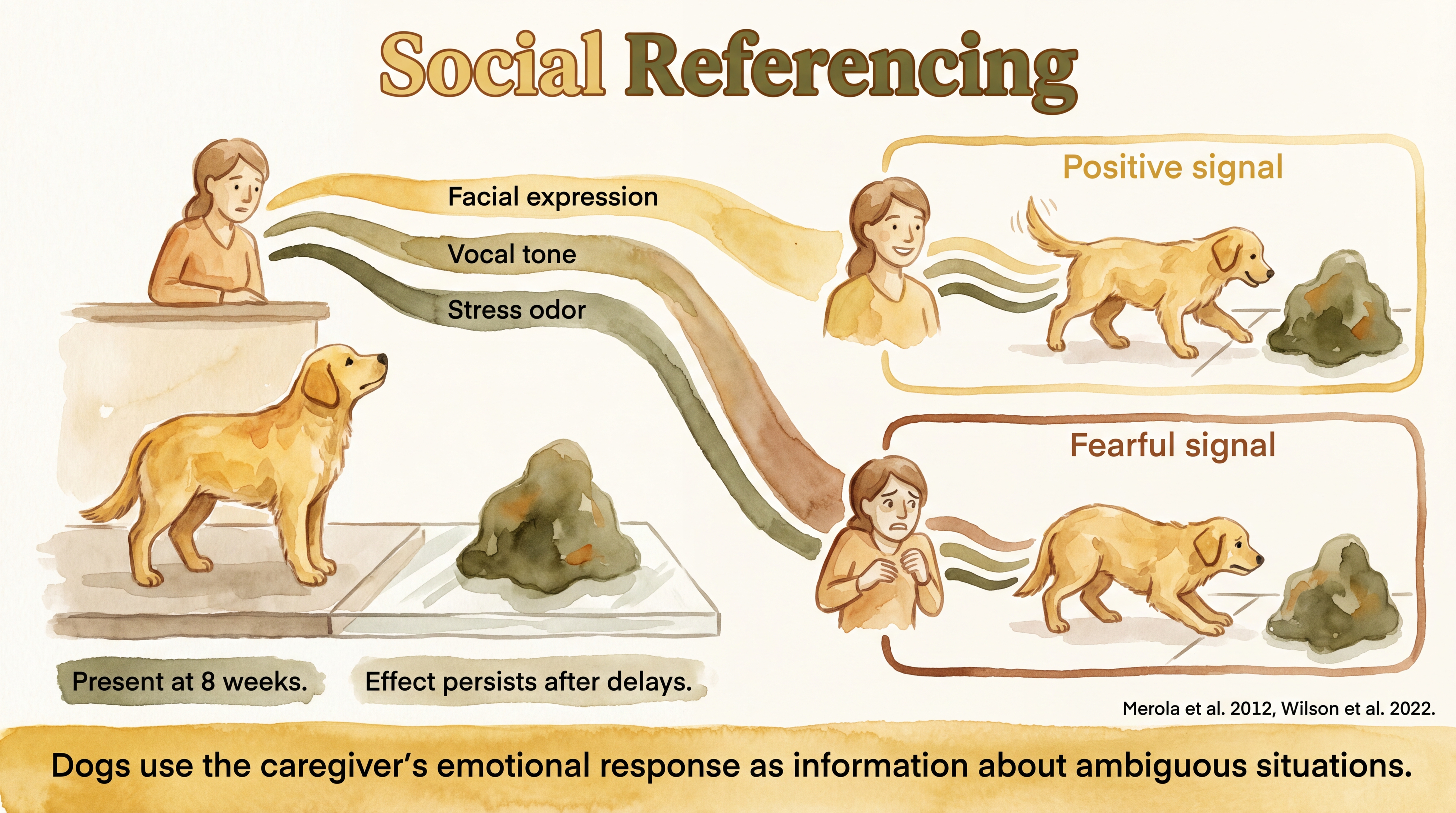
Dogs look to caregivers when uncertain - using human emotional expressions to calibrate their own response to novelty.
Key Takeaways
- Dogs use another individual's emotional response as information when interpreting ambiguous situations.
- This effect appears early in puppies, which means social referencing is part of canine development, not just adult coping.
- Human state reaches dogs through more than visible expression, including a documented olfactory stress channel.
- Owner personality and attachment variables are measurably associated with dog stress physiology, but the strongest long-term causal claims should still be phrased carefully.
The Evidence
This entry uses ambiguous claim-level tags beyond the dedicated EvidenceBlocks below. These tags mark claims where the literature remains unsettled or multiple interpretations coexist.
- Merola, I., Prato-Previde, E., & Marshall-Pescini, S. (2012)domestic dogs
Dogs used owner emotional signals to guide responses to an ambiguous object, establishing social referencing in dog-owner dyads. - Fugazza, C. et al. (2018)domestic dogs
Found social-referencing effects in puppies as young as eight weeks, with lasting influence after delay.
- Wilson, C. et al. (2022)domestic dogs
Dogs discriminated stressed versus baseline human odor samples above chance. - Parr-Cortes, Z. et al. (2024)domestic dogs
Exposure to unfamiliar human stress odor altered dog cognition and learning performance. - Schoberl, I. et al. (2016, 2017)domestic dogs and humans
Owner attachment variables and personality, especially Neuroticism, predicted lower flexibility in dog cortisol profiles.
- SCR synthesisdomestic dogs
The documented findings support owner state as meaningful social information, but stronger claims about permanent appraisal architecture or complete long-term causal pathways remain more interpretive.
No longitudinal study has tracked whether puppies exposed to consistent calm or anxious owner states during early development show different stress-response profiles or risk for anxiety-related behaviors at follow-up in adulthood.
SCR References
Sources
- Fugazza, C., et al. (2018). Presence and lasting effect of social referencing in dog puppies. Animal Behaviour, 141, 57-65.
- Merola, I., Prato-Previde, E., & Marshall-Pescini, S. (2012). Dogs' social referencing towards owners and strangers. PLOS ONE, 7(10), e47653.
- Parr-Cortes, Z., et al. (2024). The odour of an unfamiliar stressed or relaxed person affects dogs' cognition and learning. Scientific Reports, 14, 1242.
- Schoberl, I., et al. (2016). Social factors influencing cortisol modulation in dogs during a strange situation procedure. Journal of Veterinary Behavior, 11, 77-85.
- Schoberl, I., et al. (2017). Psychobiological factors affecting cortisol variability in human-dog dyads. PLOS ONE, 12(2), e0170707.
- Wilson, C., Campbell, K., Petzel, Z., & Reeve, C. (2022). Dogs can discriminate between human baseline and psychological stress condition odours. PLOS ONE, 17(9), e0274143. https://doi.org/10.1371/journal.pone.0274143