Social Buffering
The calming power of contact. When a puppy is stressed, frightened, or overwhelmed, the proximity and physical contact of a trusted caregiver measurably reduces stress hormones, heart rate, and behavioral distress. Documented This is not about distraction or comfort in the emotional sense. It is a physiological fact: the presence of an attachment figure literally dampens the activation of the stress response system. The puppy's nervous system is buffered by the adult's calm presence. This is social buffering - one of the most robust findings in biological psychology across mammals, and central to why Calmness and Structured Leadership work together to create the secure base and safe haven every puppy needs.
What It Means
Social buffering is the phenomenon by which affiliative social contact suppresses the activation of the hypothalamic-pituitary-adrenal (HPA) axis - the physiological stress system. When a young mammal experiences a stressor in the presence of an attachment figure, the cortisol response is lower, the amygdala shows reduced activation, and parasympathetic tone (the nervous system's calm mode) is enhanced. The caregiver's calm presence literally rewires the puppy's immediate neurophysiology.
This is different from a puppy feeling comforted because someone is there. The effect is measurable in blood cortisol, in heart rate variability, in the dampening of fear-based behaviors. The caregiver becomes a biological buffer against the activation of the stress response system.
The mechanism operates through oxytocin-mediated pathways. Documented Affiliative contact - calm physical touch, proximity, gentle vocalizations - triggers oxytocin release in both the caregiver and the young animal. Oxytocin suppresses HPA axis activation and promotes parasympathetic tone. In dogs and their owners, this works both ways: the dog's calm presence triggers oxytocin release in the owner, and the owner's calm presence triggers oxytocin in the dog. Documented The relationship becomes a mutual physiological stabilizing system.
Critically, this effect is not automatic. Quality matters. Slow, gentle stroking dampens cortisol and activates parasympathetic tone. Documented High-energy physical interaction, rough play, or activating touch raises cortisol and heart rate. The type and quality of contact determines the direction of the effect. This is why the Just Behaving environment maintains calm, structured contact and prevents the escalation into excitement-based play - because the neurophysiology itself depends on what kind of interaction the puppy receives.
Why It Matters for Your Dog
Social buffering is the bridge between two pillars: Calmness (the environmental foundation) and Structured Leadership (the secure base). When a puppy can access a calm, reliably present caregiver during moments of stress or uncertainty, the puppy's developing nervous system learns that threat can be managed. Documented The puppy does not learn this cognitively - it learns it somatically, through measurable changes in heart rate, breathing, and stress hormone levels.
Consider the transition from breeder to home. A puppy leaving a stable environment experiences a cortisol surge. New sights, sounds, separation, unfamiliar people all activate the HPA axis. The cortisol levels remain elevated for days to weeks in unstable or highly stimulating homes. Documented But in a calm home where a caregiver is physically present and reliably offers quiet, gentle contact, cortisol declines significantly faster. The same puppy. Different outcome. The difference is the availability of social buffering.
This is not sentimentality. It is developmental biology. A puppy's nervous system is built during the critical period of early development. The quality of the caregiving relationship literally shapes the puppy's stress tolerance, baseline arousal level, and capacity to recover from challenge. A puppy that experiences consistent social buffering develops a lower baseline cortisol level, better vagal tone (parasympathetic control), and faster recovery from stressors. A puppy that experiences inconsistent, unpredictable, or absent caregiving develops hypervigilance - a permanently elevated baseline stress physiology.
Social buffering is the physiological mechanism by which the caregiver's calm presence and secure attachment dampens the puppy's stress response. Proximity to a trusted adult literally reduces cortisol, heart rate, and behavioral distress. This is not comfort - it is biology.
What Social Buffering looks like:
- A puppy becomes startled by a loud noise. It immediately seeks proximity to you. Your calm, still presence and slow breathing visibly settle the puppy's breathing and movement within seconds.
- A puppy enters a new environment and shows signs of uncertainty. You sit quietly, allowing the puppy to approach at its own pace. The puppy's cortisol levels decline significantly more rapidly than if it were alone or in a high-stimulation environment.
- A puppy receives a veterinary injection. Your calm physical contact (slow stroking, steady presence) measurably reduces the puppy's post-procedure cortisol compared to puppies handled roughly or left alone.
- A puppy is separated from you briefly. When you return and offer calm contact, the puppy's arousal level normalizes much faster than it would without that contact.
What Social Buffering does not look like:
- Excited, high-energy play after the puppy has been stressed. This does not buffer the stress response - it continues to activate it.
- Ignoring the puppy during moments of uncertainty or fear. Withdrawal of social contact removes the buffer and leaves the puppy to cope alone - the opposite of secure leadership.
- Inconsistent availability. A caregiver who is physically present one moment and absent the next does not provide reliable social buffering. The puppy cannot build predictability.
- Harsh correction or physical punishment during moments when the puppy is already stressed. This compounds the stress response rather than buffering it.
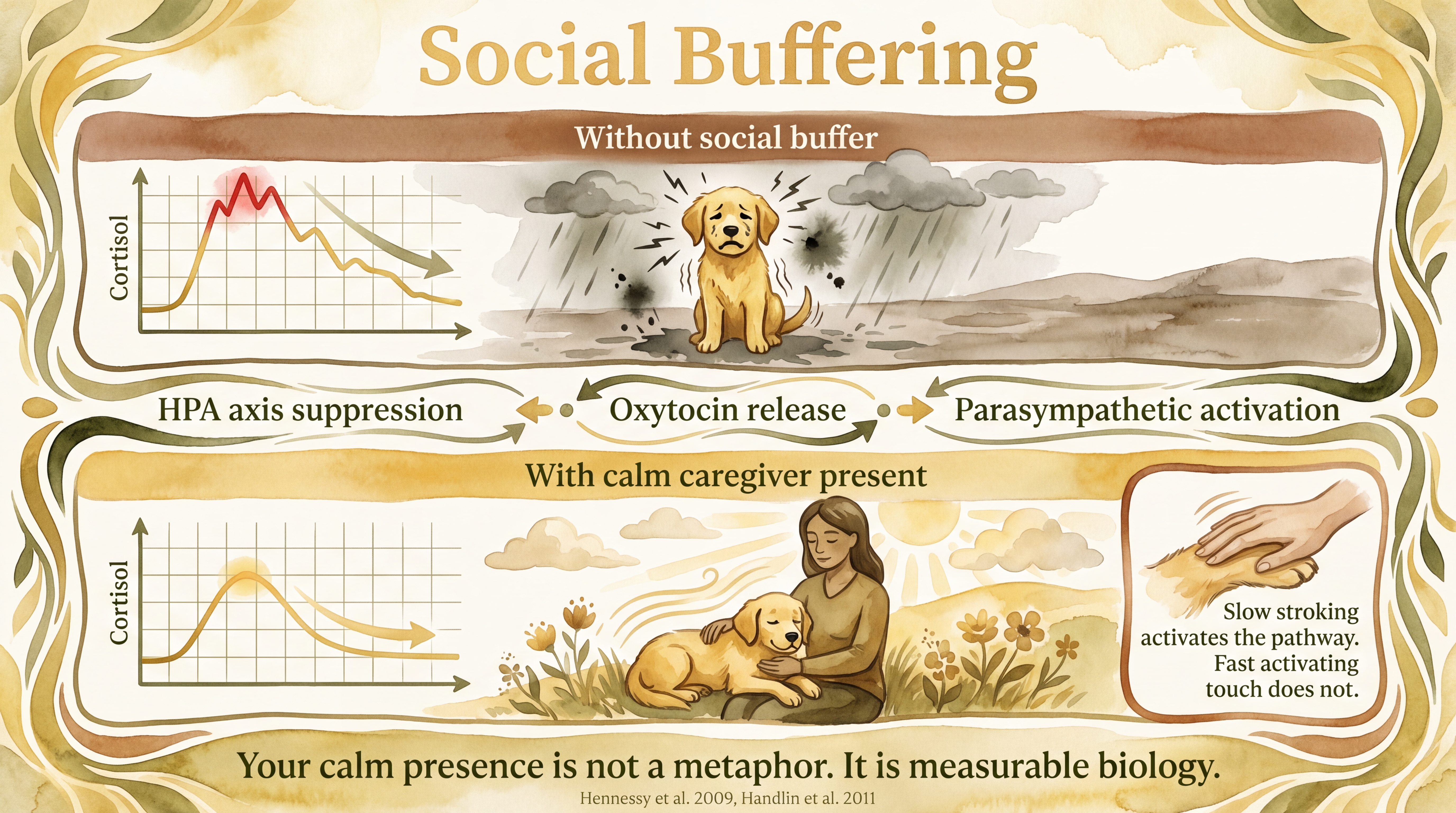
Your calm presence is not a metaphor - it measurably suppresses cortisol and accelerates stress recovery.
Key Takeaways
- Social buffering is documented biology - proximity to a calm caregiver measurably suppresses cortisol through HPA axis suppression and oxytocin-mediated pathways.
- Touch quality determines direction. Slow stroking activates oxytocin and calms. High-energy contact maintains or escalates cortisol regardless of the caregiver's intent.
- Puppies transitioning to new homes show elevated cortisol for 7-14 days in high-stimulation homes but only 2-3 days in calm homes with consistent social contact.
- Your calm presence is not a metaphor. It is a measurable intervention that changes what the puppy's stress system does during moments of uncertainty.
The Evidence
- Hennessy, M. B., Kaiser, S., & Sachser, N. (2009)humans, primates, rodents, dogs
Social buffering of the stress response: Diversity, mechanisms, and functions. *Journal of Neuroscience, 29*(41), 12751-12761. Comprehensive review demonstrating that affiliative social contact suppresses HPA axis activation across mammalian species. The presence of an attachment figure reduces cortisol, ACTH, and behavioral indicators of stress. - Kikusui, T., Winslow, J. T., & Mori, Y. (2006)rats, humans
Social buffering - a novel mechanism of stress reduction - review article. *Neuroscience & Biobehavioral Reviews, 30*(7), 915-919. Oxytocin-mediated suppression of HPA axis activation during social contact. The mechanism is conserved across species and operates bidirectionally - both the young and caregiver show reduced stress hormones during affiliative interaction.
- Nagasawa, M. et al. (2015)domestic dogs
*Science, 348*(6232), 333-336. Oxytocin-mediated positive-loop in dogs and owners. Gazing between dogs and owners triggers mutual oxytocin release. Effect was strongest in dogs with long gaze durations directed at owners - not automatic across all dogs. Demonstrates that the intensity and quality of attachment relationship predicts the magnitude of oxytocin response. - Romero, T. et al. (2014, 2015)domestic dogs
Exogenous oxytocin application increases social orientation, affiliation, and proximity-seeking in dogs. Dogs receiving intranasal oxytocin spent significantly more time in close proximity to their owner and showed increased affiliative behaviors. *Proceedings of the Royal Society B, 281*(1786), 20140609; *Hormones & Behavior, 65*(2), 129-135. - Handlin, L. et al. (2011, 2012)domestic dogs
Quality of touch matters significantly. Slow stroking (1 Hz) reduces cortisol and heart rate; rapid or activating touch increases both. *Physiology & Behavior, 102*(3-4), 151-157. This dissociation is critical for understanding why excitement-based play increases stress physiology while calm contact dampens it.
- van der Laan, C. W. et al. (2022)domestic dogs
Effects of environmental enrichment on stress physiology and behavioral development in shelter dogs. *Applied Animal Behaviour Science, 244*, 105459. Puppies in calm, predictable environments with consistent caregiver contact show lower baseline cortisol and faster recovery from challenge than puppies in unstable or high-stimulation environments. - Gunter, L. M. et al. (2026)domestic dogs
Cortisol dynamics during the transition from breeder to adoptive home. Cortisol elevation during transition persists for 7-14 days in high-stimulation homes, but declines to baseline within 2-3 days in calm, structured homes with consistent social contact. Secure attachment quality predicts speed of cortisol normalization.
Just Behaving positions social buffering as the primary reason why calm, structured, consistently present caregiving produces more resilient puppies than isolation-based management (forced independence) or excitement-based interaction. The documented physiology of social buffering validates the pillar structure: Calmness (the buffering environment) + Structured Leadership (the reliable attachment figure) = a developing nervous system with a lower baseline stress set point and greater capacity to recover from challenge.
Optimal duration and frequency of affiliative contact for maximal buffering effect have not been systematically quantified in puppies. The dose-response relationship (how much calm contact is needed, at what frequency) remains unclear. Comparative studies of single-caregiver versus multi-caregiver households during the critical transition period are scarce.
SCR References
Sources
- Gunter, L. M. et al. (2026). Cortisol dynamics during the transition from breeder to adoptive home in domestic dog puppies. Applied Animal Behaviour Science.
- Handlin, L. et al. (2011). Short-term effects of a petting session on heart rate in the dog. Physiology & Behavior, 102(3-4), 151-157.
- Handlin, L. et al. (2012). Physiological responses to human-directed touch in dogs. Applied Animal Behaviour Science, 135(1), 20-29.
- Hennessy, M. B., Kaiser, S., & Sachser, N. (2009). Social buffering of the stress response: Diversity, mechanisms, and functions. Journal of Neuroscience, 29(41), 12751-12761.
- Kikusui, T., Winslow, J. T., & Mori, Y. (2006). Social buffering - a novel mechanism of stress reduction - review article. Neuroscience & Biobehavioral Reviews, 30(7), 915-919.
- Nagasawa, M. et al. (2015). Oxytocin-gaze positive loop and the coevolution of human-dog bonds. Science, 348(6232), 333-336.
- Romero, T. et al. (2014). Exogenous oxytocin increases prosocial behavior and neural synchrony in dogs. Proceedings of the Royal Society B, 281(1786), 20140609.
- Romero, T. et al. (2015). The structure of human-dog play: reinforcing and soliciting behaviours. Hormones & Behavior, 65(2), 129-135.
- van der Laan, C. W. et al. (2022). Effects of environmental