Mirror Neurons in Dogs
Mirror neurons are one of the most famous ideas in social neuroscience. The basic concept is that some cells fire both when an individual performs an action and when that same action is observed in another. In theory, such cells could help explain imitation, action understanding, and aspects of social learning. Documented
In dogs, however, the evidence has to be described very carefully. Documented Dogs clearly show social-learning behavior. They also now have neuroimaging evidence for action-observation networks. What they do not have is direct single-cell confirmation of mirror neurons in the classic macaque sense. That is why this topic sits at a mixed evidence level rather than a documented one.
What It Means
The mirror-neuron story began in macaques. Rizzolatti and colleagues reported neurons in premotor cortex that responded both when the monkey grasped an object and when it watched another individual perform a similar grasping action. Documented In humans, later work used fMRI, EEG, and related methods to argue for broader action-observation systems that may serve similar functions, even though direct invasive recording is much rarer.
That distinction matters. "Mirror neuron" can refer narrowly to single cells demonstrated electrophysiologically, or more broadly to an action-observation system inferred from network-level measures. Documented If those meanings are mixed together, the discussion becomes sloppy very quickly. For dogs, the narrow claim is not established. No published study has directly recorded canine single neurons and shown classic mirror properties. The broader claim is more plausible: dogs appear to have action-observation networks that engage during viewing of actions performed by others.
Why It Matters for Your Dog
Why Dogs Enter the Discussion
Dogs are natural candidates for this question because they show multiple forms of social learning. They can learn from observation, use human gestures, copy demonstrated actions in Do As I Do paradigms, and respond to social-emotional cues. Once that behavioral profile was established, the next question followed naturally: what neural systems support it?
One possible answer is that dogs rely on some version of an action-observation system analogous to those described in primates and humans. But "possible" is the right word. The behavioral data create the question. They do not settle the mechanism. This boundary is important because the social-learning case for dogs does not rise or fall with mirror-neuron theory. If mirror neurons were never confirmed in dogs, the observational-learning evidence would still remain intact. Dogs would still be documented social learners.
What the Evidence Actually Shows
At the behavioral level, dogs show findings consistent with action understanding through observation. Documented That is why mirror-neuron-like mechanisms remain a live hypothesis.
At the neuroimaging level, newer work has gone further. Boch, Huber, and Lamm reported evidence for action-observation networks in dogs using imaging methods, showing differentiated temporal and parietal engagement during action observation. This is meaningful because it moves the question out of pure speculation. Dogs do appear to recruit organized neural networks while watching action.
But that still stops short of the classic mirror-neuron claim. Network activation is not the same thing as identifying individual neurons with mirror properties. It tells us that the canine brain processes observed action in a structured way. It does not yet tell us that dogs possess confirmed mirror neurons in the precise way macaque studies originally described them. That is why the current SCR wording is so careful: behavioral evidence is suggestive, neuroimaging is partial support, and direct neural confirmation is absent.
Alternative Explanations
The mirror-neuron hypothesis is attractive because it offers an intuitive bridge between seeing and doing. But it is not the only explanation for canine social learning. Associative accounts can explain a great deal. If observed actions predict outcomes, rewards, or affordances, then ordinary learning processes may build strong action-observation links without requiring a specialized mirror-cell theory. Documented Distributed perception-action coupling, reinforcement histories, attention systems, and partner-sensitivity mechanisms can all contribute. This is why well-written canine cognition work usually treats mirror neurons as a candidate mechanism rather than a settled explanatory core. The question is still scientifically open.
Dogs do not need confirmed mirror neurons for social learning to be real. The documented evidence for observational learning stands on its own. Mirror-neuron theory is best treated as a possible neural explanation, not as a premise that the rest of the science depends on.
Why the Topic Still Matters
Even with the uncertainty, this topic matters for two reasons. First, it keeps the neural discussion honest. Many popular accounts jump from "dogs copy people" straight to "dogs have mirror neurons." The evidence does not justify that shortcut. Second, it helps explain why some social-learning findings are so compelling. When a species can learn by observation, copy methods, and respond to gestures with unusual fluency, it is reasonable to ask whether specialized action-observation processing contributes. The question itself is worth taking seriously. It just cannot be answered more strongly than the data allow.
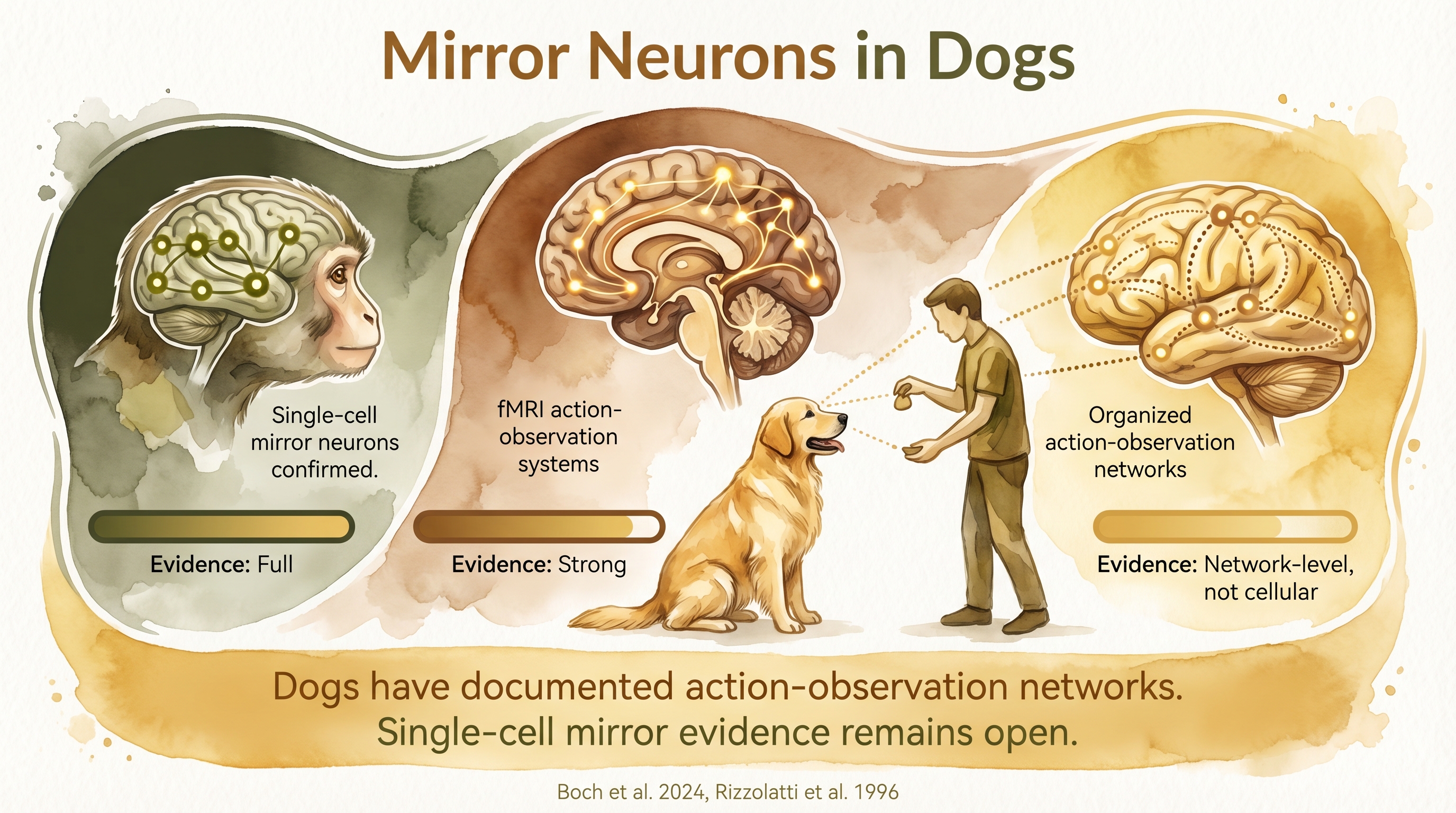
Mirror neuron research suggests dogs activate motor representations when observing others' actions - a neural basis for social learning.
Key Takeaways
- Mirror neurons were originally demonstrated in macaques, not dogs.
- Dogs now have partial neuroimaging support for action-observation networks, but not direct single-cell confirmation of mirror neurons.
- The social-learning evidence in dogs is real whether or not mirror neurons are eventually confirmed.
- Mirror neurons are best treated as a candidate mechanism for canine observational learning, not a settled fact.
The Evidence
- Rizzolatti and colleaguesmacaques
Established the original mirror-neuron findings through direct neural recording during action execution and observation. - Human action-observation literaturehumans
Used neuroimaging and electrophysiological methods to argue for broader action-observation systems that may support imitation and action understanding.
- Boch, M., Huber, L., & Lamm, C. (2024)domestic dogs
Reported action-observation network engagement in dogs at the neuroimaging level, supporting structured neural processing of observed action. - Canine social-learning literaturedomestic dogs
Behavioral findings from observational learning, imitation, and social referencing make an action-observation mechanism plausible in dogs.
- SCR-031 boundarydomestic dogs
No direct single-cell electrophysiological confirmation of classic mirror neurons has been published for canines. - Mechanism boundarydomestic dogs
Associative and distributed action-observation accounts remain viable alternatives, so canine social learning does not uniquely point to mirror neurons.
SCR References
Sources
- Boch, M., Huber, L., & Lamm, C. (2024). Action observation reveals a network with divergent temporal and parietal cortex engagement in dogs compared with humans. Imaging Neuroscience.
- Rizzolatti, G., Fadiga, L., Gallese, V., & Fogassi, L. (1996). Premotor cortex and the recognition of motor actions. Cognitive Brain Research, 3(2), 131-141.
- Rizzolatti, G., and Craighero, L. (2004). The mirror-neuron system. Annual Review of Neuroscience, 27, 169-192. DOI: 10.1146/annurev.neuro.27.070203.144230.
- Canine social-learning/action-observation boundary: dog action-observation evidence is relevant but does not prove a canonical canine mirror-neuron system.
- Mechanism boundary: mirror-neuron language remains ambiguous in dogs; use action-observation or social-learning language where possible.
- SCR-031 boundary: canine mirror-neuron claim remains ambiguous/unverified; do not upgrade mechanism language.