Observational Learning Mechanisms
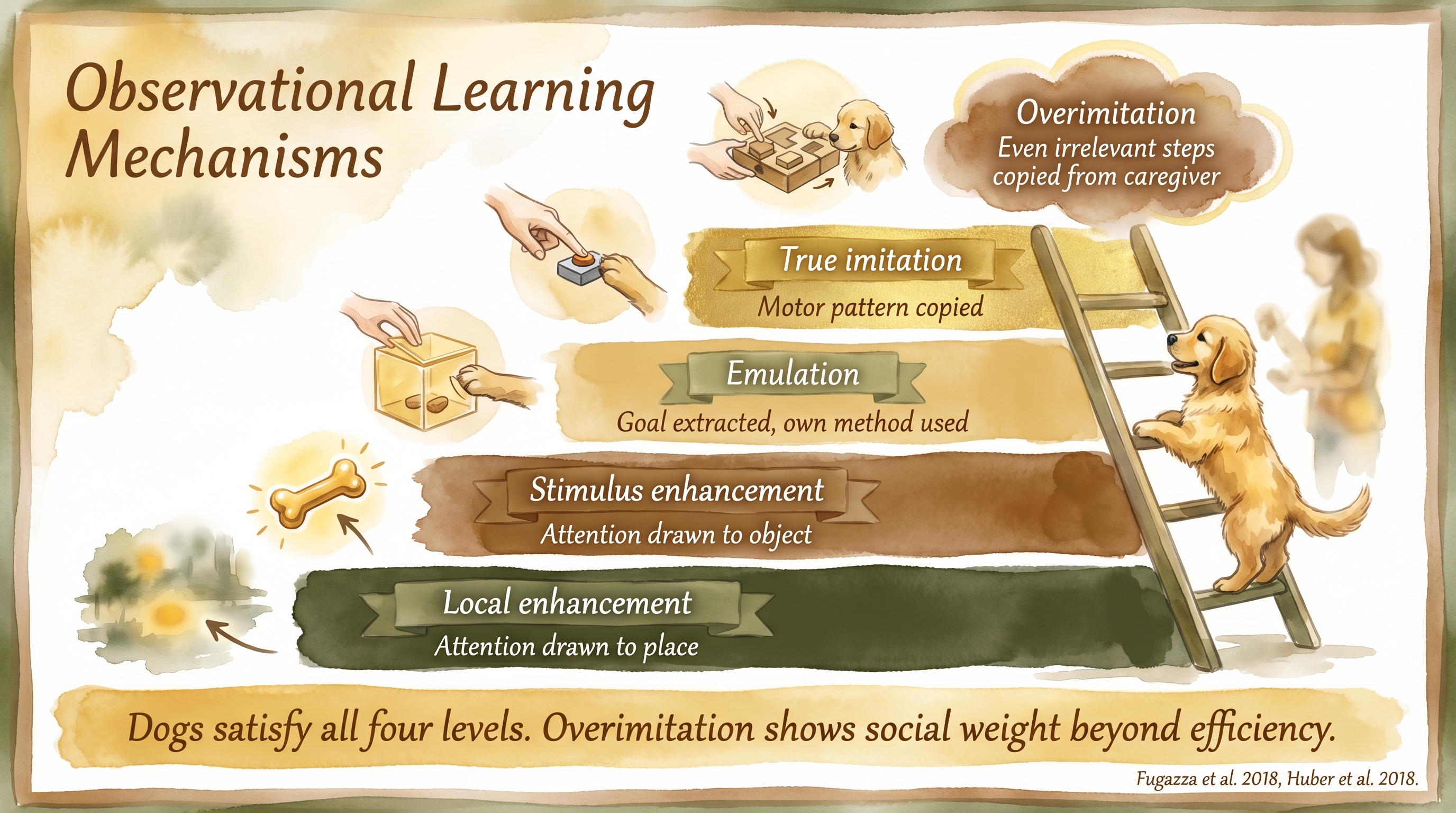
Observational learning is not one single mechanism. When a dog changes behavior after watching another dog or a human, several different processes could be responsible. Documented The observer might simply become interested in the same place. It might become interested in the same object. It might learn the goal while using a different method. Or it might copy the demonstrated action itself. Sorting those mechanisms matters because stronger claims require stricter evidence.
That is why this topic sits near the center of canine cognition research. Documented Dogs are clearly influenced by what they watch. The harder question is what kind of information they are actually extracting from the demonstration.
What It Means
The modern taxonomy usually begins with four major categories: local enhancement, stimulus enhancement, emulation, and true imitation. These categories were clarified in the comparative literature because simple copying can be deceptive. If a demonstrator runs to the left side of a box and the observer also goes left, that does not automatically prove imitation. The observer might simply have learned that something interesting is happening on the left side.
Local Enhancement
Local enhancement happens when another individual's activity makes a location salient. The observer is drawn to that location and then learns something by acting there. In dogs, this is one of the most conservative explanations for many social-learning findings. Documented It does not require representing the demonstrator's action in detail. It only requires attention to place.
Stimulus Enhancement
Stimulus enhancement is similar, but the focus is the object rather than the location. If the demonstrator manipulates a container, rope, or lid, the observer may become more likely to interact with that same object. Again, this is a real form of social information use, but it is weaker than a claim about imitation.
Emulation
Emulation means the observer learns something about the goal state. The learner understands, at least functionally, what outcome was achieved and then reaches that outcome with its own motor pattern. In canine work, emulation has been an especially important intermediate category because it fits many results that are clearly more sophisticated than simple enhancement but do not require exact action copying.
True Imitation
True imitation is the strongest of the four. The observer copies the demonstrator's method, not only the outcome. This is why the evidence bar is high. To support true imitation, researchers try to rule out enhancement and emulation by using two-action designs, bidirectional controls, or novel-action tests that make motor-pattern copying visible. This taxonomy is useful because it stops the conversation from collapsing into a false binary. Dogs are not limited to "mere enhancement," but neither should every case of social influence be labeled imitation. The mechanisms form a ladder of explanatory strength.
Why It Matters for Your Dog
How Researchers Test the Difference
The central methodological problem is underdetermination. A copied outcome can arise from multiple cognitive routes. Researchers therefore use task structure to narrow the possibilities.
In a local-enhancement design, the demonstrator draws attention to one side or one place and the observer's tendency to choose that place is measured. In stimulus-enhancement designs, the observer's attraction to a handled object is measured. In emulation studies, the question is whether the observer reproduces the same result without necessarily reproducing the same action. Documented In true-imitation studies, two-action designs become especially important because they create two possible methods for the same goal.
The Whiten and Ham taxonomy became influential precisely because it forced this level of care. Comparative cognition needed a shared language for distinguishing "the observer learned something socially" from "the observer copied the demonstrated act." That same discipline helps the dog literature.
Dogs satisfy the lower-level mechanisms with little controversy. Enhancement effects are well documented in canine work, and emulation is a strong candidate explanation in many puppy and adult tasks. The more important modern result is that dogs can also satisfy stricter criteria under the right conditions. In the Do As I Do line, dogs were trained on a generalized copying rule and then asked to reproduce novel human actions. That goes beyond simple place attraction.
What Dogs Are Documented to Do
The most secure claim is that dogs show at least the first three mechanisms very robustly.
Puppies and adult dogs use social information to change what they try first and how quickly they solve problems. That alone is enough to establish local enhancement, stimulus enhancement, and at least some emulation-based learning as real parts of canine cognition.
The higher-level question is imitation. Here the evidence is stronger than it used to be. The Do As I Do literature, along with deferred-imitation work and goal-directed action studies, shows that dogs can reproduce demonstrated human actions under controlled conditions. Documented The safest phrasing is that dogs can meet the criteria for true imitation in specific laboratory and training paradigms.
That specificity matters. It does not mean every pet dog in daily life is constantly imitating adult models in a pure laboratory sense. It means the canine nervous system is capable of more than enhancement alone.
Overimitation adds one more twist. In some tasks, dogs copy irrelevant actions that are not required for solving the problem. Once that happens, the explanatory burden increases further. Strict emulation should discard useless steps. Overimitation suggests that, at least sometimes, the observed method itself carries social value.
Why the Mechanism Question Matters
Mechanism matters because different explanations support different conclusions. If a dog only showed local enhancement, then demonstrations would mainly be attention-directing events. If a dog shows emulation, then demonstrations can teach goal structure. If a dog shows true imitation, then the method itself can become transmissible. If a dog shows overimitation, then even inefficient parts of the sequence may carry social weight. Those distinctions change how the species is understood. They also change how broad claims should be written.
The stronger the documented copying mechanism, the stronger the case that adult example carries real developmental information. But the mechanism must be stated precisely. Enhancement, emulation, imitation, and overimitation are not interchangeable.
This is also why dogs are so interesting comparatively. They are not simply miniature wolves in these tasks, and they are not human children with fur. Their social-learning profile is its own pattern: highly social, highly partner-sensitive, and unusually shaped by human interaction.
Important Boundaries
Several boundaries keep this page honest. First, social-learning studies do not eliminate consequences. Documented In many experiments, the dog still receives eventual success, access, or food. What the studies show is that observation changes the path into behavior. They do not show that consequences become irrelevant once action begins.
Second, trained laboratory performance should not be lazily generalized into every home setting. A dog proving true imitation in a DAID paradigm is not the same claim as a puppy spontaneously imitating adult household routines at home. The second claim may be plausible, but it is not directly the same evidence.
Third, overimitation does not prove full human-like norm psychology. It shows socially influenced copying of inefficient actions. Stronger cultural-psychology language remains more speculative.
Observational learning requires attention, retention, motor reproduction, and motivation - not passive exposure.
Key Takeaways
- Observational learning includes several mechanisms, not just one: enhancement, emulation, imitation, and overimitation.
- Dogs clearly demonstrate the simpler mechanisms and can also meet stricter imitation criteria in controlled tasks.
- The mechanism question matters because stronger developmental claims require stronger evidence than simple attention-following effects.
- Overimitation shows that dogs sometimes copy demonstrated method rather than only extracting the shortest route to reward.
The Evidence
- Fugazza, C. et al. (2018)domestic dogs
Showed that puppies from eight weeks use social information from conspecific and human demonstrators to improve problem solving. - Topal, J. et al. (2006)domestic dogs
Introduced the Do As I Do paradigm, providing a route for testing true imitation in dogs. - Fugazza, C., & Miklosi, A. (2014, 2015, 2016)domestic dogs
Extended imitation and deferred-imitation findings and showed social-learning advantages over shaping for some tasks. - Fugazza, C. et al. (2019)domestic dogs
Directly examined whether dogs learned goal-directed actions by imitation or emulation.
- Huber, L. et al. (2018)domestic dogs
Dogs copied caregiver-demonstrated irrelevant actions, showing that canine social learning is not always reduced to efficient goal extraction. - Huber, L. et al. (2020)domestic dogs
Refined the overimitation picture and strengthened the case for method-sensitive copying in dogs.
- SCR synthesisdomestic dogs
The existence of true imitation in controlled tasks does not by itself prove that home development is dominated by spontaneous imitation in the same form.
No controlled study has directly estimated the relative frequency of enhancement, emulation, and imitation mechanisms in naturalistic puppy development under typical household conditions.
SCR References
Sources
- Fugazza, C., & Miklosi, A. (2014). Deferred imitation and declarative memory in domestic dogs. Animal Cognition, 17(2), 237-247.
- Fugazza, C., & Miklosi, A. (2015). Social learning in dog training: The effectiveness of the Do As I Do method compared to shaping or clicker training. Applied Animal Behaviour Science, 171, 146-151.
- Fugazza, C., Pogany, A., & Miklosi, A. (2016). Recall of others' actions after incidental encoding reveals episodic-like memory in dogs. Current Biology, 26(3), 320-324.
- Fugazza, C., Moesta, A., Pogany, A., & Miklosi, A. (2018). Social learning from conspecifics and humans in dog puppies. Scientific Reports, 8, 9257.
- Fugazza, C., Colbert-White, E. N., & Pongracz, P. (2019). Social learning of goal-directed actions in dogs: Imitation or emulation? Journal of Comparative Psychology, 133(2), 195-205.
- Huber, L., Popovova, N., Riener, S., Salobir, K., & Cimarelli, G. (2018). Would dogs copy irrelevant actions from their human caregiver? Learning & Behavior, 46(4), 387-397.
- Topal, J., Byrne, R. W., Miklosi, A., & Csanyi, V. (2006). Reproducing human actions and action sequences: Do as I Do in a dog. Animal Cognition, 9(4), 355-367. https://doi.org/10.1007/s10071-006-0051-6