Social Learning Theory
Social learning theory starts with a simple claim: organisms do not need to learn everything through trial and error. Documented They can learn by watching. For Just Behaving, that matters because the Mentorship pillar is not just philosophical preference. It is built on a documented learning pathway that appears early in puppies and recurs across highly social species.
What It Means
Albert Bandura's social learning framework helped formalize something that ethologists and parents had been seeing for a long time: behavior can be acquired through observation rather than only through direct reinforcement. Documented The learner watches a model, forms some representation of what happened, and later uses that information in action.
Bandura described four processes that make this possible:
- attention
- retention
- reproduction
- motivation
The model must capture the learner's attention. The learner must retain something about what was observed. The learner must be physically and cognitively able to reproduce the behavior. Documented And the learner must have some reason to deploy it. The key point is that learning begins before the learner acts. Observation itself is doing developmental work.
That matters because it is categorically different from the simplest training story. In an operant frame, the environment is arranged so the animal performs a behavior, then consequences strengthen or weaken that behavior. In a social-learning frame, the animal may first acquire the shape or logic of the behavior from a model. Documented The contingencies are not gone, but they are no longer the whole story.
Dogs fit this framework much better than older training culture often admitted. Puppies as young as eight weeks can acquire novel behaviors through social learning from demonstrators. Documented Adult dogs also show robust social-learning capacity in multiple paradigms. The point is not that dogs can sometimes learn by watching in special lab conditions. The point is that they are built for it.
The dog literature also shows that social learning is not one single mechanism. Sometimes the observer is drawn to an object because another animal interacted with it. Sometimes the observer appears to emulate the goal rather than copy the exact motor pattern. Sometimes the observer reproduces the demonstrated sequence with striking fidelity. Those differences matter scientifically, but all of them still support the practical developmental point: models matter.
This is one reason JB resists the idea that raising must be organized around commands. If the puppy is biologically prepared to learn from observing adults, then the household is already functioning as a classroom long before anyone says "sit." The question becomes what kind of classroom the puppy is living in.
The Fugazza work is especially relevant here. Puppies do not have to wait until later developmental stages to use social learning. Eight-week-old puppies, the same age many families bring them home, already show meaningful gains from demonstrator conditions. That should reshape how people think about the first weeks at home. The puppy is not in a blank waiting period. The puppy is already learning from whatever adults are present.
Bandura's framework also helps explain why calmness matters so much to Mentorship. Attention is one of the four necessary processes. A dysregulated, over-aroused puppy is harder to recruit into observation. A calm puppy is more capable of watching, encoding, and reusing what it sees. Social learning therefore depends not just on the model, but on the state the learner is in while watching the model.
Cross-species evidence broadens the picture. Competence transfer from older to younger animals through observation or socially structured scaffolding appears across highly social mammals. The exact mechanisms vary by species, but the repeated pattern strengthens the idea that social learning is not a marginal route to development. It is one of the central routes.
This is why JB frames Mentorship as structured social learning rather than as a softer synonym for training. The puppy is not simply being exposed to a pleasant environment. The puppy is actively learning from what the adults do, what they do not do, how they move, what they ignore, what they interrupt, and what they treat as normal.
Why It Matters for Your Dog
For a family, social learning theory changes what counts as teaching. Documented Teaching is no longer only the moment when you deliberately ask for a behavior. Teaching includes greeting people, moving through doorways, settling in the kitchen, responding to frustration, and handling novelty. If the puppy is watching, the household is teaching.
Social learning theory explains why JB puts so much weight on adult example. Puppies are built to learn from models, not only from consequences arranged after they act.
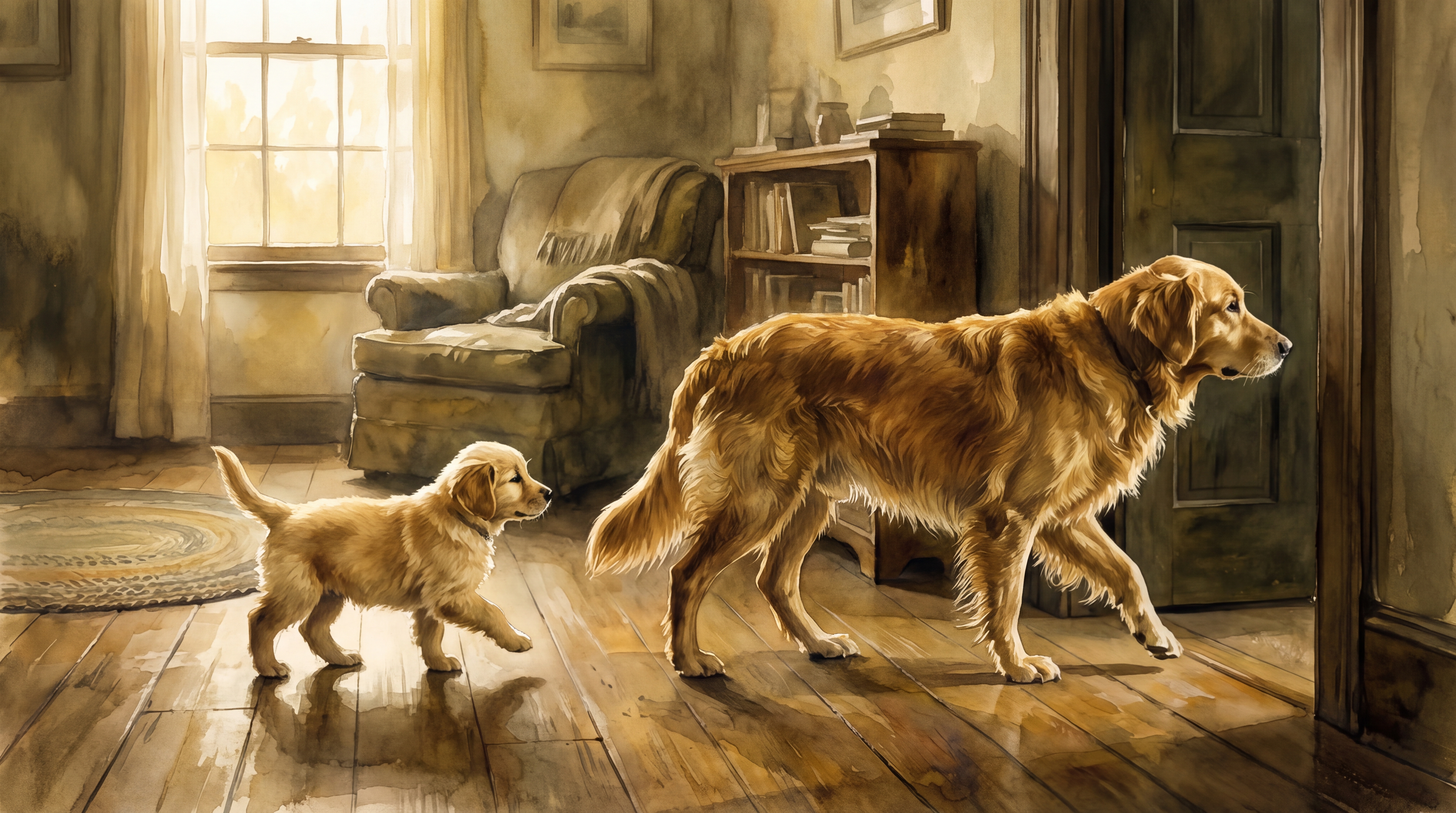
Learning by watching - the puppy mirrors the adult's calm movement without being asked or led.
What this means in daily life:
- calm adult behavior is not background - it is instruction
- inconsistent adult behavior is also instruction
- the first days home matter because the puppy is already capable of observational learning
- what you normalize will often be learned before what you explicitly ask for
Why this differs from drill-based training:
- the puppy may learn before performing
- the model shapes what the puppy tries first
- the household is always on, not just "training time"
- the quality of the adult matters as much as the technique
Once families understand that, Mentorship becomes much less mysterious. It is not passive. It is an active use of a documented developmental channel.
Key Takeaways
- Puppies can learn just by watching adults - they do not need to try every behavior themselves to understand it first.
- Calm adults are easier for puppies to learn from because young dogs can focus better when they are not overexcited or stressed themselves.
- Everything that happens in your household is teaching, not just the moments when you are deliberately working on something - routines, responses, and daily rhythm matter as much as formal lessons.
- This is why JB focuses on raising rather than training: the learning is already happening through how you live with your puppy every day.
The Evidence
- Fugazza et al. (2018)domestic dogs
Showed that puppies as young as 8 weeks acquire novel behaviors through social learning from conspecific and human demonstrators. - Fugazza and Miklosi (2015)domestic dogs
Found that the Do As I Do social-learning protocol outperformed shaping or clicker approaches for object-related tasks, with a more mixed pattern for body movements. - Fugazza et al. (2014, 2016)domestic dogs
Demonstrated deferred imitation and longer-term retention of socially learned actions.
- Bandura (1961-1965)humans
Established the modern social-learning framework and showed that behavior can be acquired through observation without direct reinforcement. - Cross-species convergencechimpanzees, dolphins, meerkats, elephants
Older, more competent animals transfer functional knowledge to younger ones through observational or socially scaffolded processes.
- JB synthesisdomestic dogs
JB's mentorship framework applies documented social-learning capacity to whole-household development rather than limiting it to isolated tasks.
No published study directly tests the specific claims or protocols described in this entry within a controlled canine trial.
SCR References
Sources
- Bandura, A. (1965). Influence of models' reinforcement contingencies on the acquisition of imitative responses. Journal of Personality and Social Psychology, 1(6), 589-595.
- Fugazza, C., Miklosi, A., & Pongracz, P. (2014). Deferred imitation and declarative memory in domestic dogs. Animal Cognition, 17(2), 237-247.
- Fugazza, C., & Miklosi, A. (2015). Social learning in dog training: The effectiveness of the Do As I Do method compared to shaping or clicker training. Applied Animal Behaviour Science, 171, 146-151.
- Fugazza, C., Pogany, A., & Miklosi, A. (2016). Do as I did! Long-term memory of imitative actions in dogs. Animal Cognition, 19(2), 263-269.
- Fugazza, C., Moesta, A., Pogany,