The Dual Mentorship Model
The Dual Mentorship Model is JB's way of naming something that already happens in good developmental environments. Puppies learn through two channels at once: calm adult dogs model how to be a dog in a social group, while calm humans provide structure, safety, and orientation inside the human world. Mixed Evidence The model itself is JB's synthesis, but the learning capacities it relies on are well documented.
What It Means
Most dog discourse assumes there is one primary teacher in the puppy's life: the human. JB starts from a different observation. In healthy developmental settings, puppies are usually surrounded by more than one kind of adult influence. There are canine adults who demonstrate greeting style, frustration tolerance, settling, movement through space, tolerance around resources, and the general rhythm of adulthood. Then there are humans, whose role is not to replace the dog mentors but to extend the developmental system into human life.
That is why JB calls it dual mentorship rather than single mentorship. The channels are different, but they are not competing.
The adult dog channel is species-native. Dogs demonstrate canine social timing, body language, arousal regulation, and social restraint in a form puppies can absorb almost ambiently. A puppy watching a calm adult dog decline play, settle by the door, or move quietly through visitor arrival is seeing the social grammar of adulthood in the dog's own language.
The human channel is broader and more architectural. Humans define the environment, the routines, the pace of transitions, the emotional floor, and the boundary structure. Humans also become the main bridge between the breeder environment and family life. In that sense, the human mentor is not just another demonstrator. The human is the adult who organizes the whole setting in which the demonstrations become meaningful.
This is one reason JB does not panic when a family has no adult dog at home. Homes without adult dogs are not disqualified from mentorship. They simply rely more heavily on the human channel. The dispatch is careful here, and so is the evidence ceiling. The claim that human-only homes can succeed under the Pillar framework is grounded in JB observation and program experience, not a controlled trial. Heuristic But it is still a practical truth within the program: human mentorship can carry the load when it is calm, structured, and developmentally adult.
The stronger documented side of the model is that puppies and adult dogs really do learn socially, and that the demonstrator type matters. Puppies as young as eight weeks can acquire novel behaviors through social learning from conspecifics and humans. Documented That alone gives the Dual Mentorship Model biological footing. The puppy is not waiting until formal training begins. The puppy arrives home already prepared to learn from watching.
Breed selection history adds a valuable nuance. Research now suggests that the most effective social learning channel can vary by breed history. Cooperative breeds, including Golden Retrievers, show stronger learning gains from human demonstrators, while breeds selected for functional independence show stronger gains from conspecific demonstrators. Documented This does not mean Golden Retrievers cannot learn from other dogs. It means the human channel is especially weight-bearing for this breed.
That is a remarkable fit with JB's actual scope. Golden Retrievers are exactly the kind of dog for whom calm human mentorship is not a fallback or artificial substitute. It may be the primary social-learning channel once the puppy enters the family environment. The adult dog still matters. The human simply matters even more.
Overimitation deepens the relevance. Dogs copy demonstrated actions even when a more efficient path exists. That matters because the model is not just about explicit instruction. Puppies are often absorbing how the adult does things, not only what the adult accomplishes. Timing, rhythm, manner, and social tone all become part of what is learned.
Cross-species mentorship evidence strengthens the broader developmental logic. In highly social mammals, adult-to-young competence transfer through modeling and structured social learning is a repeated pattern, not a niche curiosity. Documented Chimpanzees, dolphins, meerkats, and elephants do not all teach the same way, but they all show that young animals depend on older, more competent group members for developmental transfer. JB is not claiming dogs are elephants or meerkats. JB is claiming the broad pattern of elder-guided competence transmission is real and biologically familiar.
This also clarifies what each mentor contributes that the other cannot.
The adult dog provides:
- canine timing
- canine body language
- canine social calibration
- the visual example of mature dog behavior
The human provides:
- household structure
- emotional regulation
- human-world boundaries
- continuity through transition
Seen this way, the model is less a theory about two teachers and more a theory about one developmental system with two languages. The dog mentor speaks canine adulthood from the inside. The human mentor translates that adulthood into human family life.
Why It Matters for Your Dog
Families often ask whether they need another dog in the home for a puppy to turn out well. Observed-JB The better question is whether the puppy has stable adult models. Another dog can help, sometimes enormously. But the presence of another dog is not magic by itself. A dysregulated adult dog is still a model, just a bad one. What matters is the quality of the model in each channel.
The Dual Mentorship Model says puppies learn through two adult channels at once: canine adults model mature dog behavior, and humans provide the calm structure that helps the puppy live well in a human family.
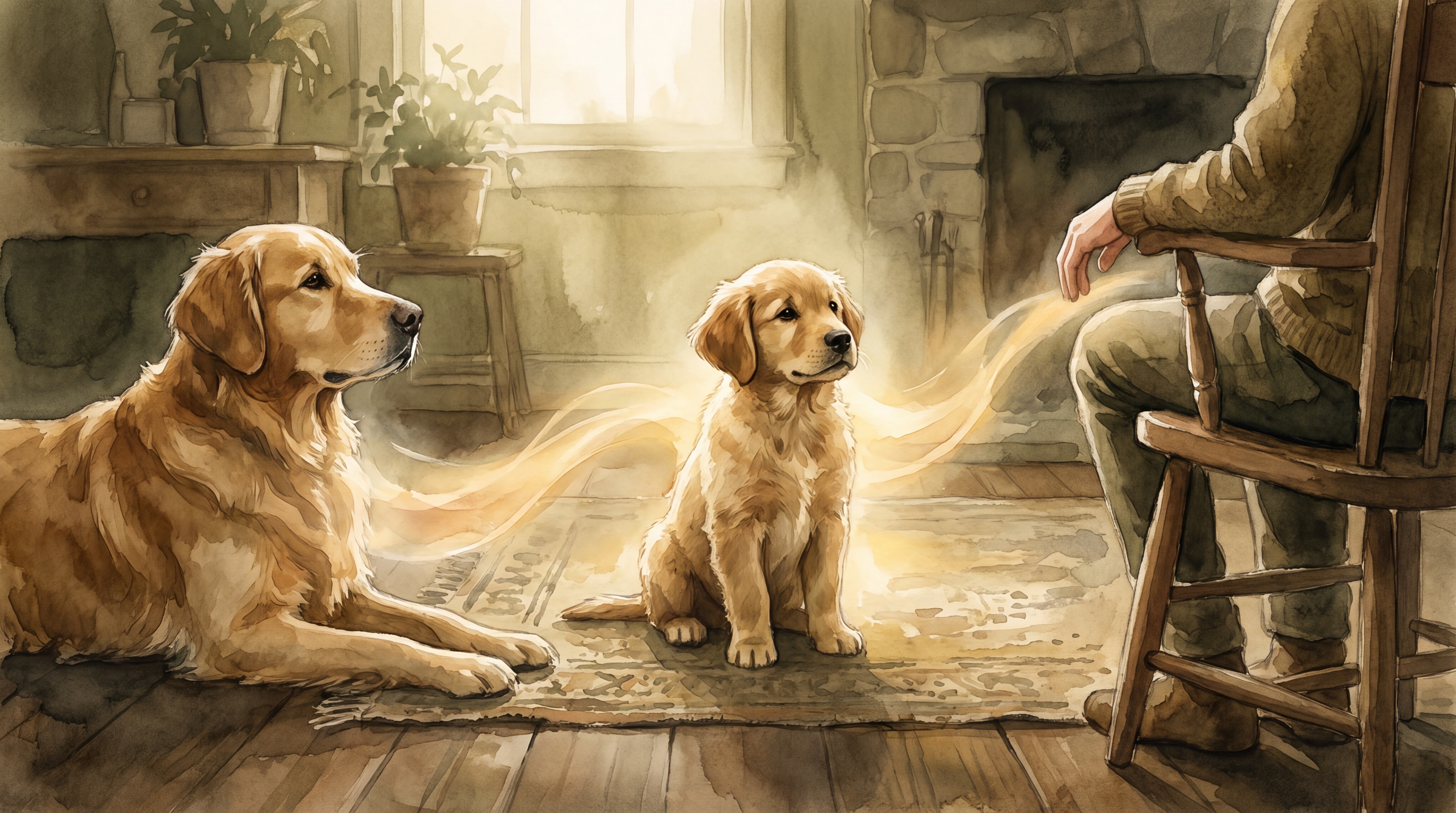
Two channels, one developmental system - the puppy learns from both the calm adult dog and the calm human simultaneously.
What the model looks like in practice:
- A puppy watches an adult dog settle through everyday events and begins copying that rhythm.
- The human keeps the house calm and structured enough that the puppy can actually notice the model.
- In a home without an adult dog, the human becomes the main visible template for pace, tone, and response.
- The transition from breeder to family works best when the human keeps the same developmental grammar intact instead of starting a brand-new social system.
What the model does not mean:
- that every home needs a resident adult dog
- that Golden Retrievers only learn from humans
- that the human channel and dog channel do identical jobs
- that mentorship is a substitute word for formal training drills
The practical takeaway is reassuring. If you have a calm adult dog, use that resource intentionally. If you do not, do not panic. Your role as the human mentor matters tremendously, especially with Golden Retrievers.
Key Takeaways
- Puppies learn from two different sources at the same time: calm adult dogs showing them how to be a dog, and calm humans teaching them how to live in a human family.
- Golden Retrievers learn especially well from human example, which means your calm presence and consistency matter more than having another dog in the home.
- The first days at home are not a waiting period before real teaching starts - your puppy is already learning from how you move through doorways, respond to novelty, and handle transitions.
- A good mentor is stable and predictable, not constantly trying to excite or drill the puppy.
The Evidence
This entry uses observed claim-level tags beyond the dedicated EvidenceBlocks below. These tags mark JB program observation or practice-derived claims that need dedicated EvidenceBlock coverage in a later content pass.
This entry uses mixed-evidence claim-level tags beyond the dedicated EvidenceBlocks below. These tags mark claims that combine documented findings with observed practice, heuristic application, or unresolved gaps.
- Fugazza et al. (2018)domestic dogs
Puppies as young as 8 weeks learned from mother, unfamiliar adult dog, and human demonstrators, with both conspecific and human demonstrations outperforming controls. - Huber et al. (2018, 2020, 2022)domestic dogs
Overimitation findings show that dogs copy demonstrated methods with high fidelity, making demonstrator quality especially important. - Lugosi et al. (2024) and Dobos and Pongracz (2023)domestic dogs
Breed-selection history predicts demonstrator-channel weighting: independent breeds gain more from conspecific demonstrators, while cooperative breeds such as Golden Retrievers gain more from human demonstrators.
- Inoue-Nakamura and Matsuzawa (1997)chimpanzees
Documented tool-use transmission from older to younger animals. - Krutzen et al. (2005)dolphins
Documented vertical social transmission of foraging traditions. - Thornton and McAuliffe (2006)meerkats
Adults actively scaffold young prey handling through graduated support. - McComb et al. (2001)elephants
Older matriarchs function as repositories of group knowledge that influence younger animals' social functioning.
- JB synthesisdomestic dogs
The Dual Mentorship Model itself is a JB framework: one developmental system, two adult channels, with the human channel carrying added weight in Golden Retrievers. - JB program observationGolden Retrievers
Homes without resident adult dogs can still produce well-adjusted outcomes when the human channel remains calm, structured, and developmentally adult.
No published study directly tests the specific claims or protocols described in this entry within a controlled canine trial.
SCR References
Sources
- Dobos, P., & Pongracz, P. (2023). Would you detour with me? Association between functional breed selection and social learning in dogs sheds light on elements of dog-human cooperation. Animals, 13(12), 2001.
- Fugazza, C., Moesta, A., Pogany, A., & Miklosi, A. (2018). Social learning from conspecifics and humans in dog puppies. Scientific Reports, 8, 9257.
- Huber, L., Popovova, N., Riener, S., Salobir, K., & Cimarelli, G. (2018). Would dogs copy irrelevant actions from their human caregiver? Learning and Behavior, 46(4), 387-397.
- Inoue-Nakamura, N., & Matsuzawa, T. (1997). Development of stone tool use by wild chimpanzees. Journal of Comparative Psychology, 111(2), 159-173.
- Krutzen, M., Mann, J., Heithaus, M. R., Connor, R. C., Bejder, L., & Sherwin, W. B. (2005). Cultural transmission of tool use in bottlenose dolphins. Proceedings of the National Academy of Sciences, 102(25), 8939-8943.
- Lugosi, C. A., Udvarhelyi-Toth, K. M., Dobos, P., & Pongracz, P. (2024). Independent, but still observant - dog breeds selected for functional independence learn better from a conspecific demonstrator than cooperative breeds in a detour task. BMC Biology, 22(1), 245.
- McComb, K., Moss, C. J., Durant, S. M., Baker, L., & Sayialel, S. (2001). Matriarchs as repositories of social knowledge in African elephants. Science, 292(5516), 491-494. https://doi.org/10.1126/science.1057895