Operant Conditioning
Compound evidence detail1 SCR / 2 parts
- Documentedthe canine welfare evidence on aversive training methods (Vieira de Castro 2020, Ziv 2017, Hiby 2004) and the attachment-mediated stress modulation evidence (Schoberl 2015, Asher 2020, Brubaker and Udell 2023)
- Heuristicthe JB claim that secure attachment context measurably alters how dogs experience mechanically operant-identical correction procedures, RF-flagged in the SCR and formally untested in controlled canine studies
Operant conditioning is the branch of learning science that studies how consequences change the future frequency of behavior. In plain language, it asks a practical question: what happens after a behavior, and does that make the behavior more likely or less likely next time? It is one of the main scientific frameworks behind modern dog training. Documented
What It Means
Operant conditioning is most closely associated with Edward Thorndike and B. F. Skinner. Thorndike's Law of Effect laid the groundwork: behaviors followed by satisfying consequences tend to be repeated, while behaviors followed by unsatisfying consequences tend to weaken. Skinner then formalized the framework and built the experimental machinery that made it measurable.
The basic unit in operant conditioning is the operant: a behavior emitted by the organism that acts on the environment. Unlike a reflex, which is automatically triggered by a stimulus, an operant is something the animal does. Sit, jump, bark, pull, wait, look away, return to the handler - these are all operants if their frequency changes based on consequences.
The classic four quadrants are: positive reinforcement (adding something after behavior to increase that behavior), negative reinforcement (removing something after behavior to increase that behavior), positive punishment (adding something after behavior to decrease that behavior), and negative punishment (removing something after behavior to decrease that behavior).
In the behavior-analytic vocabulary, positive and negative do not mean good and bad. They mean add and remove. Reinforcement and punishment also do not mean praise and cruelty. They mean increase and decrease in future behavior frequency. That purely functional language is one reason the framework can be both powerful and easily misunderstood.
Modern applied trainers often summarize operant conditioning through the ABC model: antecedent (what came right before the behavior), behavior (the act itself), and consequence (what happened immediately after). Observed-JB
That model is useful because it forces attention onto contingencies instead of vague impressions. If a dog keeps jumping on visitors, operant conditioning asks what is maintaining the jumping. Documented Is it touch, eye contact, verbal engagement, access, relief, or escape from some other demand?
Skinner's operant chamber made these questions experimentally tractable. The apparatus allowed researchers to measure response rates, schedule effects, and resistance to extinction with precision across species. Documented A great deal of the underlying schedule science therefore comes from rats, pigeons, and later other laboratory species, with canine application sometimes direct and sometimes extrapolated.
That species issue matters. The framework is scientifically real and behaviorally useful, but the JB source layer adds an important limit: the contingent operant reinforcement protocol used in formal training has no documented analog in natural canine development. That does not mean operant processes do not occur in ordinary life. It means the engineered protocol - timed treat delivery, conditioned marker, systematic schedule management - is a human technology rather than a directly documented mother-puppy teaching system.
This distinction is especially helpful when reading modern training language. A trainer can accurately describe behavior in operant terms without that description answering every larger question about attachment, arousal regulation, social modeling, or developmental maturity. Documented Operant conditioning describes one layer of the dog very well. It does not exhaust the dog.
Why It Matters for Your Dog
Families hear operant language constantly, even when nobody names it. "Reward the behavior you want." Documented "Ignore the behavior you do not want." "Mark the correct response." "Do not accidentally reinforce barking." Those are all operant ideas.
Understanding the framework matters because it improves clarity. It helps families see why behavior can become sticky very quickly when the consequence is even intermittently useful to the dog. A puppy that sometimes gets access by barking or jumping is still being shaped by consequence, even if the family never intended to train anything.
Operant conditioning helps explain why rehearsal matters. Every consequence is information. Prevention matters because it stops unwanted contingencies from repeatedly paying off in the first place.
This page is also useful because it keeps categories straight. Operant language can describe a technique mechanically, while a pillar entry may evaluate that same technique ethically or developmentally. That is why the Correction vs. Punishment pillar entry can say, truthfully, that an interruption may be describable in operant terms and still argue that the relational meaning of the act is not fully captured by the operant label alone.
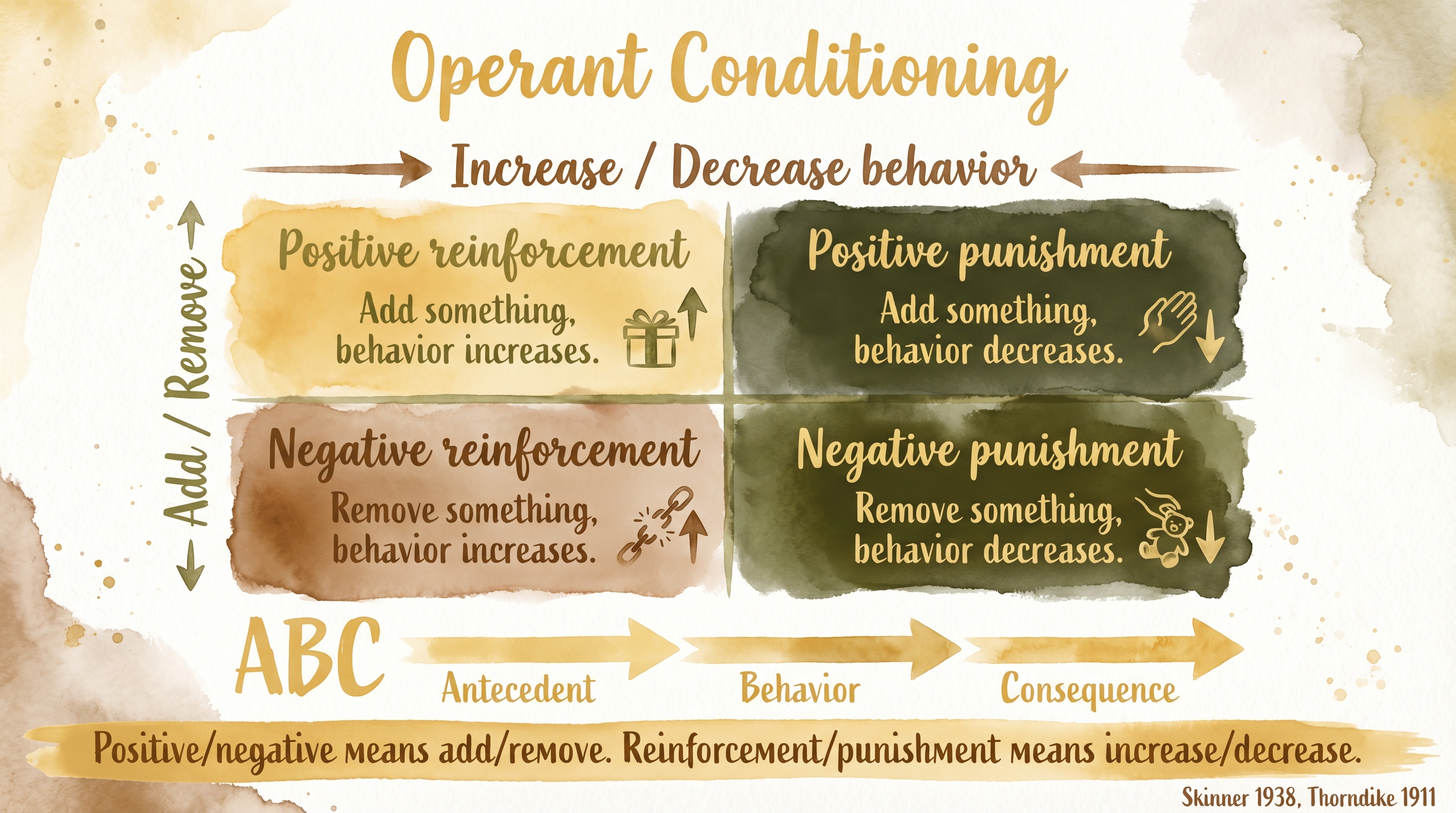
Operant conditioning shapes voluntary behavior through consequences - the four-quadrant framework that dominates dog training.
Key Takeaways
- Operant conditioning asks how consequences change the future frequency of behavior.
- The four quadrants are functional definitions, not moral categories.
- The ABC model helps identify what is maintaining a behavior in everyday life.
- Operant conditioning is a real and useful framework, but it does not answer every developmental or relational question about dogs.
The Evidence
This entry uses observed claim-level tags beyond the dedicated EvidenceBlocks below. These tags mark JB program observation or practice-derived claims that need dedicated EvidenceBlock coverage in a later content pass.
- Thorndike, E. L. (1898, 1911)multiple species
Established the Law of Effect and the basic principle that consequences shape future behavior. - Skinner, B. F. (1938, 1953)multiple species
Formalized operant conditioning as a consequence-based model of emitted behavior and developed the experimental program that made schedule effects measurable. - Staddon, J. E. R., & Cerutti, D. T. (2003)multiple species
Reviewed operant conditioning as one of the most stable and replicable frameworks in behavioral science.
- Ferster, C. B., & Skinner, B. F. (1957)rats and pigeons
Mapped schedule-controlled behavior with extraordinary precision, providing the laboratory foundation later generalized into applied training. - Hall, N. J., & Wynne, C. D. L. (2016)domestic dogs
Reviewed persistence and resistance to extinction in dogs, supporting the relevance of operant analysis to canine behavior while also highlighting species-specific variation.
- SCR-004 synthesisdomestic dogs
The claim that engineered operant reinforcement protocols have no documented analog in natural canine development is a reasoned ethological argument, not a settled empirical finding. - SCR-005 synthesisdomestic dogs
The claim that relational context changes the outcomes of mechanically similar interventions belongs to a later interpretive layer and should not be confused with the core operant framework itself.
No published study has directly compared long-term behavioral, attachment, and developmental outcomes in dogs trained with systematically engineered operant protocols versus dogs raised in relationally structured environments without formalized training contingencies.
SCR References
Sources
- Ferster, C. B., & Skinner, B. F. (1957). Schedules of reinforcement. Appleton-Century-Crofts.
- Hall, N. J., & Wynne, C. D. L. (2016). Persistence and resistance to extinction in the domestic dog: Basic research and applications to canine training. Behavioural Processes, 129, 67-72.
- Skinner, B. F. (1938). The behavior of organisms: An experimental analysis. Appleton-Century.
- Skinner, B. F. (1953). Science and human behavior. Macmillan.
- Staddon, J. E. R., & Cerutti, D. T. (2003). Operant conditioning. Annual Review of Psychology, 54, 115-144.
- Thorndike, E. L. (1911). Animal Intelligence: Experimental Studies. Macmillan. https://doi.org/10.5962/bhl.title.55072